Contact Us

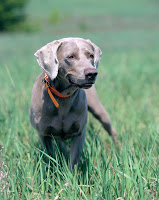
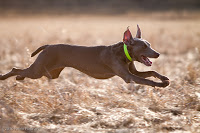
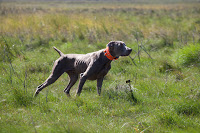
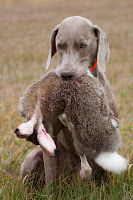
Use the form on the right to contact us. We should get back to you within 24 hours. If not, it means we are out chasing birds with dogs, shotguns and Canons. In that case we will get back to you as soon as we've finished the roasted Teal and Bordeaux . 


Form Block
This form needs a storage option. Double-click here to edit this form, and tell us where to save form submissions in the Storage tab. Learn more
         

123 Street Avenue, City Town, 99999

(123) 555-6789

email@address.com


You can set your address, phone number, email and site description in the settings tab.
Link to read me page with more information.

Pointing Dog Blog

The world of pointing dogs in words and images, moving and still.

Breed of the Week: The Braque du Bourbonnais

Craig Koshyk
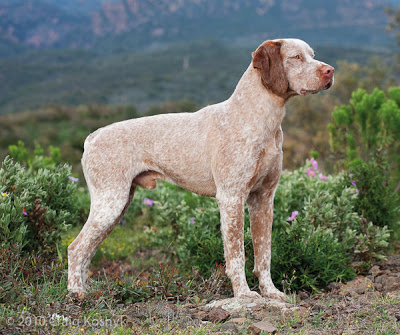
Dog breeds come and go. Some take centuries to develop and others are created almost overnight. Some slowly fade away and others disappear in the blink of an eye. For a very few breeds, there can even be a sort of resurrection. The Braque du Bourbonnais is one such breed. There are references to it as far back as the 16th century, but it had disappeared by the 1960s. Today, thanks to the efforts of a group of breeders led by a man of vision, it has returned.

HISTORY
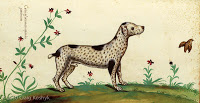
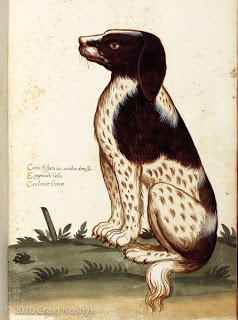
A lot of breeds are said to be as old as the hills, but not many have any real proof of their ancient heritage. For the Braque du Bourbonnais, however, there is a fairly compelling document that does seem to prove that dogs matching its description have been around since at least the late 1500s. It is an illustration by the renowned Italian naturalist Ulisse Aldrovandi that shows a dog with a striking resemblance to the modern Braque du Bourbonnais. It is titled Canis sagax ad coturnices capiendas pantherinus, which means “keen scented panther-like (i.e., spotted) dog for catching quail”. In one of his manuscripts Aldrovandi also mentions a Canis Burbonensis (dog from Bourbonnais) Naturally, breed enthusiasts point to these references as proof that the Braque du Bourbonnais is one of the oldest breeds of short-haired pointing dogs. But they do concede that, like all short-haired pointing dogs, it ultimately traces back to the original stock from southern France and northern Spain. Adolphe de La Rue, wrote in

Les Chiens d’Arrêt Français et Anglais (1881):

As for the origins of the Bourbonnais dog, which is a short-tailed breed, there is no need to look anywhere else than at the large brown Braque; the first, most ancient of our breeds. Once this is admitted, it is no longer doubtful that families where individuals are always born with a short tail have in their veins the pure and precious blood of the primitive breed from which they descend.

Until the mid-1800s, the tail-less pointing dogs of the Bourbonnais region of France were more or less unknown in the rest of the country. But as the dog scene developed, the Braque Courte Queue (short-tailed braque) soon became a standard fixture at dog shows and gained a good number of converts among French hunters. But the breed’s good fortunes did not last very long. By the early 1900s, it was obvious that breeders had become fixated on its unique coat color and its naturally short tail. Alarmed by an increasing number of deaf, infertile or even albino individuals appearing in the breed, the great dog expert Pierre Mégnin warned of breeding too tightly among a very limited number of families. Fortunately, sensible breeders heeded his advice and began crossing to other breeds, principally English Pointers.

An extraordinary document survives from that era and offers insight into what the situation was like: an article written by Mr. E. Dubut, a self-described vieux fervent de notre brave Bourbonnais (long-time enthusiast of our brave Bourbonnais). It was published in the Bourbonnais Club bulletin in 1933, and details Dubut’s efforts to reverse the errors of the past.

When I started breeding Braques du Bourbonnais 30 years ago, the dogma of absolute purity of the breed was the official, intangible doctrine of dog breeding, and the greatest achievement was to blend together all the champions of the breed, or at least their offspring. In a few years, I had assembled in my kennel the blood of all the kings and queens of the breed, but the more I concentrated my aristocratic stew, the more troubling faults I saw. Such a high level of inbreeding quickly becomes dangerous. Some of the few famous individuals of the breed, even though they are champions, have physical or mental faults that make it very dangerous for any linebreeding or inbreeding. That was the situation in my kennel around 1908. It was obvious to me that only crossbreeding could improve, revive, and save my Braque du Bourbonnais.

Unfortunately, despite the measures taken by Dubut and others, the breed continued to struggle throughout the early 1900s, and was almost wiped out during the First World War. But in 1925 the remaining supporters managed to create a club for the breed and establish a formal written standard.
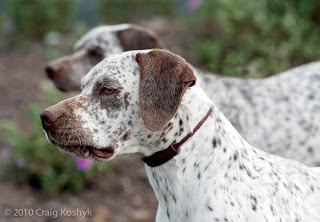
For the next decade, things improved as breeders worked to overcome the difficulties of the past. Then the Second World War dealt an even more devastating blow and the postwar years did not prove much easier. Infighting among club members over the coat color and other minor details eventually caused so many problems that the club fell apart, breeding ground to a halt and registrations fell to a trickle. In 1967 Jean Castaing wrote that he had probably seen the last of the breed.

In the 1970s the man who would lead the effort to recreate the breed entered the scene. Today Michel Comte is known as the father of the modern Braque du Bourbonnais, but back then he was considered a dreamer, attempting the impossible.

I come from a family of hunters. My father and grandfather hunted mainly with running hounds, but we had a Braque d’Auvergne as well. When I was about 16 or 17 years old, I got the idea that it would be nice to have a Braque du Bourbonnais. I was fascinated by the unique lilas passé [faded lilac] color of its coat. I dreamed for many years about owning such a dog. But everyone told me not to bother; the breed was dead. Then one day I just said: To heck with them, I will recreate it! 

Among the first steps Michel took was to seek the advice of dog expert Jean Castaing who he visited at Castaing’s summer home near the town of Agen. Unfortunately, the great man did not offer much hope. 

Basically, [Castaing] told me,“You are a nice
 guy but you are a dreamer. Reviving the breed is impossible.” And, I must admit, he was right. Revival was out of the question. But we could try to recreate it, and that is what we did! 

Efforts to create the modern Braque du Bourbonnais began in earnest when Michel, assisted by his brother, Gabriel; Dr. Louis Monavon, a local veterinarian and other enthusiasts decided to see if they could find any remaining dogs of the Bourbonnais type. They combed through back issues of hunting magazines and newspapers looking for the names of former breeders to contact. To their dismay, they discovered that the breed had been more or less abandoned by its former supporters and all the breeders had moved on to the more popular German Shorthairs, English Pointers and Brittanies.

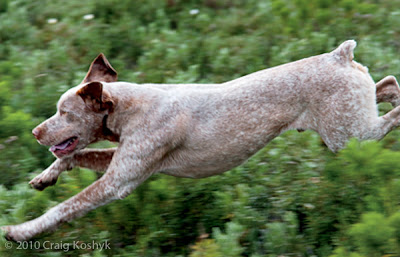
However, Dr. Monavon would sometimes see dogs in his veterinary practice that closely resembled Braques du Bourbonnais. They were mixed-breed dogs that their owners simply referred to as braques du pays (country braques). But the dogs had many of the characteristics of the original Braque du Bourbonnais, such as the naturally short tail, unique coat color and head shape. So Michel and his group decided to use some of these braques du pays in a program designed to distill and concentrate the genes of the original breed. One of the most important dogs used in the program was named Pyrrhus. Michaël Comte, Michel’s son, tells its story:

One day Dr. Bazin, the president of the south-east Canine Society, discovered a handsome “peach blossom” [fawn colored] dog in Lyon. It was an offspring of Joséphine and Napoléon,
 two dogs belonging to the famous French singer Pierre Perret, that were registered as German Shorthairs! You see, at the time, breeders did their own paperwork and the SCC [French Canine Society] just rubber-stamped the pedigrees. So that is probably how a Braque du Bourbonnais ended up with “German Shorthair” parents. In any case, Pyrrhus was entered into the stud book under the name Rasteau. He was the first in a long line of born-again Bourbonnais.


Toward the end of the 1970s, the breeding efforts of the small group began to bear fruit. For the first time in over a decade, Braques du Bourbonnais were being registered in the French stud book (LOF) and the numbers were increasing every year. By the 1980s organized events were taking place and more and more Braques du Bourbonnais were seen in the show ring and field trials.
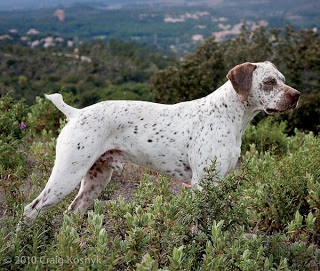
Today, the breed continues to thrive. Although growth has slowed in France, the Braque du Bourbonnais has gained a firm foothold in the US where there are now just as many, and sometimes even more, Bourbonnais pups whelped each year. Michel Comte told me: 

The breed is still a work in progress. It is a recreated breed, a synthesis of the old stock we found and the new blood we added. Castaing was right: it was impossible to bring the old Braque du Bourbonnais back to life. But what we have today is in many ways better than the original. They are faster, stronger, better hunting dogs than they used to be. 

WHAT'S IN A NAME Brak Doo Boor-Bon-Nay The breed is named after the historic province of Bourbonnais in central France. The English translation in the breed standard is Bourbonnais Pointing Dog, but breeders everywhere usually use the French name.

MY VIEWI have had the opportunity to see a number of Braques du Bourbonnais in action in France, as well as in Québec and Ontario. They definitely have a unique look. They are relatively small, not much bigger than a Brittany, but some of them can be built like fireplugs. The Bourbonnais’ coat really is something special. The heavy ticking and nearly pastel coloring is a great combination. The stubby tail and rounded head complete the package. In the field, every Bourbonnais I’ve seen was an eager worker, light on its feet and solid on point. But beyond the look and field abilities of the breed, there is something very special about the Braque du Bourbonnais: the man who led the effort to recreate it.

Lisa and I met Michel Comte at his home on the Côte d’Azur and we were fascinated by the stories he had to tell. As he spoke about his beloved breed his eyes sparkled with a rare light that we had seen in very few others. And as he reminisced about the great dogs he’d bred in the past and spoke proudly about the young prospects he was raising today, I kept thinking back to what he said when I asked him how it all started:

I dreamed for many years about owning such a dog. But everyone told me not to bother; the breed was dead. Then one day I just said: To heck with them, I will recreate it!

Later that day as we photographed his dogs in the field, I realized that we were in the presence of a great man, a man who had fulfilled his dream by achieving the near-impossible. Michel Comte and a small group of dedicated hunters brought an ancient breed of pointing dog back to the fields and forests where it belongs. And a growing number of hunters will forever be grateful they did.

To learn more about the breed, visit Michael Comte's excellent website for the breed here

.
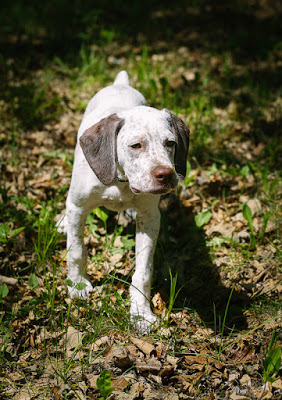
UPDATE: KOLBI is “Chasseur Kolbi d’Aspen Ridge, a wonderful Braque du Bourbonnais from a wonderful breeder. He lives with his new family in a loving home just outside of town. Lisa and I are Kolbi’s god parents (dog parents?) and will hunt with him in the fall. This story will be updated from time to time as we take new photos of the newest member of our extended canine family! Check out the growing photo essay of the little guy! https://cdog.exposure.co/kolbi
Read more about the breed, and all the other pointing breeds from Continental Europe, in my book

Pointing Dogs, Volume One: The Continentals

http://www.dogwilling.ca/index.cfm

Breed of the Week: The Braque du Bourbonnais

Craig Koshyk


Dog breeds come and go. Some take centuries to develop and others are created almost overnight. Some slowly fade away and others disappear in the blink of an eye. For a very few breeds, there can even be a sort of resurrection. The Braque du Bourbonnais is one such breed. There are references to it as far back as the 16th century, but it had disappeared by the 1960s. Today, thanks to the efforts of a group of breeders led by a man of vision, it has returned.

HISTORY

A lot of breeds are said to be as old as the hills, but not many have any real proof of their ancient heritage. For the Braque du Bourbonnais, however, there is a fairly compelling document that does seem to prove that dogs matching its description have been around since at least the late 1500s. It is an illustration by the renowned Italian naturalist Ulisse Aldrovandi that shows a dog with a striking resemblance to the modern Braque du Bourbonnais. It is titled Canis sagax ad coturnices capiendas pantherinus, which means “keen scented panther-like (i.e., spotted) dog for catching quail”. In one of his manuscripts Aldrovandi also mentions a Canis Burbonensis (dog from Bourbonnais) Naturally, breed enthusiasts point to these references as proof that the Braque du Bourbonnais is one of the oldest breeds of short-haired pointing dogs. But they do concede that, like all short-haired pointing dogs, it ultimately traces back to the original stock from southern France and northern Spain. Adolphe de La Rue, wrote in Les Chiens d’Arrêt Français et Anglais (1881):
As for the origins of the Bourbonnais dog, which is a short-tailed breed, there is no need to look anywhere else than at the large brown Braque; the first, most ancient of our breeds. Once this is admitted, it is no longer doubtful that families where individuals are always born with a short tail have in their veins the pure and precious blood of the primitive breed from which they descend.
Until the mid-1800s, the tail-less pointing dogs of the Bourbonnais region of France were more or less unknown in the rest of the country. But as the dog scene developed, the Braque Courte Queue (short-tailed braque) soon became a standard fixture at dog shows and gained a good number of converts among French hunters. But the breed’s good fortunes did not last very long. By the early 1900s, it was obvious that breeders had become fixated on its unique coat color and its naturally short tail. Alarmed by an increasing number of deaf, infertile or even albino individuals appearing in the breed, the great dog expert Pierre Mégnin warned of breeding too tightly among a very limited number of families. Fortunately, sensible breeders heeded his advice and began crossing to other breeds, principally English Pointers.

An extraordinary document survives from that era and offers insight into what the situation was like: an article written by Mr. E. Dubut, a self-described vieux fervent de notre brave Bourbonnais (long-time enthusiast of our brave Bourbonnais). It was published in the Bourbonnais Club bulletin in 1933, and details Dubut’s efforts to reverse the errors of the past.
When I started breeding Braques du Bourbonnais 30 years ago, the dogma of absolute purity of the breed was the official, intangible doctrine of dog breeding, and the greatest achievement was to blend together all the champions of the breed, or at least their offspring. In a few years, I had assembled in my kennel the blood of all the kings and queens of the breed, but the more I concentrated my aristocratic stew, the more troubling faults I saw. Such a high level of inbreeding quickly becomes dangerous. Some of the few famous individuals of the breed, even though they are champions, have physical or mental faults that make it very dangerous for any linebreeding or inbreeding. That was the situation in my kennel around 1908. It was obvious to me that only crossbreeding could improve, revive, and save my Braque du Bourbonnais.
Unfortunately, despite the measures taken by Dubut and others, the breed continued to struggle throughout the early 1900s, and was almost wiped out during the First World War. But in 1925 the remaining supporters managed to create a club for the breed and establish a formal written standard.

For the next decade, things improved as breeders worked to overcome the difficulties of the past. Then the Second World War dealt an even more devastating blow and the postwar years did not prove much easier. Infighting among club members over the coat color and other minor details eventually caused so many problems that the club fell apart, breeding ground to a halt and registrations fell to a trickle. In 1967 Jean Castaing wrote that he had probably seen the last of the breed.

In the 1970s the man who would lead the effort to recreate the breed entered the scene. Today Michel Comte is known as the father of the modern Braque du Bourbonnais, but back then he was considered a dreamer, attempting the impossible.
I come from a family of hunters. My father and grandfather hunted mainly with running hounds, but we had a Braque d’Auvergne as well. When I was about 16 or 17 years old, I got the idea that it would be nice to have a Braque du Bourbonnais. I was fascinated by the unique lilas passé [faded lilac] color of its coat. I dreamed for many years about owning such a dog. But everyone told me not to bother; the breed was dead. Then one day I just said: To heck with them, I will recreate it! 
Among the first steps Michel took was to seek the advice of dog expert Jean Castaing who he visited at Castaing’s summer home near the town of Agen. Unfortunately, the great man did not offer much hope. 
Basically, [Castaing] told me,“You are a nice
 guy but you are a dreamer. Reviving the breed is impossible.” And, I must admit, he was right. Revival was out of the question. But we could try to recreate it, and that is what we did! 
Efforts to create the modern Braque du Bourbonnais began in earnest when Michel, assisted by his brother, Gabriel; Dr. Louis Monavon, a local veterinarian and other enthusiasts decided to see if they could find any remaining dogs of the Bourbonnais type. They combed through back issues of hunting magazines and newspapers looking for the names of former breeders to contact. To their dismay, they discovered that the breed had been more or less abandoned by its former supporters and all the breeders had moved on to the more popular German Shorthairs, English Pointers and Brittanies.

However, Dr. Monavon would sometimes see dogs in his veterinary practice that closely resembled Braques du Bourbonnais. They were mixed-breed dogs that their owners simply referred to as braques du pays (country braques). But the dogs had many of the characteristics of the original Braque du Bourbonnais, such as the naturally short tail, unique coat color and head shape. So Michel and his group decided to use some of these braques du pays in a program designed to distill and concentrate the genes of the original breed. One of the most important dogs used in the program was named Pyrrhus. Michaël Comte, Michel’s son, tells its story:
One day Dr. Bazin, the president of the south-east Canine Society, discovered a handsome “peach blossom” [fawn colored] dog in Lyon. It was an offspring of Joséphine and Napoléon,
 two dogs belonging to the famous French singer Pierre Perret, that were registered as German Shorthairs! You see, at the time, breeders did their own paperwork and the SCC [French Canine Society] just rubber-stamped the pedigrees. So that is probably how a Braque du Bourbonnais ended up with “German Shorthair” parents. In any case, Pyrrhus was entered into the stud book under the name Rasteau. He was the first in a long line of born-again Bourbonnais.

Toward the end of the 1970s, the breeding efforts of the small group began to bear fruit. For the first time in over a decade, Braques du Bourbonnais were being registered in the French stud book (LOF) and the numbers were increasing every year. By the 1980s organized events were taking place and more and more Braques du Bourbonnais were seen in the show ring and field trials.

Today, the breed continues to thrive. Although growth has slowed in France, the Braque du Bourbonnais has gained a firm foothold in the US where there are now just as many, and sometimes even more, Bourbonnais pups whelped each year. Michel Comte told me: The breed is still a work in progress. It is a recreated breed, a synthesis of the old stock we found and the new blood we added. Castaing was right: it was impossible to bring the old Braque du Bourbonnais back to life. But what we have today is in many ways better than the original. They are faster, stronger, better hunting dogs than they used to be. 

WHAT'S IN A NAME
Brak Doo Boor-Bon-Nay
The breed is named after the historic province of Bourbonnais in central France. The English translation in the breed standard is Bourbonnais Pointing Dog, but breeders everywhere usually use the French name.

MY VIEW
I have had the opportunity to see a number of Braques du Bourbonnais in action in France, as well as in Québec and Ontario. They definitely have a unique look. They are relatively small, not much bigger than a Brittany, but some of them can be built like fireplugs. The Bourbonnais’ coat really is something special. The heavy ticking and nearly pastel coloring is a great combination. The stubby tail and rounded head complete the package. In the field, every Bourbonnais I’ve seen was an eager worker, light on its feet and solid on point. But beyond the look and field abilities of the breed, there is something very special about the Braque du Bourbonnais: the man who led the effort to recreate it.

Lisa and I met Michel Comte at his home on the Côte d’Azur and we were fascinated by the stories he had to tell. As he spoke about his beloved breed his eyes sparkled with a rare light that we had seen in very few others. And as he reminisced about the great dogs he’d bred in the past and spoke proudly about the young prospects he was raising today, I kept thinking back to what he said when I asked him how it all started:
I dreamed for many years about owning such a dog. But everyone told me not to bother; the breed was dead. Then one day I just said: To heck with them, I will recreate it!
Later that day as we photographed his dogs in the field, I realized that we were in the presence of a great man, a man who had fulfilled his dream by achieving the near-impossible. Michel Comte and a small group of dedicated hunters brought an ancient breed of pointing dog back to the fields and forests where it belongs. And a growing number of hunters will forever be grateful they did.

To learn more about the breed, visit Michael Comte's excellent website for the breed here.


Read more about the breed, and all the other pointing breeds from Continental Europe, in my book Pointing Dogs, Volume One: The Continentals
http://www.dogwilling.ca/index.cfm

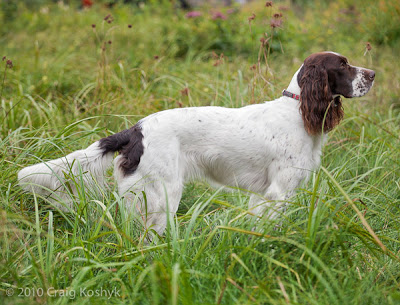
Breed of the Week: The French Spaniel

Craig Koshyk


I am a “form follows function” kind of guy. I'll take ability over looks any day. So when I want to photograph a breed of gundog, I look for individuals that have proved their talents in the field. As long as they are fairly representative of their breed type, I don’t really care how many blue ribbons they’ve won in the show ring. 

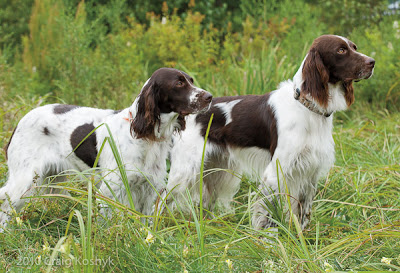
On the other hand, I am not immune to a dog’s good looks. I’ve photographed a few that were quite beautiful, and on one occasion, Lisa and I were absolutely stunned when a half dozen of the prettiest dogs we had ever seen came to greet us on the front lawn of their owner’s home. We were there to photograph them in action, but before we could even get to the field, their beauty stopped us in our tracks. We actually stood around for a few moments admiring their elegant form and complimenting their breeder, Pierre Vanier, on his drop-dead gorgeous French Spaniels.

HISTORY: By the middle of the 19th century long-haired pointing dogs could be found across much of western Europe. In France, they came in a wide variety of sizes and coat colors: brown and white, orange and white, black and white and even tricolored. Unlike the Braques, which began to form definite regional identities well before 1800, the long-haired descendants of the chiens d’oysel mentioned by Gaston Phébus were lumped into a single group: les épagneuls de France (the spaniels of France). But with a growing interest in breeding, breed clubs and written standards in the late 1800s came a movement to classify the different varieties into independent breeds. One of the first to be established was the French Spaniel. Its standard was written in 1891. 

Jean Castaing wrote that: Since it was found in every region, it could claim no regional identity, and since everyone had always known it to be brown and white with an ancient reputation for a calm and friendly nature, it was considered one of the oldest dogs of France. With the exception of the Braque Français, and probably for the same reasons, it inherited the national patronym, and if its varieties in their separatism claimed colors that probably belonged to it before, we would not contest the fact that under its more narrow flag it remained the French Spaniel par excellence.

Dividing the spaniels of France into separate, regional breeds sounded like a good idea at the time, but doing so nearly wiped them all out. Instead of forming a united front to face the challenge presented by growing numbers of Pointers and Setters imported from the British Isles, the French breeds ended up in small, localized populations barely able to fend for themselves. In addition, crossbreeding was rampant in all the breeds as hunters tried to “modernize” them. Adolphe de
 la Rue wrote that the épagneuls had been crossed with so many other breeds that finding one “of pure breeding” was extremely difficult.

James de Coninck also wrote about the issue. The spaniel was, in effect, the quintessential bird dog...white with brown patches and ticking on the legs...the wide forehead magnificently framed by long ears covered with wavy hair, the body is big, the legs a little short, the hair is wavy but not curly. That dog of 1592 is the same dog we had at the beginning of the (19th) century and even 20 years ago. I knew several of that type which, unfortunately I’m afraid, is more or less lost. There is no breed, in fact, that has been subjected to as many crosses.

Fortunately, in 1906 a French priest by the name of Abbé Fournier decided to dedicate much of the rest of his life to the revival of the classic French Spaniel. He gathered all the more or less pure individuals he could find and established a breeding program that would eventually save the breed from extinction. In 1921, a club was formed with Abbé Fournier as president and, with stricter breeding practices in place, progress was made, at least for a while. Unfortunately, like all French breeds, two world wars had a devastating effect on the French Spaniel, reducing its numbers to very low levels.

After the Second World War, efforts were renewed to revive the breed by using the few dogs that had survived. By the 1960s, the population had grown and French Spaniels were once again being presented in shows and in field trials. In 1975 hunters in Québec, who had begun to breed French Spaniels from imported stock, formed the Club de l’Épagneul Français, and in 1985 obtained recognition for the breed from the Canadian Kennel Club. Since then, the French Spaniel has become a fairly popular breed in Québec with over a dozen breeders producing, on average, about 100 pups per year. Throughout the 1970s and ’80s the breed continued to grow and improve in France, and in the ’90s a number of French Spaniels began to make their mark on the field trial circuit. Today, the French Spaniel is one of the most popular native pointing breeds in France and is gaining the admiration of hunters in other countries.

MY VIEW: I am not sure what it is about the French Spaniel, but every time I try to capture that “special something” about the way they look and the way they move, I feel that I come up short. I can’t honestly say that I have a single image that really reflects the uniquely kind look in the eyes of a French Spaniel. I am not even sure how to describe it in writing. The only appropriate term seems to be “elegant”. French Spaniels just have a certain elegance in the way they are put together and in the way they move.

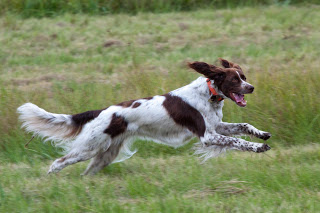
Of course all the good looks in the world count for nothing if a dog cannot perform in the field. Happily, all of the French Spaniels I’ve seen in action have convinced me that the vast majority of the breed is quite capable of putting in a good day’s work. I have also seen the two tendencies among breeders of French Spaniels. Some are focused on producing dogs that display a traditional style of search. Their dogs tend to work methodically, within shotgun range. Other breeders have opted to select for a more dynamic, galloping search that reaches out to cover more ground.

The dogs I photographed in field trials in France certainly ran with a great deal of passion at a strong gallop. The biggest running among them ranged out to well over 150 meters on either side. Other dogs, particularly those I saw in Québec, tended to work somewhat closer at a more moderate pace. No matter where I saw them though, I noted a certain feline quality to their movements.

If my admiration for the breed has not be obvious enough in other sections of this chapter, let me just come right out and say it here: I like French Spaniels, and I have a great deal of admiration for the breeders and breed clubs entrusted with the safe keeping of the ancient Espaignolz from France.

UPDATE: In recent years I've developed a classic case of middle-aged eyes. The deer grey Weimaraners I currently hunt with are getting harder to see at a distance. So there is a distinct possibility that I add a dog with an easy-to-see-at-a-distance white coat to the herd. And since I am working on Volume Two of my book, photographing lots of great Pointers and Setters I will probably end up saying "yes" to a "Britannic" pup at some point. But then again, I keep coming back to the photos I've taken of French Spaniels and the memories I have of their great looks, affectionate character and outstanding gundog qualities ... hmmmm decisions, decisions


Click here to see more photos of French Spaniels. 


Volume TWO?

Craig Koshyk


One of the most common questions I get about my book is not actually about the book itself. It is about the follow-up to it. Everyone wants to know what Volume Two will be about.

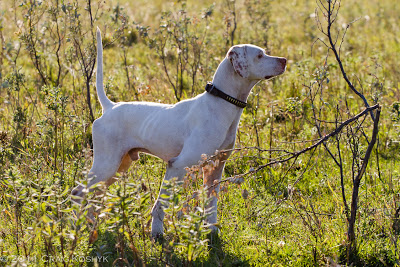
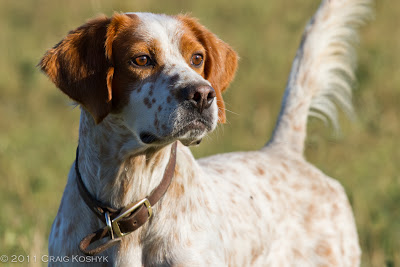
Well, it is actually pretty simple. You see, the FCI, that huge (nearly) world-wide canine organization divides the various dog breeds into groups. All pointing dogs are in Group 7. But Group 7 is subdivided into Continental Pointing Dogs and British Pointing Dogs. So Volume One is about the Continentals, and Volume Two will be about the British pointing breeds, ie: Setters and Pointers. And I am happy to say that I have already started Volume Two and have even done some photo shoots for it.


So to give you a sneak peak at some of them, here is a gallery of photos taken at the training camp of Colvin and Maizie Davis and in France at the training camp of Yannick Molès.


Breed of the Week: The Weimaraner Part 3

Craig Koshyk


SELECTION AND BREEDING


Approximately 550 Weimaraner pups are whelped in Germany each year, almost all of them bred by and for hunters. There are probably close to twenty thousand Weim pups born every year in the rest of the world. Unfortunately, 90% of them are from non-hunting lines.

Field-oriented breeders in North America tend to put more emphasis on speed, range and point than their German counterparts. Retrieving and water work are also very important for North Americans, but blood tracking and predator sharpness are generally not given much consideration. US and Canadian “field-bred” Weimaraners are often slightly smaller, faster and may be wider ranging than their relatives from Germany. In terms of appearance, they usually lack the extreme angulation of Weimaraners from show lines.

Aline Curran, an American Weimaraner breeder with US-bred and German-bred dogs, describes the differences between them:
My German dogs have more drive, more focus. They are bolder, more hard-headed, WAY more intelligent, and did I mention DRIVE? My American dogs from field lines have more style. They are faster and wider ranging, more eager to please, softer, more hyper, and did I mention STYLE? I find the German dogs easier to train, but harder to keep trained. They are very strong-willed and scary-smart. If you don’t stay on top of them, they will find very creative ways of getting away with murder. The Americans, on the other hand, are very eager to please, but don’t catch on as quickly. They are soft, so you can’t rush their training or you will lose the style, which is their best asset. Once they are trained, they stay trained with only gentle reminders. 

While it is reasonable to assume that over the last 100 years the Weimaraner has been bred to fairly high levels of purity, rumors persist that crosses to other breeds have occurred. Only one story can be confirmed. During the 1960s, there was a short-lived, and rather divisive program in Germany where a few Weimaraners did in fact receive “outside blood”.

According to a former president of the Weimaraner club, Dr. Werner Petri, a small group of breeders crossed English Pointers and Weimaraners in the early ’60s in an effort to establish a new breed called the Deutsch Halbblut. But the program never really got off the ground, and no dogs from it entered established Weimaraner lines. 

Several years later, a member of the German Weimaraner club bred one of his Weimaraners to a well-known Pointer bitch. He then bred the offspring to each other. All this was done without the knowledge or permission of the club. When word finally reached the board of directors, they decided, reluctantly, to allow the program to continue under the guise of research into the phenomenon of hybrid vigor. If the offspring were capable of passing all the required tests, then further steps would be taken to blend the crossbred dogs into established Weimaraner lines. In the end, the experiment was declared a failure. The Pointer bitch threw pups with extremely bad bites. That was enough justification for the breed warden to terminate the program. When I asked club members in Germany about those years, one of them said, “That is a chapter in the history of the Weimaraner that is now closed, thank goodness!”

Elsewhere, rumors of crossbreeding continue to make the rounds. In the US, claims and denials of crosses to Pointers and GSPs have been around for years. In France, knowing winks are exchanged in some circles. The French are rumored to have crossed everything from Pointers to GSPs to Salukis into some lines. However, nothing in either country has ever been proven
or publicly declared. What we do know is that in both the US and in France there are still very few Weimaraners capable of winning all-breed field trials. If crosses have been made, they have not had 
a huge effect overall. Perhaps they were done so long ago that they don’t really matter anymore, or they were not done widely or often enough to change the breed to the same degree as the GSP or Vizsla have been changed.

Clubs
The parent club for the breed in Germany is the Weimaraner Klub. There are also clubs in over 20 other countries. Among the largest are the Weimaraner Club of America and the Weimaraner Club 
of Great Britain.

Tests and Trials
The Weimaraner club of Germany follows a testing and breeding program similar to other JGHV-affiliated clubs. It sanctions VJP, HZP and VGP events, as well as various tracking tests. In Germany, Weimaraners must pass at least the first two levels of tests (VJP, HZP), as well as a coat, conformation and character examination, in order to be certified for breeding. The Austrian and the Czech clubs run similar tests, although they use a slightly different scoring system.

In the US, there is a fairly active AKC field trial scene for the breed. The Weimaraner Club of America and its affiliates organize 20 to
 30 trials every year, including a National Championship held near Ardmore, Oklahoma. Several kennels have been very successful in the field trial arena, and have done an outstanding job of keeping the hunt in their lines, while working toward developing class bird dogs for all-breed competition. The WCA also holds field-oriented ratings tests. Dogs can earn titles for upland bird work and/or retrieving. There is a small but growing number of Weimaraners participating in the NAVHDA testing system, with several kennels now using it to select their breeding stock (see a video of some of them here, starting at about 12:50 mark).

In the UK, France, Italy, Holland, Denmark, Sweden, Norway and Finland, Weimaraners can occasionally be seen in field trials and hunt tests. Like their American counterparts, European Weimaraner enthusiasts outside of Germany, Austria and the Czech Republic tend to place more emphasis on the breed’s upland bird hunting abilities than on big game hunting or blood trailing.

Health: In addition to the health issues faced by other breeds, the Weimaraner seems to be at a somewhat higher risk for autoimmune reactions to certain vaccination protocols. As a precautionary measure, the Weimaraner Club of America recommends that Weimaraner pups receive parvo and distemper shots separately, about two weeks apart. Weimaraners are also reported to be at a higher than average risk for a severe form of hypertrophic osteodystrophy (HOD), an inflammatory condition of the bones and other organs that can be fatal. Other issues of concern are bloat (gastric torsion) and von Willebrand’s disease.


FORM

The unique look of the Weimaraner is a double-edged sword. Having a hunting dog with a unique color and chiseled good looks is great. I've had Weimaraners for over 12 years, and I am still flattered when my hunting buddies tell me my dogs are handsome. But, on the other hand, the look of the breed has captured the attention of huge numbers of non-hunters who now make up the largest market for it. As a result, many breeders select almost exclusively for looks, and ignore the most important feature of the breed: its hunting instincts.

Size: Weimaraners can be substantial dogs, among the biggest of the Continental breeds. North American field-bred Weimaraners tend to be smaller than their show-bred compatriots.
Males: 59 – 70 cm
Females: 57 – 65 cm

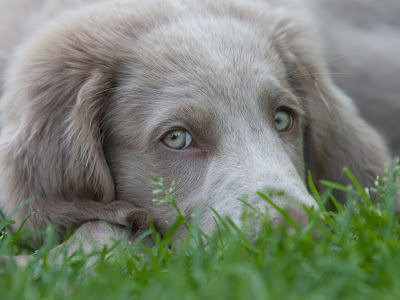
Coat: Most Weimaraners have a short silver-grey coat and cropped tail. Long-haired Weimaraners are identical to the short-haired variety except for having a long, soft topcoat, with or without an undercoat. The long hair lies flat and measures 3 to 5 cm in length. It is somewhat longer on the ears and backs of the legs, and slightly shorter on the head. The tail develops a “plume” of long hair when the dog nears maturity. The tail of the long-haired Weimaraner is usually not cropped.

Long-haired Weimaraners were known to exist for many years before they were officially accepted in 1935, but have always been less common than the short-haired variety. Even today they only represent about 30% of the breed’s population in Germany and Austria; less in other countries. Curiously, the Weimaraner Club of America is the only Weimaraner club in the world to list the long-haired coat as a disqualifying fault. But the disqualification only applies to the show ring, so long-haired Weimaraners may participate in any other event open to pointing dogs.

Another type of coat known as stockhaar is quite rare, and only occurs in dogs that carry both the short-hair and long-hair genes. It is a double coat with a medium-length, flat-lying topcoat, and thick undercoat with a slight amount of feathering sometimes seen on the backs of the legs. Mating a short-haired Weimaraner to a long-haired Weimaraner may produce a stockhaar coat, but it is not a sure bet. The same holds true for two short-haired Weimaraners that carry the recessive long-hair gene. There is only a slight chance that they could produce a stockhaar coat.

Color
The breed’s silver-grey color has always been its most distinctive feature. But a grey coat is not unique to Weimaraners. Pups with grey coats have cropped up from time to time in other breeds. Writing in Weimaraner Heute, Dr. Werner Petri describes seeing grey pups in a litter produced by two black Middle Pinschers, and that prior to the Second World War, grey pups appeared in several litters out of solid brown German Longhaired Pointers. I’ve been told by breeders of GSPs in the Czech Republic and Slovakia that grey pups occasionally occur in their breed and are suspected of being throwbacks to a time when Weimaraners were crossed into GSP lines. A former president of the Cesky Fousek Club, Dr. Jaromir Dostal, has also confirmed that grey pups can also occur in Cesky Fousek litters.

What is unique to the Weimaraner, at least among the pointing breeds, is that breeders specifically select for the silver-grey coat color. According to the breed standard, it is silver, deer or mouse grey, as well as shades of these colors. Genetically, silver-grey is actually a shade of brown that has been altered by a recessive dilution gene. If a Weimaraner is bred to a dog of another breed with a non-diluted coat color, the resulting pups are never grey. They are usually liver or black.

While silver-grey is the only officially recognized color of the Weimaraner, another coat color can occur. The so-called blue Weimaraner has a distinctly blue-grey coat color similar to that of blue Great Danes, Dobermans or Italian Greyhounds. The color is actually a dilution of black. Blue Weimaraners have black noses and lips, and may have black mottling on the skin inside the mouth. Physically, other than the coat, blues look just like the silver-greys. They have a small but devoted following in the US, and have recently gained some ground in the UK, France and even in Germany, where breeders not affiliated with the parent breed club are now trying to cash in on the “rare” variety. 

Unfortunately, blue fanciers are like the grey fanciers—most of them do not hunt! Blues are bred, almost exclusively, as companion animals. Since a blue coat is listed as a disqualification in the show ring, they are not even bred for blue ribbons. Of course, that is not to say that there aren’t any good blues out there; there certainly are. I am aware of several breeders of blues that test their dogs with NAVHDA and have earned respectable scores. Nevertheless, for hunters and field trial enthusiasts, finding a first-rate hunting dog among the blue Weimaraner population usually presents an even greater challenge than finding one among the silver-greys.

“Blues” remain a hot-button issue in Weimaraner circles but space does not permit an analysis of the issues involved. However, a resolution may be on the horizon. In 2009, a club was formed in the US with the goal of establishing the Blue as a separate and independent breed. If you want to read my take on the Blue issue, here is a link to a mini rant I wrote a while back.

UPDATE: I recently wrote about another coat type/color in Weims: White. 

FUNCTION

Field Search: I have seen Weimaraners that were ultra- close workers, hunting at a fairly methodical pace. I have also seen one or two that ran for the horizon like bats out of hell. However, most Weimaraners have a close to medium range and hunt at a medium gallop. Judy Balog, a leading American Weimaraner breeder, says: Good Weims can search a field as well as any other versatile breed. But even the widest-ranging Weimaraners are not run-offs. They keep a sharp eye on their owners and willingly hunt for the gun while handling kindly.


Pointing
The pointing instinct can be slow to develop in some Weimaraners. Once they mature, however, they are generally strong pointers. Those selected for field trials in the US and Europe tend to have a very strong pointing instinct that develops earlier. Americans, in particular, place more emphasis on style of point, and look for dogs that display a higher head and tail. Like most other Continental breeds, natural backing is occasionally seen, but it is not particularly common.

Retrieving
Most Weimaraners are natural-born re- trievers that show a strong desire to fetch anything and everything at a very early age. The retrieving instinct may, in fact, be one of the most deeply seated traits of the breed. Even in lines where the run and point have almost been completely bred out, the desire to retrieve often remains quite strong.

Tracking
Perhaps because of its Leithund heritage, the Weimaraner has always been known for a “deep nose”. In Germany, a lot of emphasis is placed on selecting and testing for tracking ability. A lower head is greatly valued. So is giving voice on track, a behavior called spurlaut. In America, many breeders prefer a higher head, but do not ignore tracking ability completely as it is an important aspect of upland game hunting and NAVHDA testing. However, there is very little emphasis placed on big game tracking among Weimaraner fanciers outside of Germany and Eastern Europe. Nor is there any attempt to select for traits such as spurlaut.

Water Work
Weimaraners can be excellent water workers. Some may need more encouragement than others when first being introduced to water, but once they have learned to swim, they can be top-notch performers. The short-haired version of the breed may not be the best choice for the late-season waterfowler. Even the long-haired variety, which is better able to work in cooler temperatures, may not be well suited to breaking ice in deep waters. 

Judy Balog says that: The young Weim may need a little more early encouragement, but once they mature I think they’re hard to beat and most make top-notch water retrievers. 


CHARACTER
With such a huge population and so many different lines of Weimaraners out there, it is difficult to describe a “typical” weimaraner. There is a wide range of personalities in the breed, running the gamut from eager-to-please gundogs to hyperactive basket cases. But if we limit the discussion to dogs with a well-balanced character we can say that, in general, Weimaraners are friendly, extremely intelligent, high-energy dogs. They are not well suited to living in a kennel, and not really the kind of dog that can be left to their own devices around the house. They are often slow to mature, both physically and mentally.

Me and the Amazing Maisey
Training
The breed is particularly well known for forming a very strong attachment to its owner/handler. This can be a double-edged sword when it comes to training. The fierce loyalty and tremendous desire to please are great assets but, if not handled properly, they can sometimes lead to dogs that show very little independence. Again, it really depends on what lines they come from and how they are raised. Generally speaking, training a Weimaraner from good, proven stock is fairly straightforward.

Protection
For over a century, Weimaraner breeders in Germany have sought to breed courageous dogs with a strong protection instinct. Weimaraners are the only pointing breed in Germany required to pass tests designed to evaluate these traits. Tanja Breu-Knaup, a leading breeder of long- haired Weimaraners in Germany, explains that the breed’s reputation of being mannscharf (literally “man-sharp”) is slowly fading.
In the 1980s, when I first showed up to a training session with my dogs, everyone thought that they would be aggressive. But I proved to them that my dogs are NOT aggressive. Thankfully, things have changed since then. 
Instrumental in the public’s change in attitude has been the decision by the parent club to modify the testing procedure. Steve Graham, an American who has imported Weimaraners from Germany, explains:
The man-sharpness test (Mannscharfprüfung) was replaced by the new Wesenstest in 2001. In the older test, the handler holds the dog on a lead, and the judge, armed with a stick, makes threatening moves toward the handler. The dog is expected to show courage and willingness to defend its handler.In the newer test, the dog must also prove that it is not fearful or aggressive. A group of a about a dozen people forms a large circle around the handler and dog. Slowly, the people move toward the center. When the circle is more or less closed, the handler must let go of the leash and exit the circle leaving the dog behind. Once outside of the circle, the handler calls the dog. The dog should then go to the handler. When this is done, the handler and dog re-enter the circle. Judges look for any hint of fear or aggression. If they detect the slightest amount of either, the dog is prohibited from breeding. 


Read more about the breed, and all the other pointing breeds from Continental Europe, in my book Pointing Dogs, Volume One: The Continentals
http://www.dogwilling.ca/index.cfm

Amazing Maisey

Craig Koshyk

I've held off writing about some behind-the-scenes drama happening with one of my dogs this summer since I did not know how things would turn out. It was touch and go there for a while. But I can now say that I have a happy ending to write about. So here it is, the story of our Amazing Maisey. 


4 months ago, I sent a female longhaired Weimaraner named Maisey to Germany to train for the VGP test. My nephew personally delivered her to a breeder, trainer and full time super-hero named Tanja Breu Knaup whose vom Fenriswolf kennel has produced of the most celebrated LH lines in Germany.

At first, everything went very well. Maisey is a heck of a good dog and even though the only field training she had received until then was from me - a mediocre trainer on a good day - Tanja would soon see that Maisey had what it takes to pass the toughest test of all, the Master Hunting Test known as the VGP. 

Then, about 6 weeks into training, disaster struck. While running at full speed in the woods, Maisey injured her eye. A thorn pierced the cornea. After an emergency examination, the vet gave us the bad news. Maisey could end up losing the eye. 

At that point, we figured there was no way she would ever run the VGP, let alone pass it. All efforts had to go into just saving the eye. So for about a month Tanja focused on nursing an injured dog back to health. And it was not just a matter of letting the eye heal itself. At first, special drops had to be administered every 2 hours 'round the clock! And by the end of the first week, the eye looked really, really bad. 

But slowly, almost imperceptibly at first, the eye began to show signs of recovery. After about a month, a specialist examined it and told us that it was indeed healing nicely and would probably not need to be removed. With a huge sigh of relief, I though, "OK, she may not run the VGP, but at least she will have two good eyes".

Then Tanja said that it was time to get back to training! 

I was stunned. I thought there was no way in heck for a dog who has not even run the VJP or HZP or any NAVHDA test in her life to be trained in such a short period of time for the toughest test of all, the VGP. But knowing Tanja and the fierce determination that has made her one of the top Weim breeders in the world, I along with Maisey's co-owner (and world's best veterinarian) Colleen Skavinsky figured, what the heck, we've come this far, why not double down?

So Tanja and Maisey headed back to the field, forest and water for what must have been the world's shortest and most intense VGP training program ever.

This weekend they ran the test. I got the results by email about an hour ago. Not only did Maisey run the test, not only did she pass the test, she scored 300 points for a prize 1!! She also earned a rating of "excellent" for coat and conformation and passed her character/protection test to boot!

I am in awe of that dog and of her super-hero trainer. Just last month I was bursting with pride and admiration for another super-duo of trainer and dog. My soul-sister Judy Balog ran my dog Henri to a prize 1 in his NAVHDA Utility Test. And today is another great day thanks to another wonderful dog and trainer.

Thank you Tanja and Maisey, 
Thank you Judy and Henri, 

And to anyone out there who thinks that Weims can't get it done or that women can't breed and train great gundogs, I say watch out, here comes a couple of great grey dogs and their female handlers/trainer/breeders to kick your skinny ass!!