Contact Us

Use the form on the right to contact us. We should get back to you within 24 hours. If not, it means we are out chasing birds with dogs, shotguns and Canons. In that case we will get back to you as soon as we've finished the roasted Teal and Bordeaux . 


Form Block
This form needs a storage option. Double-click here to edit this form, and tell us where to save form submissions in the Storage tab. Learn more
         

123 Street Avenue, City Town, 99999

(123) 555-6789

email@address.com


You can set your address, phone number, email and site description in the settings tab.
Link to read me page with more information.

Pointing Dog Blog

The world of pointing dogs in words and images, moving and still.

Breed of the Week: The Spinone

Craig Koshyk
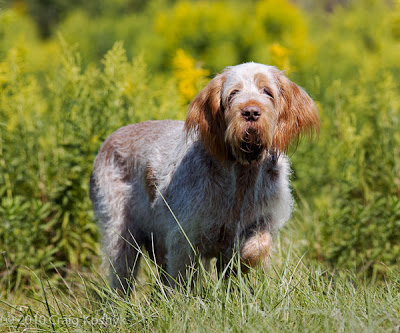

I love Italy. I love the food, the wine, the culture and especially the language, which I speak with an English/French accent so thick you can cut it with a knife. When Lisa and I are in Italy, we live on a steady diet of the pizza, pasta, Chianti and cappuccino. And once in a while, when it is really hot, we’ll order a nice cold beer.

Our Italian brew of choice is “Birra Moretti” a perfectly drinkable beer with an interesting picture on the label. It is an image of a smiling man lifting a frothy mug to his lips. He’s wearing a green suit, green hat and has a prominent red moustache*. One day, in a small town near Padua, as Lisa and I enjoyed a Birra Moretti, I saw a dog and his owner walking across the central square. The dog was fairly large, white and orange and as it got nearer I realized that it had the same bushy moustache as the Moretti guy! When he and his owner walked by our table, I said “excuse me sir, but what kind of dog is that?” “e un Spinone” he replied “It is a Spinone”.

Just about any history you are likely to find on the Spinone will make the claim that the breed was created in the furthest mists of time. But a few vague references to hunting dogs in obscure Greek poems are not enough to prove an ancient origin. On the other hand, images found in Renaissance paintings do show that dogs resembling the Spinone were in Italy at least as far back as the 1400s.
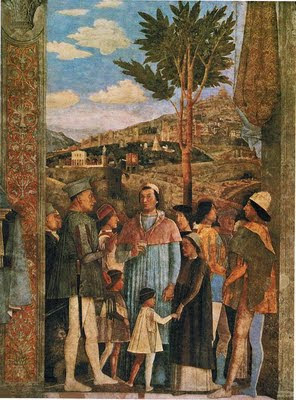
Perhaps the most intriguing image is one found on the west wall of the Ducal Palace in Mantua. Painted by Andrea Mantegna circa 1474, the fresco is divided into three panels. The left panel shows a horse and four men with hunting dogs that appear to be greyhounds and mastiffs. The right panel, often referred to as “The Meeting”, is said to represent Ludovico Gonzaga, his son, Cardinal Francesco, and other members of his family. In the bottom left corner of the scene, behind Ludovico’s legs, is a small rough-haired dog that some believe may be an ancestor of the Spinone.

Despite other ancient images featuring dogs that resemble Spinoni it was not until 1834 that the first written reference to the breed was made by Bonaventura Crippa, who wrote: We should not forget to mention the hard-coated Bracco commonly called Spinoso.

Many breed histories point to those lines as the first time the Spinone is mentioned in the literature, albeit with a slightly different name. However, they all seem to skip over the very next line where Crippa makes the extraordinary claim that the Spinoso was English!
This species of dog originated in England and is used by us more to hunt in the marshes and the woods. 

It is not clear how Crippa came to believe that the “hard-coated Bracco commonly called Spinoso” came from England, but he is surely mistaken. Rough-coated dogs had existed in Italy, and across all of Europe, for centuries, wherever short-coated dogs mixed with long or curly-coated breeds. In any case, no other work on the Spinone mentions an English connection. All of the major authorities agree that ancestors of the Spinone were probably native to Italy. In Les Chiens d’Arrêt, author Jean Castaing provides us with the most likely scenario for the development of the breed.
I believe that the Spinone developed in more or less the same way as other such breeds… like all other pointing griffons [it] was born from the cohabitation of braques and barbets. (Jean Castaing, Les Chiens d’Arrêt, 342)
By the mid-1800s, Spinoni (plural of Spinone) could be found throughout much of the Italy. And like their cousin, the Bracco Italiano, different types were seen in the various regions. In Piedmont and Lombardy, for example, Spinoni tended to have rough brown and white or orange and white coats. In the Veneto area they were said to have had longer and softer brown roan coats. Not only where there different coat types and colors in various regions, but it seems that just about every noble family was breeding their own versions as well.
…Many aristocratic families or of higher classes had their own “breed” of Bracchi or Spinoni, [which were] simply numerically small families from which you try to get subjects with a certain appearance and the hunting aptitudes that the hunting culture and environment required. (Giambattista Benasso, I Cani Da Ferma Italiani, 32)
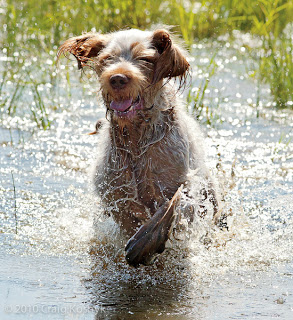
Despite their many varieties, almost everyone agreed that the Spinone was better suited to the wetlands than the short-haired Bracco.
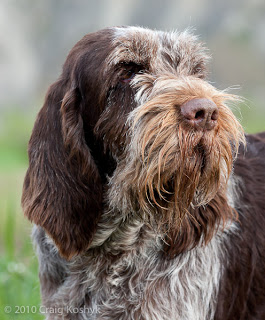
It seems that nature, having granted it a long and rough coat, has specifically destined it to deal with reeds and thorns. Its search is fairly active and persistent, and a hunter who hunts for birds only in the woods and swamp could benefit far more from it than from the one with short hair that is used in open and arid country. (Bonaventura Crippa, Trattato Della Caccia, 228-229)
When tracing the development of the Spinone, it is important to remember that throughout much of the 1800s the entire Italian peninsula underwent massive social, political and economic changes. Insurrections, revolts, and two wars of independence finally led to Italian unification in 1861. By the 1880s the country had made great progress in terms of education, health care and political stability; and, like elsewhere in Western Europe, hunting and dog breeding became increasingly popular with the growing middle class.

Enter Ferdinando Delor, writer, editor and founder of the influential magazine Caccia e Tiri. In 1881, he helped found the Kennel Club Italiano. Among the club’s first tasks was to bring order to the Spinone breed by accepting only dogs that met the newly established official standard. The club also had to decide whether or not to permit crosses to other rough-haired breeds. Delor suggested that crosses to the Stichelhaar—he called it a “German Spinone”—and the Korthals Griffon could lend the Spinone a helping hand. 
…In the, lets us say, miserable state in which our rough-haired breeds are found, these crosses would be advisable…the German Spinone and the Griffon have a great affinity with ours and, if done with intelligence, would not bring overly radical modifications to the look and aptitudes of our Italian dogs. [We] must be careful about the introduction of blood from the Griffon a Poil Soyeux [Boulet Griffon]; once brought in, it is difficult to eradicate.  (Giambattista Benasso, I Cani Da Ferma Italiani, 42)
In Germany and France, many breeders of rough-haired dogs, including Eduard Korthals, believed that all pointing griffons were of the same family and should be allowed to mix. So it is understandable, especially after the First World War, that breeders were encouraged to cross Spinoni with Korthals Griffons, Stichelhaars and even German Wirehaired Pointers.

So in 1922, the French and Belgian stud books were opened to the Spinone, which was registered alongside the other griffons. But the situation did not last long. Breeders soon realized that the Spinone brought with it certain characteristics, such as an orange and white coat and dewclaws on the rear legs, that were proscribed in other griffon standards. In addition, many believed that the Spinone had received too much “foreign” blood—mainly from English Pointers—in the recent past, and its standard was moving away from that of the other griffons. The Spinone was therefore removed from the Wirehaired Pointing Griffon stud books and declared a separate and independent breed. 
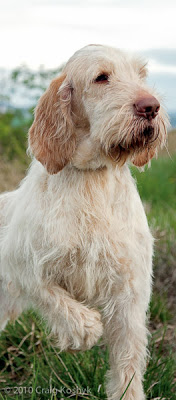
And it was around this time, when the breed was struggling to form its own stud book and standard, that the Spinone began to feel the full effects of the massive importations of bird dogs from England, and to a lesser extent, from France and Germany. Spinoni numbers declined as Italian hunters turned their attention to these faster, wider ranging breeds. In an effort to reverse the trend, breeders tried to “modernize” their lines. It is said that crosses to Boulet and Korthals Griffons, German Wirehaired and Shorthaired Pointers, and English Pointers were done at the time—with mixed results. Speed and range increased in some lines, but the look and character of the breed was adversely affected.

If the effects of unregulated crosses hurt the Spinone and the increasing competition from other breeds reduced its numbers, then the Second World War nearly wiped it out. Of course, all the other Continental breeds faced difficult challenges in the post-war years, but for some, recovery was fairly rapid. Not only were breeders able to rebuild the population bases, but they managed to improve the overall hunting ability across the breeds in very short order. 

Unfortunately for the Spinone, recovery took considerably longer. In fact, it was not until the 1980s that any real progress was made in terms of field ability. It seems that Spinone breeders were slow to adapt to the rapidly changing hunting scene in Italy. With severe reductions in wild game populations and fewer places to hunt, their breed earned the reputation as an outdated type of dog kept only by older hunters unwilling to change their ways. 

To make matters even worse, many breeders based their selection almost completely on the breed’s conformation standard, and not on its natural hunting abilities. The few breeders who eventually tried to turn things around had an uphill battle. They had to... 
…use the handsome to develop the good in terms of hunting, which of course is a very difficult undertaking. It required years and years of work, but following the path laid out by the late Emilio Pedrazzini, who can be considered the father of modern Spinone, the breed finally rose to a high level. (Marino Panizza quoted in I Cani Da Ferma Italiani, 99) 
Today the Spinone continues to improve and gain ground among hunters in Italy and elsewhere in Europe. The number of field trial champions has risen dramatically over the last 20 years and some Spinoni have even won all-breed trials on the continent. In North America, the Spinone has found a home among a fair number of dedicated NAVHDA breeders who have made excellent progress in recent years.


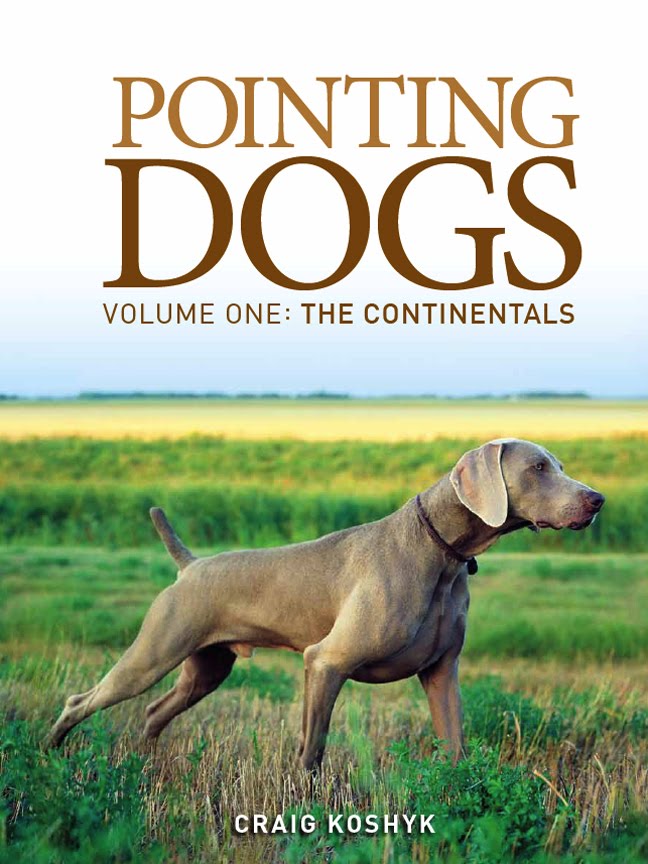
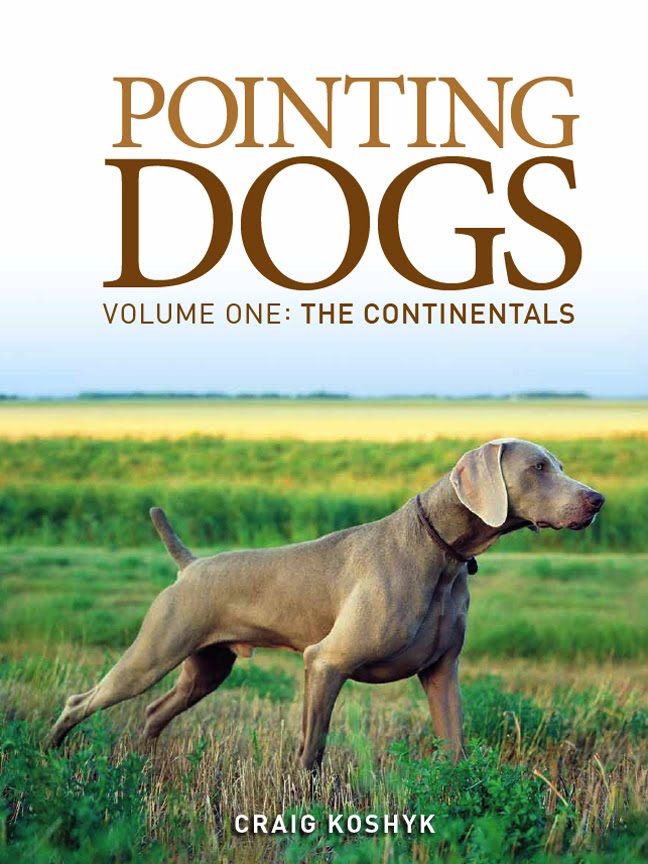
Read more about the breed, and all the other pointing breeds from Continental Europe, in my book Pointing Dogs, Volume One: The Continentals
http://www.dogwilling.ca/index.cfm

Breed of the Week: The Bracco Italiano!

Craig Koshyk

Of all the breeds I've studied, the Bracco Italiano may be the most misunderstood...at least by North Americans. In much of Europe the breed is fairly well known and well respected for its outstanding nose and unique working style. In Italy it has a very loyal following among hunters and field trialers and there are breeders in the UK, Holland, Germany, France and elsewhere on the continent. But in North American it is a different story. In most areas, the breed is almost completely unknown and where it is known, it tends to baffle most hunters. They have a hard time getting their head around a big houndy looking pointing dog that hunts at a fast, powerful, rhythmic trot. 


You can read about the breed's history and development in my book and find plenty of photos of the breed on line. What I would like to do is try to demystify the breed's unique trotting pace for my readers and explore the other aspects of the breed's hunting style. Let's start with a video that shows a Bracco Italiano in training. It is a very interesting clip, albeit very home made and pretty shakey. It shows the progress of a young dog figuring things out. At the beginning he looks like a typical adolescent trying to figure out how to get all four legs working together. But he does show a bit of the trotting pace that is natural to the Bracco.

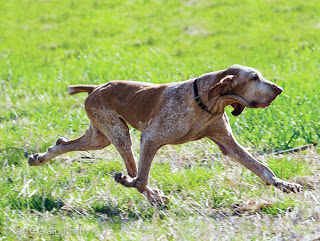
A bit later on from about 1:10 to the 2:50 mark he gallops. This is tolerated in a young Bracco; handlers and trainers allow them to just get out there and run. But from about 2:55 on the dog really starts to get into the rythm of the characteristic "flying trot" known in Italian as the Trotto Spinta. And there are flashes of sheer brilliance in there, note how beautifully high he keeps his head most of the time and how he really seems to float across the ground. Now remember, this is a young dog just figuring things outs. Older dogs on the field trial circuit range out much wider (up to a couple hundred meters or more on either side), and even faster but with the same high head and quick, flying trot.

I've seen Bracchi (that's the plural of Bracco) trot that way in field trials in Italy and the first time I did,  I was stunned. In fact, I am still blown away each time I see a top notch Bracco do its thing now. And even though the video does give some idea of how fast the dogs can move, you really have to see them in person to understand. Remember, these are dogs are in the 60 to 70 pound range, some can be 27 inches at the shoulder! They are probably move across a field at the same speed as a smaller dog running at a gallop does. Yet the trotting pace is said to be much more energy efficient and therefore easier to sustain all day in often hot/dry conditions -- like power-walking compared to running or jogging.
Bracco Italiano showing the famous "trotto spinto"
Here is how I describe the breed's performance characteristics in the Bracco Italiano chapter in my book:

Field Search
Hunters whose only experience is with dogs that gallop may find the appeal of a trotting style difficult to understand. But this naturally gated pace is a very important aspect of the Bracco Italiano, and is much valued by hunters and field trialers in Italy. Jonathon Shaw, a Bracco breeder, trainer and field trialer from England, explains:
A Bracco on an extended trot is wonderfully impressive, astonishingly fast and reminiscent of a Tennessee Walking Horse; head held high, legs well-extended, but not the hackney gait of a Pointer. The Bracco certainly doesn’t “amble”. The gait is very purposeful and flowing—whatever the terrain.
Italians call it a trotto spinto, litterally a “thrusting trot”, with speed and power coming from the powerful back legs. When I asked Bracco expert Cesare Bonasegale about the trotto spinta, he replied:
The trot is not the fastest gait of the Bracco; they can gallop, after all. But the trotto spinto is the natural gait of the breed, and the one that best matches its nose. During this type of trot, there is an instant in which all four paws are off the ground at the same time.
The Bracco is reputed to have great stamina, much of it due to the fact that it is able to sustain its trot from dawn to dusk, under a variety of conditions. Today, most breeders continue to select for a natural trot but if a dog has too much of a tendency to gallop, trainers sometimes resort to a device called a braga. 
The braga is a figure eight arrangement made up of a collar and strap around the chest. The top of it sits on the withers and has a small ring attached. Through this stretches a cord, and at either end is some form of attachment, either Velcro or a broad rubber band which is affixed to the dog’s hock. It can then be adjusted for length. It encourages the dogs to trot and inhibits galloping. (Jonathon Shaw, pers. comm.)
As with many of the Continental breeds, the forces of modern competition have had an influence on the development of the Bracco Italiano. The current trend is toward dogs that gallop more and have a bigger range.
Game is not as abundant as it used to be. Dogs must search larger areas. A Bracco should hunt in a range that is suitable for the terrain. In large, open areas, he may range up to 150 meters or even further on either side. Of course, when he is hunting in dense vegetation, he should stay closer. (Cesare Bonasegale, pers. comm.)
Pointing
Most Bracchi have a very strong pointing instinct. Some back naturally. The pointing style is classically Continental. An interesting document called the Pastrone Working Standard, published in 1937, describes it in detail: 
Upon detecting a scent the dog gradually slows and returns extremely prudently towards the presumed origin, head held high... ears cocked to the maximum and the tail stiff and lowered a little. ... And when motionless he holds still, his tail raising slightly. This stationary position requires that the dog be horizontal, either slightly lower or slightly higher. … Later, when he senses to be suddenly upon the game (and only in this case), he stops immediately, staying more often than not upright, or with the limbs a little flexed...
Retrieve
The average Bracco Italiano is a natural, soft-mouthed retriever. But the breed is mainly an upland game specialist, and its traditional retrieving duties involve small game, mainly birds. The retrieval of (and aggression towards) fox and other predators is not considered a normal part of the Bracco’s job description in Italy. 

Tracking
The Bracco has always been bred and trained primarily as a hunter of small game, so there is little to no emphasis among breeders on selecting for dogs that show good blood-tracking abilities.

Water Work
Unlike the Spinone, water work has never been high on the list of priorities for most Bracco breeders, and there are no water tests for the breed in Italy. Nevertheless, a well-bred Bracco from hunting lines should be relatively easy to train for some kinds of water work. Breed expert Lucio Marzano told me:
The Bracco Italiano has a very sweet, affectionate personality and bonds very tightly to his owner, sometimes excessively so. They naturally keep in contact with the handler, always hunting for him. So a Bracco is very easy to train. All you have to do is take him hunting. Within the breed, it is more common to see timid dogs than aggressive dogs, but both tendencies should be penalized. 
For more information on the Bracco Italiano, visit the breed club website in Italy or in the US, UK, or Holland


Read more about the breed, and all the other pointing breeds from Continental Europe, in my book Pointing Dogs, Volume One: The Continentals
http://www.dogwilling.ca/index.cfm

The Guerlain Griffon

Craig Koshyk


In 1907 Robert Leighton wrote about 
an orange and white rough-haired breed known 
as the Guerlain Griffon. He described it as:
...perhaps the most elegant in shape and appearance, owing to its shorter and less rugged coat and lighter build. This breed is usually white in color, with orange or yellow markings, rather short dropped ears, and a docked tail, and with a height of about 22 inches. The nose is always brown, and the light eyes are not hidden by the prominent eyebrows so frequent in the French spaniels.
W. E. Mason also mentions the breed:
This is a medium-sized dog, short in the body and compactly built. He has a big head for his size and the eyes are rather large and light-brown in color. The nose is always brown with nostrils well open. Chest broad and back strong and well-developed. The legs are straight and muscular, rather on the long side and well-covered with short, wiry hair. Stern [tail] is carried straight, covered with wiry hair but without feathering, and a third of its length is generally docked. The coat is hard and wiry, rather short and not curly.
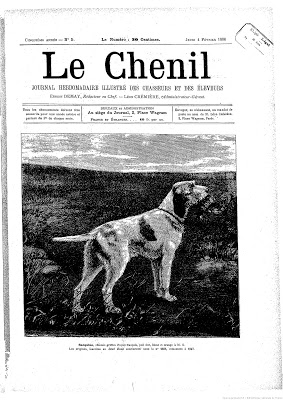
The most interesting document I have found on the Guerlain Griffon is an article published in the February 4, 1886 edition of Le Chenil. It was written by the Marquis of Cherville (Gaspard de Pekow) and describes his own efforts to establish the breed that was later perfected by a man he refers to only as “Mr. G”.

 The Marquis wrote that he purchased a brown and white rough-haired griffon from a Mr. Lebastard in 1846. He named the dog Tom, and became so fond of it that a short while later he bought a bitch with a similar coat in Normandy. However, when he bred the two together, he found that the results were not what he had hoped for. The offspring had long, silky hair. They were also smaller than their parents and much less vigorous. So, in 1857, the Marquis bred a bitch named Crimée, a perfect hunter but with mediocre looks, to an extraordinarily vigorous Pointer named Narbal. From that union, he kept two pups: a dog he named Garçon and a bitch he named Cartouche.

When Cartouche was a year old, the Marquis gave her to Alexander Dumas, the well-known author of such classics as The Count of Monte Cristo and The Three Musketeers. Dumas did not keep Cartouche; he presented her as a gift to the national hero of Italian unification, Giuseppe Garibaldi. Naturally, this created a huge demand for her puppies in Italy, and she was bred several times leaving many 
descendants.

Garçon, Cartouche’s brother, had a harsh, fawn-colored coat with white “socks” on all four legs.
He was very tall, with incredible physical strength. I once saw him in front of M. Clérault, retrieve at a gallop a hare of seven or eight pounds and, despite the weight, he leaped over a stream a meter 
and a half wide in a single bound. 
The Marquis repeated the breeding that produced Garçon and Cartouche. From it, he kept a bitch. He named her Mike. But Mike’s coat was mainly white with only small fawn-colored patches and spots. Nevertheless, the Marquis was so pleased with Garçon and Mike—he wrote that they were the best hunting dogs he’d ever known—that he decided to establish his own line by way of a brother-sister mating. 

In the article, which is written in French, he actually uses the English expression “in and in” to describe his breeding program. However, he admits that things did not pan out the way he had hoped. After the third generation, everything seemed to fall apart. The dogs were smaller and lacked vitality. Many fell ill, some were timid and others had little to no hunting abilities. Realizing that he was getting on in years, and no longer having the time to continue his projects, he stopped breeding his griffons and turned to English dogs instead.


This is where “Mr. G” enters the story. His full name was Aimé Guerlain and he was the son of Pierre-François Pascal Guerlain, the founder of one of the oldest perfume houses in the world. Aimé Guerlain was also an avid hunter who spent many days in the marshes of Picardy, particularly near Le Crotoy, a spa his father established in the early 1800s on the Bay of the Somme. 


In 1868, in an effort to establish his own line of dogs, Aimé Guerlain bred a bitch from a strain of griffons known as Griffons Picards, to one of the Marquis’ dogs. The pups turned out so well that he bred several more litters using similar combinations. As his line developed, Guerlain avoided the problems of excessive inbreeding by crossing to English Pointers when he needed outside blood. He eventually produced a white and orange wire-haired pointing dog that became known as the Guerlain Griffon. When the Marquis saw some of them in the field, he wrote:
Their search, without being too wide, is very active and sufficiently open; they have a good nose and their points are very solid; they are remarkable for their prudence and cooperation. Well-trained, they are exceptional retrievers. Overall, Mr. G, and M. Boulet, in their breeding of griffons, demonstrate a steadfastness, a tenacity that we must applaud and from which their breeds will benefit greatly if these men can create converts from among their colleagues.
When the first field trial was held in France in 1888, the winner of the quête restreinte (close search) stake was a Guerlain Griffon named Sacquine. Sadly, despite this and other achievements —Aimé Guerlain even sent a number of his dogs to Tsarevich (Grand Duke) Nicholas of Russia — he was unable to gain many converts beyond the circle of his close friends. The Guerlain Griffon eventually died out just after the turn of the 20th century.

Read more about the breed, and all the other pointing breeds from Continental Europe, in my book Pointing Dogs, Volume One: The Continentals
http://www.dogwilling.ca/index.cfm

More on the Boulet Griffon

Craig Koshyk


In response to a comment on a forum, I wrote:

The story of the Boulet Griffon is very interesting. One of the most fascinating aspects is just how famous the breed and its creator really were; and how quickly they faded into near total obscurity.

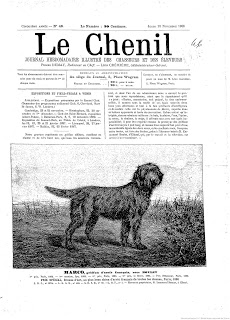
I always knew that the breed was well known at one time, but it was not until major libraries and foundations began to make their archives available on-line that I realized just how big of a deal the Boulet Griffon was in its day. For example, there was a sporting newspaper/magazine called "Le Chenil" published weekly in France from the 1880s to the 1920s. I had only seen a few copies of it in old bookstores in Paris but could never afford to purchase a copy. But then one day about a year ago I discovered that the National Library of France had just uploaded the entire collection to the net and that I could consult any issue I wanted for...FREE!

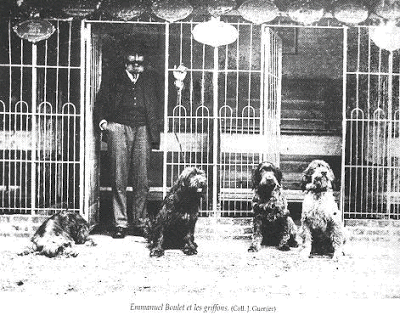
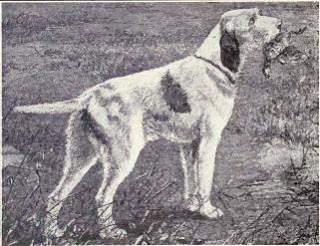
To the left is the front cover of Le Chenil for the week of Nov. 18, 1886. It features an illustration of Marco the most famous of Boulet's dogs. The caption beneath the photo reads: Marco, French pointing griffon of the Boulet breed. 1st Prize, Paris 1882 with special mention, 1st Prize, Spa 1882, 1st Prize, Le Havre 1882, Prize of Honor, Paris 1886, Special Prize, Le Bronze d'Art for the handsomest French pointing dog of all classes, Paris 1886 (then Marco's registration numbers are given for various studbooks) Breeder and owner, M. Emmanuel Boulet from Elbeouf.

Needless to say, as soon as I found the site with all the issues, I spent 18 hours a day for weeks on end reading every single one of them. And the number of times Boulet and his dogs were mentioned..and in absolutely glowing terms... was unbelievable. Just about every single issue from about 1880 to 1900 had an article, ad, announcement about him or some sort of note regarding a placement of one of his dogs in a show or field trial.

But then it just sort of trails off. Eventually there is nothing.

As mentioned in the previous post, in the 1990s a guy in France tried to recreate/revive the breed but gave up after only a few years. Today, the closest thing to a Boulet Griffon is a non-pointing breed called the Barbet. You can see photos and read about the Barbet here.


Read more about the breed, and all the other pointing breeds from Continental Europe, in my book Pointing Dogs, Volume One: The Continentals
http://www.dogwilling.ca/index.cfm

Breed of the Week: The Boulet Griffon

Craig Koshyk

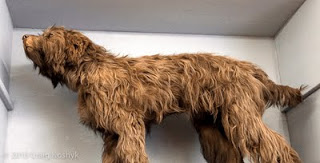
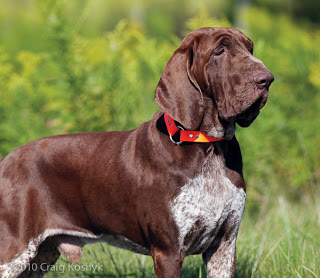
If one of the main functions of kennel clubs or registries is to preserve breeds of dogs, it is sadly ironic that the only thing left of the Boulet Griffon are the dusty remains of Marco, the first dog ever entered into the French stud book. His taxidermied body is stored, half-forgotten, at the Municipal Museum of Natural History in Elbeuf, France.
Marco, the first dog entered into the L.O.F (French Stud book)
Born into a wealthy family in 1840, Emmanuel Boulet founded a weaving business in Normandy. Like his contemporary, Eduard Korthals, Boulet had an enormous passion for outdoor sports and the breeding of gundogs. Unlike Korthals, he did not set out to create a new breed. Boulet wanted to save and improve upon an old breed that had almost disappeared, the Griffon d’arrêt Français à poil long (French Longhaired Pointing Griffon).

He started with several dogs purchased from a Mr. Govellain, who had kept a line of them for over 60 years. After a somewhat rocky start, Boulet eventually achieved a level of consistency in his dogs that was almost unheard of in the French pointing breeds. In terms of looks:

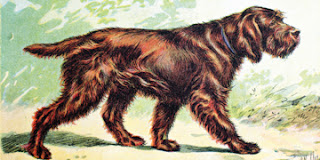
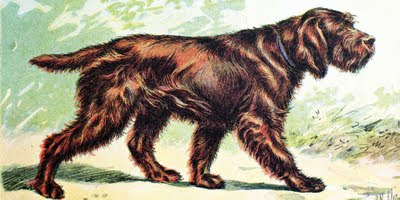
The Boulet Griffon has many of the same characteristics as the Korthals Griffon, the chief difference being that his coat is much longer and not so hard in texture. The coat is fairly long and semi-silky, without being glossy, flat rather than wavy, and never curly. Its color is that of a dead chestnut leaf or a dark coffee brown, with or without white; never black or yellow. (from The New Book of the Dog by Robert Leighton)

Illustration of Marco in better days
Boulet selected his dogs to be naturally close-working, but with excellent noses and a firm point. With help from his friend and professional trainer, Léon Verrier, his dogs became very successful in field trials and won countless awards in shows. The sporting press from the 1880s and ’90s, is filled with articles on the Boulet Griffon; lauding the master breeder’s genius and casting him as the saviour of the Continental pointing breeds. The publicity soon attracted the attention of some of the most powerful people in the world, including Nicholas, the Tsarevich (Grand Duke) of Russia, who traveled to Elbeuf while on a state visit to France just to meet Mr. Boulet and see his griffons. Even the president of France paid homage to the great breeder, presenting him with a national medal of honor for his work. Legend has it that in return, Boulet offered the president a sweater knit from the wool of his griffons.


Yet, despite the popularity of the Boulet Griffon and the fame and fortune of its founder, only a few short decades after Emmanuel Boulet died, the breed faded into oblivion. It is tempting to conclude that it was the founder’s death that led to the breed’s demise, but the truth of the matter is that Boulet himself abandoned it in 1890. In a letter published in the sporting press, Prince Albrecht of Solms-Braunfels tells us why.
It was also Mr. Boulet, who ranked as the top griffon breeder in France, who recently picked out three young dogs...in the Ipenwoud (Korthals’) Kennels. This gentleman stated to me that he now wanted to breed this line pure and not cross it with his line...because his dogs are too long- and soft-haired as a result of crossbreeding and he wants only prickly-haired dogs.
After Boulet’s death in 1897, a few breeders attempted to continue his work but were unable to prevent the Boulet Griffon from eventually disappearing just after the Second World War. For many years the FCI continued to publish its standard, but in 1984 the breed was finally removed from the list of recognized breeds and its standard dropped. Several years later, a Frenchman by the name of Philippe Seguela began a breeding program aimed at recreating the Boulet Griffon. He managed to produce dogs that were apparently quite close to the original in terms of looks and performance. Unfortunately, he abandoned the project in the early 1990s.

For more information on Emmanuel Boulet and his dogs see Ria Hörther's excellent article (in Dutch) from her website.

UPDATE HERE: http://pointingdogblog.blogspot.ca/2011/06/more-on-boulet-griffon_29.html

Read more about the breed, and all the other pointing breeds from Continental Europe, in my book Pointing Dogs, Volume One: The Continentals
http://www.dogwilling.ca/index.cfm

The Deutsch Drahthaar/German Wirehaired Pointer

Craig Koshyk


A good friend of mine was born and raised in New Zealand. 
He moved to Canada more than two decades ago to pursue his life’s passion—falconry. He had flown his birds of prey over Springer Spaniels and German Shorthaired Pointers in his homeland, but when he moved to Manitoba he decided to go with another breed. He wanted a sturdy pointing dog able to handle the tough cover and harsh climate of central Canada. After weighing the pros and cons of several breeds, he chose the German Wirehaired Pointer.

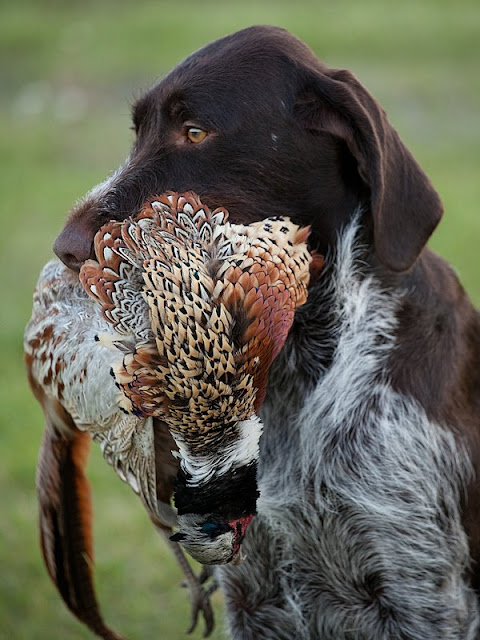
He acquired two males and hunted with them for several years. Then he decided to add a female to his kennel. I was there when she arrived by plane from Germany. Despite having spent over 14 hours in a crate, the minute that pup was let out she jumped into her new owner’s arms, licked his cheek and then ran to a small pond on the other side of the yard. When she got there, without any hesitation, she dove in and gave chase to a family of ducks.

She was just four months old.

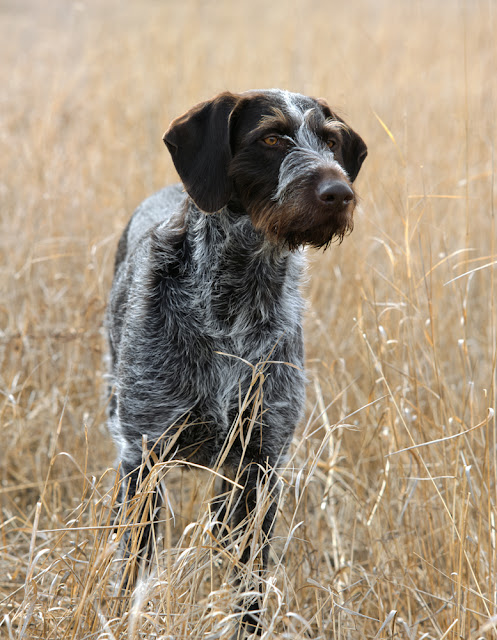
That young pup eventually grew up to be an absolutely superb gundog. That’s her in the photo above. To me, she will always represent the very essence of the German Wirehaired Pointer: a rough and tumble, intensely loyal, hard-working gundog. And the fact that a falconer from New Zealand living in Canada could get a pup from a breeder in Germany and have it start hunting the minute its feet hit the ground is testament to the incredible achievements of a small group of people who had the courage to follow a revolutionary idea nearly a century ago.

The story of the German Wirehaired Pointer begins around the turn of the 20th century as the early experimental period of dog breeding was coming to an end. By then, many breeds had been declared separate and distinct and their stud books closed to so-called foreign blood. Kennel clubs, registries and breeding associations were forming across Europe and breeders were lining up to earn blue ribbons in the show ring for “improving” their breed.

Increasingly, the trend among many breeders was to base their selection of breeding stock on two main criteria: appearance and pedigree. They believed that selecting the best looking animals and maintaining them within a closed registry was the most appropriate way to improve their dogs. But hunters soon discovered the fatal flaw in this way of thinking. They realized that selecting dogs based on appearance alone was futile. Unless a strict testing program was established to select dogs based on their inherited hunting abilities, there would be no way to make any progress. However, most breeders stopped short of actually challenging the closed stud book and the concept of pure breeding. They still believed that breeds should be kept separate and breeders should avoid “contaminating” their lines with outside blood.

The creators of the German Wirehaired Pointer held a different view. They believed that all rough-haired pointing breeds were members of the same family and that breeding among them should be allowed. They also believed they should be able to cross to an unrelated breed, the Deutsch Kurzhaar (German Shorthaired Pointer). Naturally, many members of the hunting dog establishment considered this attitude an affront to the sanctity of pure breeding. Yet, despite considerable risk to their reputations and fierce condemnation by their peers, supporters of the German Wirehaired Pointer stuck to their convictions.

Like other breeders of the time, they knew that the only way to breed better hunting dogs was to select breeding stock based on the dogs’ abilities, not their outward appearance. This is the essence of the famous saying “durch Leistung zum Typ”, which means “form follows function”. But unlike the others, these early visionaries went even further. They believed that everything follows function, even the most sacred tenant of them all: breed purity.

They argued that dividing the varieties of rough-haired dogs into supposedly pure, independent breeds was just “hair splitting”. They could see that it was leading to the splintering of forces at a time when everyone should be working together. So they decided to join forces and even came up with slogans to summarize their approach. They urged each other to “take the good where you find it” and to “breed as you like but be honest about it and let the results be your guide”. Even today, such ideas can cause a stir. But back then they must have seemed like heresy to members of the canine establishment.

In an effort to gain some insight into what it must have been like at the time, I asked a friend in Germany, Wilhelm Heinrich, a GWP owner with a keen interest in the history of the breed, to translate portions of club newsletters published by the Verein Deutsch Drahthaar and to offer me his thoughts 
on the early years of the breed. 
"When the VDD was founded, most of the members were renegades from the Pudelpointer club that was founded in 1897. The most important of them was Alexander Lauffs, the VDD president from 1902 to 1934. He was obviously an impressive personality and very influential in many aspects, particularly in the selection of his comrades-in-arms for his cause. Another important founding member, Mr. Berkhan, was also a Pudelpointer renegade. In 1927, when looking back on the wild days of breeding around 1900 and on the battles since then, he wrote in the Drahthaar club newsletter No.5, May, 1927:
I was still convinced that for breeding Pudelpointers I would 
need one Pointer and one Poodle. I finally succeeded in acquiring a splendid pair of Poodles. Even the renowned cynologist, 
Dr. Steffens-Lollar, agreed, upon presenting him my Poodle, Rappo, in the hunting field, that one would hardly find a better Poodle for breeding. Rappo was bred to some beautiful and talented purebred Pointer bitches. The offspring were, of course, not half bad, but not quite phenomenal. According to Oberländer and Hegewald, this crossing should have been superior to everything else bred at that time. So, was the conclusion, that for a good versatile dog the mixture of Poodle and Pointer alone was insufficient, not a natural one, and that a third blood, namely that of the Deutsch Kurzhaar [GSP] would be useful, if not essential for that purpose? I first spoke out about this opinion in [the sporting magazine] Hundezucht und Sport. I received countless approvals, eminent breeders such as Hass-Birkbusch and Lauffs-Unkel agreed, and from this idea the VDD was soon founded.”
In the early years, GWP breeders mainly used Stichelhaars and Pudelpointers in their programs. Griffons were also used, but less frequently. Soon crosses to German Shorthaired Pointers were undertaken, as well. This led to some difficulties in breeding a proper wire-haired coat, but rapid progress was made in terms of field ability. In 1904, perhaps reflecting the patriotism of the club members, the Verein Drahthaar (Wirehaired Club) was renamed Verein Deutsch Drahthaar (German Wirehaired Club). After all, Germany had developed its own long-haired pointer and its own short-haired pointer, so the VDD’s mission was to give Germany its own national wire-haired pointer. At first, the new club grew slowly. At the outbreak of the First World War in 1914, there were only a few dozen members and a total of 56 entries in the club’s stud book. After the war the club saw phenomenal growth. In 1921, the VDD passed the 1,000-member mark. By 1926, German Wirehaired Pointers had become so popular that they made up nearly half of all dogs in the German versatile dog registry. In 1928 the breed was finally recognized by the Delegate Commission and, by the middle of the 1930s, it had almost achieved the status of Germany’s national dog. In the difficult years that followed, the German Wirehaired Pointer, like all other German breeds, suffered tremendously. After the war, the breed stock was strongly diminished. For example, my mother gave away our dog in late 1945 because there was not enough food—they had not enough for my three little brothers. However, the first post-war meeting of the VDD took place in 1947. In 1949 Germany was divided, but the VDD still remained as one club because the borders were open. It is said that breeding during the first years after WWII was quite chaotic, and that they used almost everything that had a tail. In fact, Weimaraners were used, as well as German Longhaired Pointers and German Shorthaired Pointers. Breeders after WWII were also faced with a difficult problem. They were allowed to breed dogs, but they were not allowed to have guns. These regulations only remained in place for a few years in the West, but for over decade in the East. So in an East German hunting magazine from 1956 it was noted that the Eastern dogs were quite good, but that they were not used to the sound of gunfire!
The first Hegewald test after the war took place in 1949. Eighty-three German Wirehaired Pointers were entered. In 1954, 200 GWPs were nominated for the Hegewald in Giessen. The last Hegewald test with combined Western and Eastern groups was in 1959. After that, East German hunters were not allowed [by their government] to attend. In 1961 the wall was built, and because of the Cold War, all contact was cut. It was not reestablished until 1989. In 1992 the Eastern and Western clubs were reunited."
Only a few German Wirehaired Pointers were exported prior to the Second World War, but in the 1950s good numbers of them made their way to the US and other European countries. In 1959, the German Wirehaired Pointer Club of America was formed and the breed was recognized by the AKC. Through the 1960s and ‘70s, the breed’s popularity grew steadily in North America. In 1971, Group North America, a chapter of the German club, was formed in the US. Members of the club test and bred their dogs according to the regulations set out by the VDD, the parent club in Germany. In 1974 a similar group in Canada was formed but did not become an affiliated chapter of the VDD until 1984.

Today it is clear that the goals of the breed’s founders have been achieved and their approach to breeding, so hotly contested in the early years, completely validated. The GWP is among the most successful pointing breeds on the planet. Few can rival its versatility, none come close to its popularity in Germany, and it is gaining supporters around the world every year.


Read more about the breed, and all the other pointing breeds from Continental Europe, in my book Pointing Dogs, Volume One: The Continentals
http://www.dogwilling.ca/index.cfm