Contact Us

Use the form on the right to contact us. We should get back to you within 24 hours. If not, it means we are out chasing birds with dogs, shotguns and Canons. In that case we will get back to you as soon as we've finished the roasted Teal and Bordeaux . 


Form Block
This form needs a storage option. Double-click here to edit this form, and tell us where to save form submissions in the Storage tab. Learn more
         

123 Street Avenue, City Town, 99999

(123) 555-6789

email@address.com


You can set your address, phone number, email and site description in the settings tab.
Link to read me page with more information.

Pointing Dog Blog

The world of pointing dogs in words and images, moving and still.

What the Readers are Saying

Craig Koshyk

Over the last three weeks, I have been busy sending books to addresses as far away as the Ukraine, Finland and New Zealand. Of course most of the orders have been from a bit closer to home, but every day I get a few emails letting me know that they have arrived (mainly) safe and sound. 

Some of the purchasers have also been kind enough to send me their feedback on the book and/or post a review to a forum, blog or newsletter. So at the risk of sounding like a proud father bragging about his kid, bear with me as I post some of the comments I've received so far. 

I was counting the years, then the months, then the weeks for the publishing of this book, but it was worth the wait. I don't think there is any similarly thorough, well-put together, high quality book about the pointing dogs anywhere in the World. Not only the fantastic pictures, but also the very profound content makes the book a precious piece for everyone who is interested in hunting dogs. Not one breed of the Continental Pointing Dogs is left out of the book, breeds I have never seen and never heard of, and the topics and breed's comparisons in their work style, what each chapter covers give a great overview for the reader.  This is THE BOOK about the Continental Pointing Dogs - Zsófia Miczek, Hungary

"Well, THE BOOK arrived today.  It is stunningly beautiful, thoughtfully created, and overwhelming in its scope.  I really cannot imagine how you ever managed such a huge project.  It must have felt as if sometimes this book took over your lives.  Lisa and you must be made of stern stuff to have made it through.  We are very honoured to have been included in your stupendous book.  Bless you and thank you. - Al and Nell McKim, Canada 
"It is hard to know where to start, when attempting some sort of review. In short, this book is a staggering opus.  It features all the HPRs I've ever heard of, and then a whole lot more besides, along with comprehensive sections on the History, Form and Function of each breed.  (Caution:  This book is dangerous.  You will find yourself making a shopping list.  Personally, I am now coveting the Braque du Bourbonnais.  It has a natural bob-tail, did you know?)

The photos are stunning and effortlessly capture the beauty of the dogs in the field.  There are many whole-page photos of dogs, and I found myself wanting even more, and wanting the smaller photos BIG.  I wanted huge *posters* of these photos, they were so stunning.  Realistically, though, I think the photos couldn't be any bigger without something having to go, in this 364 page book.  It must have been very difficult for Craig to choose which photos to use and which not to include; which photos would go full-page and which would have to stay smaller.  (Writers call this 'killing your babies'.  Craig must have killed many.  I feel for him.)

I have only read the Weim and the SRHP sections thoroughly, so far, but have dipped in and out of many others and I look forward to reading more.  I've already learnt things I didn't know:  I had no idea Weims were listed in the German GSP stud book until the 1920s and were considered a grey variant of the GSP!  I'm no expert myself, but I have no doubt that even the most experienced owner of their breed will learn something new from this book.  

The quality of the book is top-notch:  The hardback is thick and heavy, the pages are dense and creamy and (very important to me, this one) it has that 'new book' smell!  The book is (probably must be, to cover costs) pricey.  However, when you think that it costs about the same as a tank of petrol and a couple of entries in a field event, it's a worthy investment.

In the book, Craig often refers to people who have done a great service for their breed by, say, bringing it back from near-extinction or promoting working abilities.  I think it's clear to anyone with their hands on this epic that Craig, himself, has done a great service for all these breeds through creating something which is such a breathtaking tribute to the dogs we all live with, and love.  -
Joanna Laurens, UK

It is  a fabulous book – congratulations! I think you did an excellent job on the history, and you're right most people get it wrong.  I said to Sheila, Craig did a great job.  He sticks his neck out here and there and I’ve yet to find a time when it could be chopped off! - Joe Schmutz, Canada

I received the books today!  Wow, I am in awe   Of course I went to the Weim pages first, but enjoyed randomly flipping around and reading about breeds I'd never heard of before.  It will sit proudly on my book shelf! -Anne Taguchi, USA

There are more messages like this, but I won't post them just yet. I need to find a good contractor to widen the doorways in my home. My head is too swollen to fit through them!
Breed of the Week: The Stichelhaar

Craig Koshyk


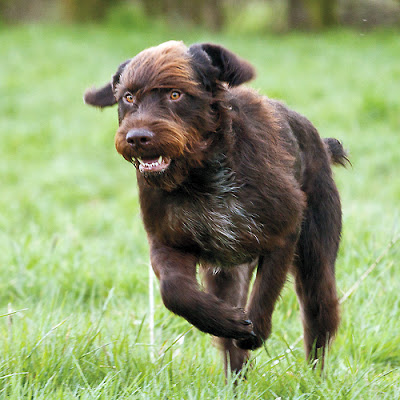
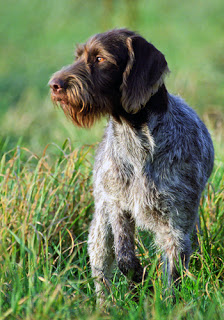
Developed in the mid to late 1800s, the Deutsch Stichelhaar also known as the German Rough-haired (or Broken-Coated) Pointer, is best known as one of the four key ingredients in the make-up of the Deutsch Drahthaar (German Wirehaired Pointer).  But that is about all many know about the breed, if that. I am sure that the vast majority of hunters and gundog enthusiasts have never even heard of the Stichelhaar.

Here's an excerpt from the breed chapter in Pointing Dogs, Volume One.
When I first started to photograph dogs and compile notes for this book, I chose to study the better known breeds since it was much easier to find information on them. And, besides, I knew where to find hunters who owned some. But when I started looking into the more obscure breeds, things got a bit trickier. Not only was solid information harder to find, but tracking down owners or breeders of some breeds proved to be difficult. In the case of the Stichelhaar, not only did it take some digging, I also needed a bit of luck to finally see one in the flesh.
At some point in every book or article explaining how the German Wirehaired Pointer was developed, a breed known as the Stichelhaar is mentioned. Some GWP histories even provide a brief description of the Stichelhaar’s appearance or hunting ability, but most don’t even offer that. In fact, I’ve even read that the Stichelhaar was extinct. So I had a heck of a time finding information on the breed and could not even confirm that is was still around. The only illustrations I could find were old paintings or fuzzy black and white photographs in long out of print magazines and books. After a while, I started to think that maybe the Stichelhaar really was extinct.  
Then, in 2001, I attended a hunt in northern Germany organized by Hans Schmidt, a renowned breeder of long-haired Weimaraners. While there, I asked him if he knew anything about the Stichelhaar. Expecting him to tell me that the breed was extinct, I was stunned when he replied, “Oh, yes, there are a number of them in the area. I see them sometimes when I am out hunting. They are strong hunting dogs—a very old breed you know.” He then told me that a Stichelhaar breeder lived not too far away from him and suggested that we call him to arrange a meeting! Twenty-four hours later, I was at the home of Elso Kratzenberg, the secretary of the Deutsch Stichelhaar Verein.
Standing in Herr Kratzenberg’s driveway, we exchanged handshakes and introductions and took a few minutes to discuss the kinds of photos I wanted to take. Once we had agreed on a plan, he let his dogs out of the house and into the yard. As the two big, rough-and-ready dogs came bounding up toward us, I couldn’t help feeling like the scientist in Jurassic Park when he laid eyes on a real-life dinosaur. Finally, right there in front of me, were living, breathing, tail-wagging Stichelhaars, a breed I thought had gone the way of the dodo bird. 

Nowadays, thanks to the internet, there is a lot more information about the Stichelhaar available. Even the German breed club has a website. Nevertheless, the breed still is and always has been a marginal player on the German gundog scene. For most of its history is has been barely hanging on.  Here's another except:
I have only seen a few Stichelhaars, all in northern Germany. I have spoken to a couple of owners/breeders including the secretary of the original club. I’ve read a few copies of the club’s newsletter and have followed the ups and downs of the breed via German websites and forums. I am far from an expert, but I certainly know more about the breed now than when I first read that it was extinct. The first time I photographed Stichelhaars, I got the impression that they were more like Griffons than German Wirehaired Pointers. They seemed fairly laid-back and easygoing. Their coats seemed longer and harsher than many of the GWP coats I’ve seen, but not as bushy as the coats on some Griffons. In the field they showed a lot of drive, ran at a medium gallop and pointed staunchly. In the water, they swam like otters 
A few years after I had seen Stichelhaars for the first time, I photographed a number of Cesky Fouseks in the Czech Republic. After the photo session and interviews with Cesky Fousek owners and breeders, I compared the photos and written notes I made about the Fousek to the ones I had made of the Stichelhaar. The similarities were striking. I concluded that the two breeds do indeed represent a sort of “same church, different pew” situation. In terms of look and performance they are, for all intents and purposes, identical. The divisions between them are merely political. 
Unfortunately for the Stichelhaar, it is club politics that now threaten its survival. Infighting among club members and the struggle for control of the Stichelhaar’s future is coming dangerously close to killing the breed. From what I have seen in the field, forest and water, it would be a crying shame if the breed ended up going the way of the dodo. I sincerely hope that cool heads and reason will prevail.


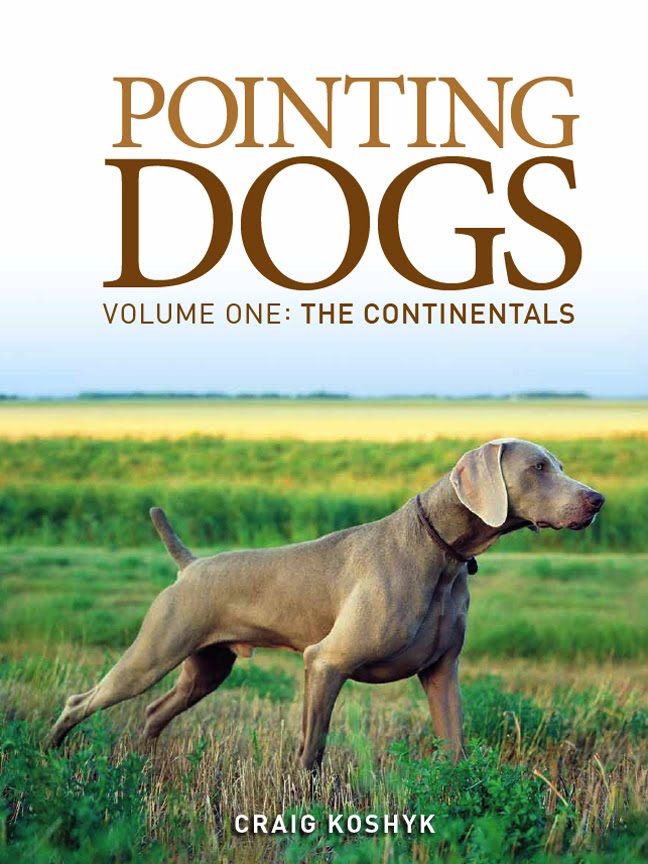
Read more about the breed, and all the other pointing breeds from Continental Europe, in my book Pointing Dogs, Volume One: The Continentals
http://www.dogwilling.ca/index.cfm
 

The Pudelpointer

Craig Koshyk


If you made a list of the pro's and con's of this week's breed of the week, the list of pro's would be very long indeed. And the list of con's might only have one thing on it: the breed's name. 

Ask just about any Pudelpointer owner or breeder and they will tell you that having to explain the name of their breed gets old real fast. What drives them round the bend quickest is that fact that so many people, when they first hear the name, assume that the breed is some sort of modern designer dog like the Labradoodle or Puggle*. And unless they have the time to sit through a half hour power-point presentation on the history of dog breeding in Germany circa 1885 it is really hard to explain in a few sentences. I do my best to explain the name in the Pudelpointer chapter of my book and I also dig pretty deep into the history of the breed, in particular into the kinds of dogs that gave the breed the first part of its name, the so-called "Pudels."

Here is an excerpt from the history section:

In the late 1800s, English Pointers were enjoying great popularity across Europe and were well regarded for their tremendous speed and passion in the field. But what were the Pudels, Königspudels and Polish Waterdogs that Hegewald wrote about? Today, no one seems to know much about them. But in Hegewald’s time, everyone knew what they were. In fact, as far back as 1621, Englishman Gervase Markham wrote that:
The water dog is a creature of such general use…that it is needless to make any large description of him…since not any among us is so simple that he cannot say when he sees him: “This is a water dog.”
Fortunately, Markham then goes on to actually describe the water dog, saying that it:
...may be of any color and yet excellent, and his hair in general would be long and curled, not loose and shaggy; for the first shows hardness and ability to endure the water, the other much tenderness and weakness, making his sport grievous. His head would be round and curled, his ears broad and hanging, his eye full, lively and quick, his nose very short, his lip hound-like, side and rough-bearded, his chops with a full set of strong teeth, and the general features of his whole countenance being united together would be as lion-like as might be, for that shows fierceness and goodness…
The dogs Markham describes were probably the descendants of herding dogs that had long, thick coats to protect them from the elements and the strength and agility to work in the toughest conditions, including cold water. Everywhere they were found, they were crossed with other breeds, some of them short-haired. Hans Friedrich von Fleming gives us further details in the 1719 book Der Vollkommene Teutsche Jäger (The Complete German Hunter).
The shepherds have small or medium driving dogs, which have shaggy hair. Such Budels are now covered with a Hound, so the offspring fall with long ears and shaggy hair. In order that they swim better their thick hair is taken off, a good beard and eyebrows remain, and the tail is docked. Because of their beard, the French call them Barbet. These water dogs from the gray color of the Shepherd and the red hair of the Hound are mostly brown, though often white with brown spots, or even black. They are brisk and faithful, they hunt gladly, and they like by nature to swim. They retrieve well in reeds and fast rivers. They also hunt out foxes, otters, and wild cats from the reeds. Such a water dog is of great service to the fowler.
Rough-coated water dogs went by different names in different regions. They were often said to come from Russia, Poland or Bohemia. In all likelihood, they didn’t develop in just one region since they were found across much of the continent. The names they were given were probably based more on stereotypes than the dogs’ actual origins. Jean Castaing suggests that the English called them Russian for the same reason the Germans called them Polish; because they had a rough, unkempt appearance that was considered typical of Eastern European people at the time.

Here is an excerpt from the "my view" section of the chapter:

Compared to many other breeds of gundogs, Pudelpointers are rare. Yet Lisa and I have seen them in Germany, France, Slovakia, the Czech Republic, the US and Canada. We’ve even hunted over a few right here in our home province of Manitoba.

Our frequent contacts with the breed are due to the fact that when we travel to photograph dogs or to hunt, we tend to meet people that are just as passionate about hunting as we are. Since the breed is and always has been in the hands of hunters, it stands to reason that we would come across more Pudelpointers in a couple of seasons than the average dog walker at a local park would see in a lifetime.

I’ve seen North American-bred and German Pudelpointers. I’ve run my dogs in fun trials and training sessions with an excellent Pudelpointer owned by one of the guys in our local pointing dog club. And I remember a fantastic photo shoot in Ontario with Pudelpointers that hit the water like Labs. In all of these encounters, I never felt the least bit intimidated by any of the dogs. Every Pudelpointer I have ever met has been an easygoing, friendly dog whether it was in the house, in a camper or staked out beside a truck. In the field, they all hunted hard. Sure, some were faster and bigger-running than others. Some were also better looking than others—I can confirm the variation in coat quality in the breed—but not a single one of them left me with any doubt about their hunting desire.

For me, the bottom line on Pudelpointers is this: they are the real deal; they are dynamic hunting dogs bred by and for hard-core hunters.


* I can understand why Pudelpointer owners bristle. Labradoodles are now everyone's punching bag for what is wrong with the "designer dog" breeds. But there are some valid parallels to be made between the two. First of all, both started off as a brilliant idea, supported by men of vision who were seeking to created something greater than the sum of its parts. Of course we can now say that Pudelpointer succeeded and that the Labradoodle did not. Even the man who did the first crosses of Labs and Poodles eventually disowned the Labradoodle "breed" due to all the hucksters who jumped on the bandwagon. Secondly, both breeds are a combination of a smooth haired breed and a curly haired breed and generally produce wirehaired pups. And finally, both breeds' names are a combination of the names of the two breeds that they were created from.

The story of the Labradoodle is actually quite tragic. What started out as a good idea (hypoallergenic guide dogs for the blind) ended up being a victim of a modern dog breeding culture dominated by money, greed and ego. The Pudelpointer on the other hand was developed during the golden age of dog breed creation, when there was still a sense of honor and purpose among many of the leading dog breeders.


Read more about the breed, and all the other pointing breeds from Continental Europe, in my book Pointing Dogs, Volume One: The Continentals
http://www.dogwilling.ca/index.cfm

The Drentsche Patrijshond a.k.a Dutch Partridge Dog

Craig Koshyk

That, my friends is a nice looking dog. And I can tell you that he is a heck of a  good hunter too!

Barak (yes, that's his name) is a Drentsche Patrijshond. He is Dutch born and bred and spends most of his time in the Netherlands chasing the surprisingly abundant game birds there. But I've actually seen Barak do his thing in France and in Canada as well as in his native land. And one day in particular really stands out in my memory.

We were hunting grouse and snipe in the Interlake area of Manitoba with Barak's people, Roel and Marjolein. I had my Pont-Audemer Spaniel Uma with me and Marjolein was handling Barak. As we made our way through a "bluff" of poplar trees, Barak slammed on point about 30 yards in front. Marjolein was about 40 yards to his right and began to move in. I heard Uma's bell coming towards me from the left. As she ran past she saw Barak and slammed into a back. 

So there I was, rare French gun (a Darne) in hand, walking up to a rare Dutch breed of pointing dog that was being backed by an even rarer French breed of pointing dog.  And to top it all off, instead of sharing the scene with one of my rough-around-the-edges hunting buddies and his beat up pump gun, my partner on the shoot that day was a beautiful Dutch woman carrying a fine over and under shotgun!

Like the English, Dutch hunters train their pointing dogs to flush on command and then stop for the shot. So when she got to within about 10 meters of Barak, Marjolein said something in Dutch that probably meant "get em up boy!"  Instantly Barak made a bold charge toward the grouse and slammed on the breaks at the flush. The bird got up at the edge of the bluff and flew into a large open meadow offering me a perfect right to left crossing shot. I fired. It dropped. Marjolein yelled whatever the Dutch equivalent is for "Good Shot!" and Barak made the retrieve. 

As he came towards us with the grouse,  I realized that Mar and I had just witnessed something that no other hunter on earth has before or since: a Drentsche Patrisjond, backed by an Épagneul de Pont-Audemer pointing a ruffed grouse for a lovely Dutch woman and a curious Canadian fellow who really wanted a grouse for diner.  

For more information on the Drentsche Patrijshond, check out the chapter on the breed in my new book or visit the website of the Drentsche Patrijshond Club of North America


Read more about the breed, and all the other pointing breeds from Continental Europe, in my book Pointing Dogs, Volume One: The Continentals
http://www.dogwilling.ca/index.cfm


The Drentsche Patrijshond a.k.a Dutch Partridge Dog

Craig Koshyk

That, my friends is a nice looking dog. And I can tell you that he is a heck of a  good hunter too!

Barak (yes, that's his name) is a Drentsche Patrijshond. He is Dutch born and bred and spends most of his time in the Netherlands chasing the surprisingly abundant game birds there. But I've actually seen Barak do his thing in France and in Canada as well as in his native land. And one day in particular really stands out in my memory.

We were hunting grouse and snipe in the Interlake area of Manitoba with Barak's people, Roel and Marjolein. I had my Pont-Audemer Spaniel Uma with me and Marjolein was handling Barak. As we made our way through a "bluff" of poplar trees, Barak slammed on point about 30 yards in front. Marjolein was about 40 yards to his right and began to move in. I heard Uma's bell coming towards me from the left. As she ran past she saw Barak and slammed into a back. 

So there I was, rare French gun (a Darne) in hand, walking up to a rare Dutch breed of pointing dog that was being backed by an even rarer French breed of pointing dog.  And to top it all off, instead of sharing the scene with one of my rough-around-the-edges hunting buddies and his beat up pump gun, my partner on the shoot that day was a beautiful Dutch woman carrying a fine over and under shotgun!

Like the English, Dutch hunters train their pointing dogs to flush on command and then stop for the shot. So when she got to within about 10 meters of Barak, Marjolein said something in Dutch that probably meant "get em up boy!"  Instantly Barak made a bold charge toward the grouse and slammed on the breaks at the flush. The bird got up at the edge of the bluff and flew into a large open meadow offering me a perfect right to left crossing shot. I fired. It dropped. Marjolein yelled whatever the Dutch equivalent is for "Good Shot!" and Barak made the retrieve. 

As he came towards us with the grouse,  I realized that Mar and I had just witnessed something that no other hunter on earth has before or since: a Drentsche Patrisjond, backed by an Épagneul de Pont-Audemer pointing a ruffed grouse for a lovely Dutch woman and a curious Canadian fellow who really wanted a grouse for diner.  

For more information on the Drentsche Patrijshond, check out the chapter on the breed in my new book or visit the website of the Drentsche Patrijshond Club of North America


Read more about the breed, and all the other pointing breeds from Continental Europe, in my book Pointing Dogs, Volume One: The Continentals
http://www.dogwilling.ca/index.cfm

Dog Breeds. What are they good for? Part 2.

Craig Koshyk

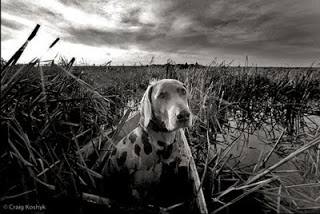
Félix wearing a camo neoprene vest in the Libau Marsh
If, as we've seen in part 1, dog breeds are nothing more than wobbly man-made creations, the question is: should we even have breeds?

For me, the answer is yes. But it is not because I think closed stud books and "pure" breeds are in and of themselves, good ideas, but because they are, for all their faults and frailties, all we have to work with.

We've learned to live with the quirky system that created our breeds in the past and maintains them now. For better or worse, breeds have become a part of our sporting heritage and represent personal, regional and national identities within the overall community of hunters and well beyond.

Breeds are not very practical entities, they are forever fighting against their very being and would disappear within a couple generations if we let them go. But they do provide a certain level of predictability (Labs produce litters of Lab puppies) and can be easy to understand (Pointers point, Springers spring etc.).

In fact, having breeds is actually a good idea...on paper. They are like having different brands of a consumer item, different flavors of ice cream as it were. But the way they are created, developed and maintained is inherently flawed. It is based on a bizarre mix of "blue blood" myth, magical thinking and misunderstood Darwinism. Instead of improving breeds, our systems actually sacrifices real progress on the alter of breed purity.

The sled dog concept on the other hand is a far less dogmatic and more pragmatic approach to breeding the better canine mousetrap (for whatever purpose). It removes the burden of the closed stub book and allows breeders to focus on one goal only: create a better dog. Period. I wonder what would happen in pointing dog field trials and tests if the organizers opened up a category for "mixed" breeds. If breeders were allowed to breed to whatever they want and run their dogs against all others. My guess is that give enough resources, really smart, driven, dedicated breeders would come up with some fantastic dogs.

We tend to view the creators of our current breeds as brilliant men from a bygone era...and they were. But they were not supermen and most of them had the equivalent of about a 6th grade education and were completely in the dark regarding the science of genetics. Give the brilliant men and women of today the same freedom and resources as Korthals had in his day (imagine a genius level breeder working for Bill Gates) and what do you think we would get?

I think we would end up with a situation similar to what we already have, minus all the hand wringing about keeping breeds pure and all the fuss about DNA testing etc. There would be a type of dog that looks remarkably like the Pointer kicking ass in all age field trials, a dog that looks remarkably like the Lab dominating retriever trials and a bunch of wiry beasts with beards and moustaches along with GSP looking dogs at the top of the NAVHDA heap.

Because at the end of the day, the top performing breeds in the world today are those that have allowed a certain amount of wiggle room when it comes to being a pure breed. Their creators from the past and the people who breed them now focus (mainly) on one goal: creating a better dog....meanwhile all the others are still running around in circles, chasing their Victorian age shadows.