Contact Us

Use the form on the right to contact us. We should get back to you within 24 hours. If not, it means we are out chasing birds with dogs, shotguns and Canons. In that case we will get back to you as soon as we've finished the roasted Teal and Bordeaux . 


Form Block
This form needs a storage option. Double-click here to edit this form, and tell us where to save form submissions in the Storage tab. Learn more
         

123 Street Avenue, City Town, 99999

(123) 555-6789

email@address.com


You can set your address, phone number, email and site description in the settings tab.
Link to read me page with more information.

Pointing Dog Blog

The world of pointing dogs in words and images, moving and still.

The Pont Audemer Spaniel

Craig Koshyk
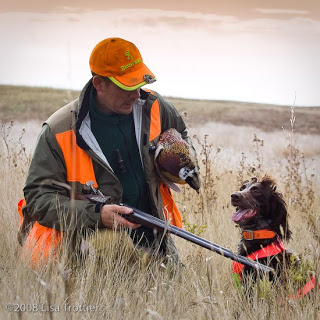
Me and Uma the Ponto with a Dakota rooster
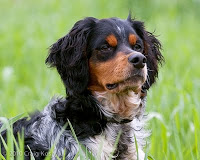
Last week's B.A.W. was the Brittany, one of the most popular gundog breeds in the world. This week we'll have a look at its cousin from Normandy, the almost completely unknown, curly-haired "clown of the marsh" named the Pont-Audemer Spaniel.

The 'Ponto' as it is affectionately called, is one of several Épagneul (pointing spaniel) breeds from France. It is named after the small city of Pont-Audemer, in Normandy. The breed was once relatively common in north-western France, but time, fashion and two world wars took their toll. Today, the Ponto is just hanging on with an average of only 30 to 50 pups born per year in the whole world! 

As far as I know there are only 3 Pontos in North America, all of them in Canada. Two live here in Winnipeg and one in Ontario.  In France there are only about half a dozen breeders and because there are so few Pontos around, the breed doesn't have its own club but is part of a club that represents three breeds, the club de l' Épagneul Picard , du Bleu de Picardie et du Pont Audemer.

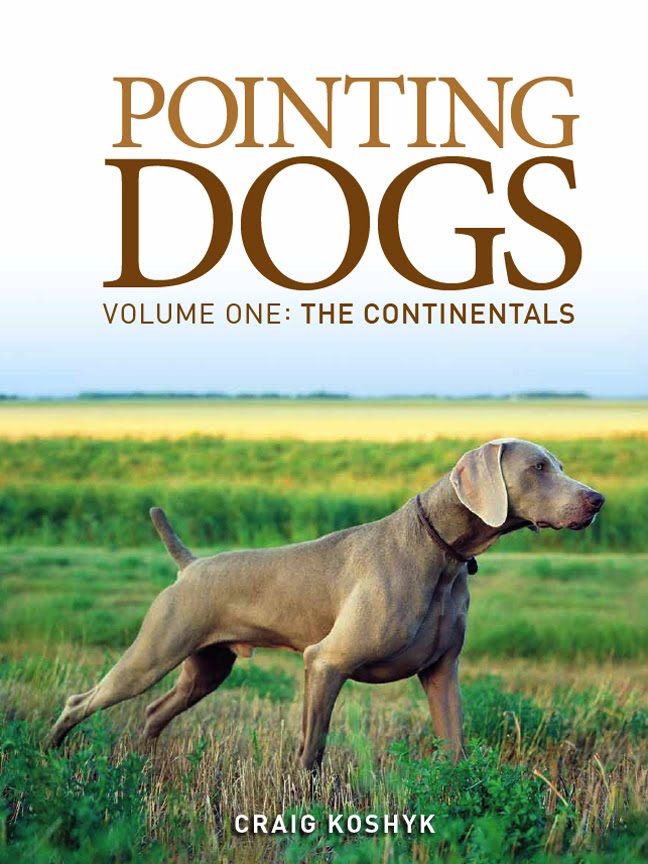
The preview of the book that I now have on-line includes the entire Ponto chapter. It has a ton of information on the breed and features photos of my wife's dog Uma, Uma's cousin Vinnie and various aunts and uncles from France. You can click on the book below to flip the pages or to enlarge it for easier reading on screen.

Enjoy!


Read more about the breed, and all the other pointing breeds from Continental Europe, in my book Pointing Dogs, Volume One: The Continentals
http://www.dogwilling.ca/index.cfm

Dog breeds. What are they good for? Part 1.

Craig Koshyk

Recently someone asked me about dog breeds. Specifically, how and why the various breeds were created in the first place? and why do we still have them now? Here are my thoughts:

The concept of a breed of animal or plant is relatively new, only taking hold about a 150 years ago at a time when people were moving away from the idea that everything was controlled by the all-knowing sky wizard and towards the notion that through science (or at least science-y sounding systems) man could control nature and mold it to his tastes. The "sport" of pure breeding dogs came about when social, political, and scientific forces such as Darwinism (and its twisted off-shoot Eugenics) and the Victorian mania for classifying everything from insects to elements all sort of lined up.

Soon, all kinds of "pure" dog breeds were created synthetically by mixing general types of dogs or, in some cases, by distilling naturally occurring land races that had been around for centuries. Studbooks were opened for them, then slammed shut as soon as enough fathers were bred to their daughters and mothers to their sons. Next, the breed's back stories were written and greatly embellished or even pulled out of thin air.

And for a while it worked! Breeds flourished and seemed to pop up everywhere. They were declared independent and separate from the others over the flimsiest of excuses...a different shade of coat colour, a few centimeters of size, being on the wrong side (or right side depending on where you were) of some political border or river or mountain range. In fact, the divisions between breeds are the most artificial aspect of the entire system. They exist only in the overheated imaginations of breed supporters. Skin all the pointing breeds out for example, ignore a few inches of height and some aspects of head shape and they are all pretty much interchangeable.

But here we are in 2011, and we know all about the dangers of closed studbooks and the risks of shallow gene pools and breeds kept so "pure" that all the members are nearly clones of each other...and suffering terrible disease as a result.  So why do will still have "pure" breeds and why do we spend so much time, energy and money keeping the artificial divisions between them intact?

Because their very existence depends on people being people...sentimental, superstitious, silly, not nearly as bright as we think we are... people.

Dogs exist to please us and somehow we find pleasure in having so many different breeds. Somehow, knowing that on many levels it makes zero sense to keep breeds "pure", we recoil from the thought of "polluting" our breed with the unclean blood of another. Dog breeds still exist because we've all bought into an outdated, disproved Victorian fantasy about pureness of blood, royal families, breed improvement and social climbing. Basically, our forefathers brewed a batch of kool-aid and we are still eagerly sipping on it. 

Yet some people have managed to see past the smoke and mirrors. But they are not running pointing dogs. They are running "mutts" in the Iditarod. And their dogs would run circles around ours.

Continue reading in Part 2: Should we maintain the "pure" breeds or just mix them all up?

Dog breeds. What are they good for? Part 1.

Craig Koshyk

Recently someone asked me about dog breeds. Specifically, how and why the various breeds were created in the first place? and why do we still have them now? Here are my thoughts:

The concept of a breed of animal or plant is relatively new, only taking hold about a 150 years ago at a time when people were moving away from the idea that everything was controlled by the all-knowing sky wizard and towards the notion that through science (or at least science-y sounding systems) man could control nature and mold it to his tastes. The "sport" of pure breeding dogs came about when social, political, and scientific forces such as Darwinism (and its twisted off-shoot Eugenics) and the Victorian mania for classifying everything from insects to elements all sort of lined up.

Soon, all kinds of "pure" dog breeds were created synthetically by mixing general types of dogs or, in some cases, by distilling naturally occurring land races that had been around for centuries. Studbooks were opened for them, then slammed shut as soon as enough fathers were bred to their daughters and mothers to their sons. Next, the breed's back stories were written and greatly embellished or even pulled out of thin air.

And for a while it worked! Breeds flourished and seemed to pop up everywhere. They were declared independent and separate from the others over the flimsiest of excuses...a different shade of coat colour, a few centimeters of size, being on the wrong side (or right side depending on where you were) of some political border or river or mountain range. In fact, the divisions between breeds are the most artificial aspect of the entire system. They exist only in the overheated imaginations of breed supporters. Skin all the pointing breeds out for example, ignore a few inches of height and some aspects of head shape and they are all pretty much interchangeable.

But here we are in 2011, and we know all about the dangers of closed studbooks and the risks of shallow gene pools and breeds kept so "pure" that all the members are nearly clones of each other...and suffering terrible disease as a result.  So why do will still have "pure" breeds and why do we spend so much time, energy and money keeping the artificial divisions between them intact?

Because their very existence depends on people being people...sentimental, superstitious, silly, not nearly as bright as we think we are... people.

Dogs exist to please us and somehow we find pleasure in having so many different breeds. Somehow, knowing that on many levels it makes zero sense to keep breeds "pure", we recoil from the thought of "polluting" our breed with the unclean blood of another. Dog breeds still exist because we've all bought into an outdated, disproved Victorian fantasy about pureness of blood, royal families, breed improvement and social climbing. Basically, our forefathers brewed a batch of kool-aid and we are still eagerly sipping on it. 

Yet some people have managed to see past the smoke and mirrors. But they are not running pointing dogs. They are running "mutts" in the Iditarod. And their dogs would run circles around ours.

Continue reading in Part 2: Should we maintain the "pure" breeds or just mix them all up?

B.A.W. (Breed a Week)

Craig Koshyk


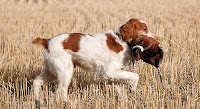
My new book covers over 50 different breeds of pointing dogs from Continental Europe. I'd like to share some of the things I've learned about each one of them and post a selection of photos for readers to enjoy so I've decided to post a BAW (breed a week) feature article every Monday for the next 52 weeks. Let's start with one of the most popular pointing breeds on the planet, the Britanny or, as it is known in its native France, l'Épagneul Breton.

In the introduction section of the Brittany chapter I wrote:
Sooner or later, if you hunt the prairies long enough, in a truck that’s old enough, you’ll get stuck the middle of nowhere. It happened to me, 
last year. After chasing sharptails most of the day under an early-season sun that should have kept me under a shade tree, I found myself in a lifeless pickup truck at the end of a dusty trail in southern Saskatchewan.

My GPS unit showed that the nearest service station was a two-hour hike down the gravel road. With the hot sun sinking near the horizon, I had no choice; I started hiking. After about 20 minutes I heard a vehicle coming up the road from behind. I flagged it down. A friendly farmer—there’s no such thing as an unfriendly farmer in Saskatchewan—leaned out the window.

“Lost?”

“No, my truck won’t start. I think its the alternator.”

“Hop in, I’m on my way to town. Garage is open till 8.”

I climbed into the cab and shared the seat with a white and orange dog wagging a stubby tail. I almost said, “Hey, an Épagneul Breton!” But I remembered that out there on the prairies that’s not the name they go by.

“Nice Brittany,” I said.

“Thanks, he’s getting old. But he still loves to hunt”.

On our way into town the old Brittany held its head in the slipstream and lapped at the wind. I’m sure he was prairie-bred; probably from prairie-bred parents. But I knew his heritage ultimately traced back to little dogs from western France that went on to conquer the hearts of hunters around the world.


Like many of the pointing breeds, the Brittany has a fascinating history. But finding information from the time before the breed was officially recognized in the early 1900s is not easy. Curiously, I've found that there is actually more information available in English than in French about the kinds of pointing dogs that existed in Brittany  in the 19th century. Here are some excerpts from the history section of the Brittany chapter:

Geographically, La Bretagne (“Brittany” in English), is a peninsula in the far west corner of the French hexagon. Culturally, its people have always felt somewhat separate from the rest of the country. Their traditional language, Breton, is not a French dialect, but a Celtic language related to Welsh and Cornish. In fact, until the turn of the 20th century, much of Brittany’s population did not even speak, read or write French. So it is not surprising that very few French texts make any mention of what kind of dogs there were in Brittany before 1900. Fortunately, many of the British sportsmen who travelled to the region in the 1800s wrote articles and published books about their adventures. Recently, many of the old publications have been made available on the internet. Reading through them today, a fascinating picture emerges of what the dogs in Brittany were like in the mid-1800s.

One of the most detailed accounts is from a book titled The Wanderer in Western France written in 1863 by George T. Lowth. In it, Lowth describes short- and long-haired pointing dogs that were “found everywhere” in Brittany:  
There is also a breed of setters, quite equal to any in England, and, in fact, not to be distinguished from them. These animals are claimed in Brittany as a native breed, but one cannot help suspecting that it owes its origin, not very many years since, to some of our emigrant countrymen, settled, since the war, in various parts of that country—so tempting to them from its moderate cost of living, and its many advantages in sporting—two irresistible attractions.
English sportsman John Kemp also wrote about his hunting adventures in Brittany and said that it was common practice to cross spaniels and setters. 
I have put a spaniel to a well-bred setter bitch, and been lucky enough to combine the ranging qualities of the latter and the hunting perseverance of the former. The French have tried this cross very frequently. I lately purchased one of the produce; and I can say that few dogs perform better in the field than this one

Another classic book from the same era is Wolf Hunting and Wild Sport in Brittany, written in 1875 by Edward William Lewis Davies who lived in Brittany for two years in the 1850s. He mentions seeing all kinds of dogs: Harriers, Poodles, double-nosed Spanish Pointers, and “mongrels of the lowest type”. He also wrote about a “Brittany Pointer”. This has been interpreted by some as the first mention of the Brittany Spaniel in English. But there are other, earlier descriptions such as the one above, and it is clear that the Brittany Pointer described by Davies had a short coat: 
They certainly are not so fine in the skin as the Spanish or English pointers; but, although they do not carry long-haired jackets and feathered stems like setters or spaniels, their coats are thick and close set, and well-adapted to the rough country in which they do their work.
However, Davies does write about local hunters cropping the tails of their dogs. Could some of the dogs been naturally short-tailed, a defining characteristic of the first Brittanies? 
There is a sad disfigurement practiced on Brittany Pointers...the tail, that indicator of all a dog’s thoughts, that silent tongue that explains all he means, is chopped off in puppyhood by the braconniers (poachers). Yet the poor uneducated peasant of Lower Brittany, the braconnier who gets his livelihood by the chase, shooting partout (everywhere), breaks a pointer for his own use immeasurably superior in many respects to the highly-trained dogs so often met with in our turnip fields and grouse moors. ...he will, as already stated, face the thorniest brake, never rake in drawing for his birds, and, above all, will retrieve his wounded game by land or water perfectly.
Today, the Brittany is known the world over for its "maximum qualities in a minimum volume" and has become the poster-child for the French approach to breeding gundogs.


Read more about the breed, and all the other pointing breeds from Continental Europe, in my book Pointing Dogs, Volume One: The Continentals
http://www.dogwilling.ca/index.cfm

Welcome to the Pointing Dog Blog!

Craig Koshyk

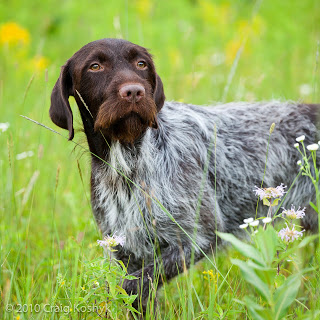
This is Jack, a dog I kept calling "Jacques" due to his French heritage. He is from Aspen Glo Kennel and one of the best looking Wirehaired Pointing Griffons I've ever had the pleasure to photograph!
Yes, I know. The world needs another dog blog like Winnipeg needs more winter. But please, humor me.

In return, I promise to post pointing-dog related rants, ravings, ruminations and retorts as well as photos, videos, links and anything else I can convert into bits and bytes. I will also use the blog to supplement and expand on the content of Pointing Dogs Volume One: The Continentals and to keep readers posted on the progress of Volume 2 and other book projects now in the pipeline at Dog Willing Publications. I will also do my best to answer any questions that come my way and respond to the feedback, good, bad or ugly, I receive on Volume One.

So let's get ready to talk pointing dogs and please, don't be shy, post a comment or three!

In the meantime...

Craig Koshyk


I've had quite a few inquiries about how the Mega Book Project from Hell® is progressing so I thought I would post a quick update.

Pointing Dogs Volume One: The Continentals is now at Friesen's Printing sitting patiently in the "on deck" position. Early next week they will send me a proof copy of the entire book and a high-res version of the book cover. As soon as I give those two items the green light, the fine folks down at Friesens will press the shiny red "GO" button on the humungous printing machine! A week or two later, the book will be delivered to our storage facility, probably by some sort of gigantic truck with reinforced axles and a sign on the front saying "wide load".

Currently, I am finalizing a brand new website and hatching a marketing plan that will be launched in the first week of May. So stay tuned for all kinds of stuff coming from Dog Willing Publications to a forum, facebook page, website and magazine near you.

Now, in the meantime how about some light entertainment for your viewing pleasure? Here is my greatest youtube hit ( over 18 thousand views!). Please forgive my feeble video skills and "great face for radio" face and just sit back and enjoy some grouse hunting with Henri, Souris and Uma!