Contact Us

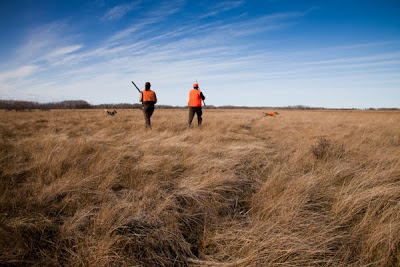
Use the form on the right to contact us. We should get back to you within 24 hours. If not, it means we are out chasing birds with dogs, shotguns and Canons. In that case we will get back to you as soon as we've finished the roasted Teal and Bordeaux . 


Form Block
This form needs a storage option. Double-click here to edit this form, and tell us where to save form submissions in the Storage tab. Learn more
         

123 Street Avenue, City Town, 99999

(123) 555-6789

email@address.com


You can set your address, phone number, email and site description in the settings tab.
Link to read me page with more information.

Pointing Dog Blog

The world of pointing dogs in words and images, moving and still.

Important Rules for Writers

Craig Koshyk

Rule #32: 
Always proof read to make sure you haven't any words out. 
  

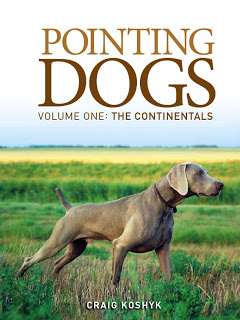
It has taken me about 12 years to gather the information and photographs for my upcoming book Pointing Dogs, Volume One: The Continentals. In one of the final chapters I sum it all up with the following lines:
I have watched double-nosed Spanish Pointers hunt quail in the arid hills of Guadalajara, and I’ve seen Old Danish Pointers seek partridge under the wind turbines of Jutland. I’ve chased ruffed grouse with Pont-Audemer Spaniels in Manitoba and hunted sharptailed grouse with a small herd of Large Munsterlanders in Saskatchewan. I saw a Weimaraner kill a roe deer with a single bite on the island of Baltrum, and I’ve seen German Shorthaired Pointers and Brittanies just about everywhere I’ve been. And everything I’ve seen has led me to one conclusion: a pointing dog’s raison d’être is to put a smile on its owner's face.
Now that the book is headed to the printing press, I can sum up the writing/editing/designing part by saying that American journalist Gene Fowler was correct when he wrote: Writing is easy: All you do is sit staring at a blank sheet of paper until drops of blood form on your forehead.

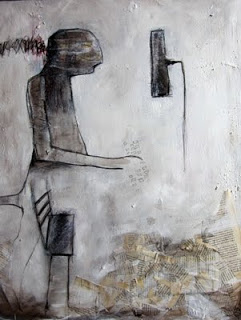
The image above is a co-creation from the über-talented artist Fontana Swing. It shows me doing what I've been doing for approximately 16 hours a day for the last 18 months: Writing, pausing, writing some more and trying my best to make sure that I haven't any words out.
Missed it by THAT much!

Craig Koshyk


Q: Hey, February has come and gone, and still NO BOOK? What’s the holdup!?!
A: Murphy. Yes, that Murphy. The one with a law named after him that says: "If anything can go wrong, it will."

Technical issues? Check. Darn computers! You’d think that with all their secret pixie dust and magic electrons, they would never do us wrong.....Wrong.

Health issues? Check. I spent most of the weekend at the emergency vet clinic while one of my dogs underwent surgery to remove some kind of towel he ate! Good timing Henri! Oh, and after paying the good Doctor for his emergency services, my credit card is now in the intensive care ward, with some kind of banker-priest standing by, just in case.

Drama? Check. Don’t ask. Let's just say that I now have 30% less hair and my complexion has taken on a whole new level of fish-belly pallor.

Weather? Check. My outside thermometer quit last week. Just got up and left. It was last seen boarding a flight to ANYWHERE but here. But I must say, today it seems a bit warmer. We may get up to minus 20 this afternoon and the weatherman just downgraded the blizzard warning to “apocalypse-lite.”


Q: So when the book will be done!?!
A: Despite all the setbacks, the book is actually written, proofed, poked, prodded and massaged into super-fine form. It fact, it is basically done. The only things remaining are a few final tweaks to some photos--we were having color issues with one of my computers. Everything should be at the printer's by March 21, and the book should start shipping a couple of weeks after that.


Q: Is there any silver lining to all this?
A: Yes indeed! In order to solve one of the technical/design issues we had, we decided to actually expand the book. It is now a massive 384 pages! And at last count, there were over 400 photos with descriptions of over 50 different breeds, dozens of expert contributions, charts, graphs, appendices, an extensive bibliography, glossary and index. In fact, it is so big now that if you plan to order a copy, you may want to consider adding a buttress or two to the coffee table it will sit on.

And speaking of ordering, a brand new www.dogwilling.ca website will be launched in the next couple of weeks. You will be able to order the book directly from the site for quick convenient shipping to your front door (I hope you have a sturdy mail carrier!).

Stay tuned.


Wheels are in motion.


I just hope Murphy is on vacation!

An English system for German dogs?

Craig Koshyk

Recently, a thread was started on the Working HPR gundog forum about the creation of a club for German hunting dog breeds in the United Kingdom. I found the subject very interesting and offered the following observations:


The development of our pointing breeds,British and continental, and the breeding, testing and registration systems we've invented for them has followed the ebb and flow of various cultural, social and political forces. Let's not forget that all the pointing breeds started in southern europe. They then spread across the continent and into the UK in the 1600s (longhaired setting dogs) and after the War of Spanish succession in 1715 (short haired pointing dogs "braque" and "old spanish pointers").Then for the next century and a half, they sort of languished on the continent, taking on regional characteristics but not really advancing beyond the fairly primitive model from the south.

Meanwhile in the UK, the 1700s and 1800s were years of unbridled innovation and advancement. Aided by the huge leap forward in livestock breeding techniques pioneered by Robert Bakewell in the 1770s, and driven by fierce competition within a growing class of nouveau riche, landed gentry and various other social climbers, pointing dog development shifted into high gear. British innovation, a genius for animal husbandry and the free enterprise system transformed long-haired setting dogs and short-haired pointing dogs into the various Setters and the Pointer.

And after the fall of Napoleon in 1815, these improved versions of the old breeds returned to the land of their ancestors. When they did, it was as if a bomb had gone of on the continental sporting scene. It is hard to overemphasis the impact. British Pointers and Setters were light years ahead of the continental breeds and stunned the dog-men of the day. Breeders across the continent stampeded to either get some of the dogs for themselves or to breed their dogs to them. Some even admitted it, many, due to nationalism and other social restrictions, did not. But it is safe to say that there is not a single, solitary pointing breed on the continent that does not have at least a drop or two of British blood in it. Some are clearly half breeds, others, more like 9/10th breeds.

The British influence is still very strong to this day. The English setter is the most popular pointing breed in France and Italy where over 20 thousand (!) are bred each year. Pointers are very popular everywhere and are still used (by the light of the moon) to add speed, range and nose to many breeds. The British competitive system of field trials and dog shows still dominates in many countries and now regularly produces Setters and Pointers that would run circles around their relatives back in the UK. So what happened?

Why are we now discussing setting up a German based non-competitive system in the UK? How did the Brits go from absolute monarchs of the pointing dog kingdom to net importers of types of dogs that the average 19th century English Sportsman would have considered curiosities at best, and wooly-haired pointing pigs at worst? Well it turns out that the "wooly-haired pointing pigs" were actually damn good dogs. And when the British pointing breeds made their way to the continent in the early 1800s, they rocked the world of hunters there. So breeders set their sights on building an even better mousetrap.

Some, like the French, Italians, Dutch, Danish adopted the British system of competitive trials and conformation shows. They now produce some of the best pointing dogs in the world. The Germans, Czechs, Slovaks and Hungarians came up with their own system of non-competitive tests. And they too succeeded in building better mousetraps for the average hunter that wanted a do-it-all kind of dog.

Meanwhile, back in Jolly Old England, it was the Brits' turn to let their pointing breeds languish. Pointers and Setters split into (mainly) show and (very few) field lines and the average British rough shooter migrated to spaniels and labs. Where there were once over a hundred kennels and dozens of lines of working Pointers and Setters, there were soon only a handful, if that.

So after couple of world wars and several decades of British servicemen and women being stationed in Germany and elsewhere, the continental breeds began to arrive on British shores. And they were no longer thought of as wooly-haired pointing pigs. They were now seen as fantastic do-it-all dogs that the Brits christened "HPRs".

The German breeds were the first to really take off. They rekindled interest in pointing dogs in the UK but found themselves to be a sort of square peg in a round hole. They were breeds from a system that was not based on field trials and dogs shows. They were products of a non-competitive all-round testing system.  But no such system existed in the UK. The only venue available to them to prove their abilities under judgment were field trials and dogs shows. So they adapted. Some, like the Weimaraner, became a mainly a show dog (and couch potato), others like the GSP retained and even improved some aspects of its working ability via the field trial system. But none of the German breeds were tested for the exact same things in the UK as they were tested for in German and so they tended to diverged from the original design.

So here we are today, wondering what sort of system could be established to reconcile two very  different approaches to breeding and proving pointing dogs. My answer is "I don't know'. The Brits could look at the North American model and systems like NAVHDA and go from there. Or they could just import, wholesale, the German system like some clubs have done in the US. But I am not British and I have no idea what sort of thing would stimulate enough interest and gain enough gravitas to succeed. However, I am an optimist, so I do believe that a system could be created or imported.

But here's the rub... and it is a big rub: I fear that the age of innovation and excellence in pointing dog breeding has come to an end. The very hunting culture for which our dogs were designed is in slow but steady decline and the doors now seem to be closed to new breeds or new initiatives.

Let's face it, the very essence of kennel clubs is not innovation, evolution or progress. Kennel clubs are  the social equivalent of aspic in which we seek to seal our breeds "as is" forever and ever, despite paying lip service to the idea of "improving" them. The last great systemic shakeup in pointing dogs, I believe, was the creation of NAVHDA in the very early 1970s and the creation of North America chapters of the German clubs in the 70s and 80s. So from here on out, despite all the improved communication the Internet has brought us and despite more exchange of genetic material via cheap travel and pet passports, inevitably, the pointing dog culture will become increasingly marginalized until it is truly a niche, within a niche, within a niche.

So does that mean one should not try to create a British system for HPR evaluation? No. Does it mean no one should try to form a UK chapter of a German breed club? I don't think so.

But what is does mean is that the task will become more difficult every year. So if you are going to do it, do it now. None of us is getting any younger -- when was the last time you saw a group of 20 somethings discussing dogs and hunting and testing and trials? The clock is ticking on the fate of hunting in many countries. This may be the last chance that the continental pointing dogs in the UK will ever have of getting their act together.


And now for something photo-related

Craig Koshyk


When I am not in out in the field with my dogs, I spend much of my time in the darkroom working with old-school photographic papers and chemicals. And when I say old school, I mean really old school.... as in mid-1880's-0ld-school.

One of my favorite techniques is known as platinum/palladium printing. In a nutshell, it means coating cotton paper, by hand, with solutions of platinum and palladium salts and then exposing the paper, under a negative, to ultraviolet light. The result is a warm-toned photographic image of delicate, subtle tone. The photo of Felix and Souris above is a platinum print. On screen it looks OK, but the print is really something to behold if I do say so myself.

A few years ago, I worked out a method to coat kind of paper that everyone thought would never work. I then wrote a small "how to" booklet to share the technique with other platinum/palladium printing enthusiasts. I sold a fair number of the booklet and got some great feedback from the folks that tried my technique.

Recently, I revised the booklet and had it completely redesigned. Today, I am happy to announce that it is now available for purchase on line!

It is called Vouloir C'est Pouvoir which means "Where there is a will there is a way" and is available through the fine folks at Blurb. You can get a sneak preview below and if you want to order one as a stocking stuffer for the old school photo dweeb in the family, just click that shiny "buy" button....you know you want to!

Photos, finally!!

Craig Koshyk


Just got a note from our Dutch friends Marjolein and Roel. They are now back in Holland with a head full of hunting memories and two dogs that have certainly earned a huge bag of biscuits for all their hard work in Manitoba, Saskatchewan and North Dakota.

I've been very busy putting the finishing touches on the massive never ending book project, but took some time off to upload some photos from the season.

Click the photo of Henri pointing or on the title of this post to view the gallery.

Enjoy!

Dutch Mojo

Craig Koshyk


Just popped into town for a booze run.... not much time to write, but I can say that our Dutch guests certainly have some mighty powerful MOJO working for them!

Weather? Perfect
Birds? Gajillions
Dog work? Outstanding.
Every single dog has been on a freakin hot streak!!

Uma, my wife's 7 year old Ponto has pointed about 8 snipe in her life, 6 of them yesterday!!

Maizey my LH female somehow figured out stop to flush on her own and yesterday I kept her steady to wing and shot...and I have NEVER trained her for that! She had 11 points in just over an hour while running like a field trial dog. (note to self, check the pedigree one more time...there HAS to be some yankee FT blood in there somewhere even if she is from Germany!)

Zeiss, my buddy's LH male has been putting on a clinic on how to hunt grouse. His run, point, fetch..everything is off the charts right now. Mar had a hard time believing he is German!

Henri is still battling Giardia, but he put on a picture perfect run and pointed like a seasoned pro the day before yesterday. Today he will be back out there to demonstrate the concept of "rockin and rollin" in the big wide open fields we have out here.

The two dogs that Marjolein and Roel brought with them have been doing great! Barak is a 7 year old Drent Partridge dog and he is really living up to his name...he is handling our "partridges" very well! The day before yesterday (his first day here) I hunted with him and Uma, the Ponto. Barak had a beautiful point on a ruffie and Uma backed him. That alone was a sight to see! But then Mar gave the command for Barak to flush (that is how they do it in Holland) and I became the only person on the planet to ever shoot a ruffed grouse over the point of a Drent Partridge Dog, backed by a Pont Audemer Spaniel....with a French Darne shotgun!!!

Mar's young LH weim Dirkje has been very impressive. She is only just over a year old but has managed to point grouse, snipe and woodcock...and she has never been hunting before! We've run her with some of the more experienced dogs to help her figure things out but it looks like she can figure them out for herself! And on top of being a great hunter, she is really pretty (I could say the same thing about Marjolein, but I don't want to make her husband jealous)....

All in all, the Dutch Adventure has started off with a bang...actually lots of bangs!

Other tidbits:
Barak's new nickname is Mouffette (skunk in French... he got a little too close to one on his first day in the field!).
Mar is a really good shot...better than all the guys combined I think.
Snipe fried in butter is like heaven on a cracker.
Grouse cooked any way you like is even better.
There is water everywhere....bring extra socks and boots if you venture north this year

Ok, time to get back at it...more updates later