Contact Us

Use the form on the right to contact us. We should get back to you within 24 hours. If not, it means we are out chasing birds with dogs, shotguns and Canons. In that case we will get back to you as soon as we've finished the roasted Teal and Bordeaux . 


Form Block
This form needs a storage option. Double-click here to edit this form, and tell us where to save form submissions in the Storage tab. Learn more
         

123 Street Avenue, City Town, 99999

(123) 555-6789

email@address.com


You can set your address, phone number, email and site description in the settings tab.
Link to read me page with more information.

Pointing Dog Blog

The world of pointing dogs in words and images, moving and still.

The Turkish Pointer's Spanish Connection: Updated

Craig Koshyk

Since my previous post about the Turkish Pointer, I've received a few questions and comments regarding the origins of the breed, its 'double nose' and it's hunting style. Answers/replies below.

Origins: Personally, I believe that the Turkish Pointer is a transplanted Pachon Navarro. The most plausible explanation for it's origin is that somehow, probably in the 1920s or 1930s a small number of Pachones made their way to Turkey from Spain. Over time, a small local population formed in the Tarsus region and became known as the Tarsus Catalburun (Turkish Pointer).

Double Nose: All dogs have a slight crease between their nostrils but it is usually no more than a very shallow line. But many Pachones and Turkish Pointers have nostrils that are clearly divided by a much deeper furrow making it look like the business end of a side-by-side shotgun. This is the famous “double nose” referred to in the old literature.

Anatomically, it is actually a cleavage in the structure of the nose itself. It is not unique to the Pachon Navarro. In fact a good number of breed standards mention a split or double nose but when they do, it is always listed as a serious or disqualifying fault.

A 'double' nose.

It is interesting to speculate just how the double nose came to be viewed as a positive characteristic. It is certainly possible that an individual with a split nose just happened to be an excellent hunter with a very fine sense of smell. Was this then seen as “proof” that at double nose was better than a regular nose?

Nowadays of course, breeders understand that the double nose offers no advantage over a normal nose and that it is simply a cosmetic feature of the breed. Furthermore, not all Pachones and Turkish Pointers have a double nose. Nor do all breeders select for it. Pachon breeders understand that by using double-nosed dogs in their lines, they run the risk of producing pups with completely cleft palates. I was told that up to 10% of pups are either stillborn or are put down immediately after birth since the cleft is so profound that the they are incapable of breathing or nursing properly. But most Pachones have a moderate cleft and are fine. They can breathe and suckle, run and hunt just like any other dog. 

Hunting Style: I found a pretty neat video the other day showing a Pachon Navarro hunting. It is pretty much exactly what we saw in Spain when we were there to photograph them and if you read the old literature from Spain and from England about how the classic old spanish pointers hunted, my guess is that if you could go back 300 years or so and watch the first "Spanish Pointers" brought to England hunting, you would see more or less exactly what is in the video.
"There were Ponto and Tanto, the two great, solemn-eyed, double-nosed Spanish Pointers who lurked in a dignified way about the house, a gentle gloom upon their countenances. They were the grandchildren of the Spanish Pointers owned by my great grandfather, Robert Asplan, the little, old, dapper gentleman who wore black knee-breeches with stockings and silver-buckled shoes. I think those Spanish Pointers knew that their day was done, that they were the last of their race -- gone with the hand-sickle and the centuries of the long September stubbles, where partridges had sit like quails. --  J. Wentworth Day, The Dog in Sport, 1938
Spanish Pointer by George Stubbs (1724-1806)


UPDATE: A recent article by well known Spanish dog expert Dr. Jose Manuel Sanz Timón explores the connection between the Pachon Navarro and the Turkish Pointer. Sanz Timón feels that we may need to re-examine our theories of the Pachon's origin, suggesting that the Turkish Pointer may in fact be its predecessor.

Coincidentally, Sanz Timóns blog post appeared just a few days before this one. However, I was unaware of his post at the time and only read it today, after the good Dr. brought it to my attention. My post on the Pachon-Turkish Pointer connection was inspired by a discussion on the versatiledogs forum that followed my article on the Turkish Pointer published on June 17 and based on breed description found in my book published in 2011.

In any case, I am happy to see that the Turkish Pointer is getting some much needed attention. When I first started researching it in 2008, I could find almost no information on it. But I eventually contacted and interviewed Umit Dincer, who wrote a book about the breed. Now, there are several websites and blogs about the Turkish Pointer and even a few videos on YouTube and elsewhere.

Personally, I am not convinced that the Turkish Pointer predates the pointing breeds developed on either side of Pyrenées mountains in the 13th century. Of course, hunting dogs certainly existed in Turkey, and everywhere else, since the dawn of civilization. But training, selecting and breeding dogs specifically to seek and point game seems to have been a European thing, not an eastern or mid-eastern thing.

The fact that many Turkish Pointers and Pachon Navarros have split noses and other similarities in physical attributes suggests that they may be related, but offers no evidence one way or another for which one came first. In addition, a split nose is actually listed as a fault in many breed standards indicating that it can occur from time to time in just about any breed (in the same way as a cleft palate can occur in humans). In 1913, a small population of dogs with split noses was also found in Bolivia and recently 'rediscovered'. Does that mean they are related to Turkish Pointers and Pachon Navarros? And if so, which one came first?


Read more about the breed, and all the other pointing breeds from Continental Europe, in my book Pointing Dogs, Volume One: The Continentals

http://www.dogwilling.ca/index.cfm

Breed of the Week: The Turkish Pointer

Craig Koshyk

Until very recently the Turkish Pointer, a.k.a. the Tarsus Catalburun, was a completely unknown to hunters outside of Turkey. Today, most people still know nothing about it, even in its homeland.


Tarsus is a 2,000-year-old city in south central Turkey. In ancient times it was the capital of the province of Cilicia and was the scene of Mark Antony and Cleopatra’s romance as well as the birthplace of Saint Paul. Today the city is a popular tourist destination and an important industrial center. 

It is known that pointing dogs have been in the region since at least the 1930s, but no one knows exactly how or when they arrived. Some believe that the Turkish Pointer may be an indigenous breed of pointing dog that has been around for centuries. It may have developed in the region long ago and then made its way to western Europe, either while much of Spain was under Arab control in the 8th to 11th century, or when European Crusaders returned from the Middle East in the 12th century. If so, then the Turkish Pointer would be the great-grandfather of all the pointing breeds in the world today.


A Turkish origin for all pointing dogs is an intriguing idea, but it is not supported by the available evidence. No one disputes the fact that certain types of dogs were introduced to western Europe from the Middle East and North Africa. But there is no reason to believe that any of them were pointing dogs, and many reasons to believe that they were not. As we’ve seen in the historical overview in the Introduction, pointing dogs have never been a part of Middle Eastern or Asian hunting traditions. Even today hunters still practising traditional Oriental hunting methods do not employ pointing dogs of any kind. It is also quite telling that there are no illustrations, photos or written references to pointing dogs in the Tarsus area before the 1930s.

So it is far more probable that the Turkish Pointer is in fact a sort of landrace that developed in the Tarsus region out of a nucleus of European dogs imported in the 19th century. The Turkish Pointer has a classic shape and hunting style that harkens back to a bygone age and, like the Pachón Navarro, it has a “double nose”. In fact, its name in Turkish, Catalburun, is derived from this trait; catal (pronounced chatal) means “fork” and burun means “nose”. 


In terms of hunting style and ability, the Turkish Pointer works in much the same way as the Pachón Navarro. It is mainly used to hunt partridges and rabbits and, despite a rather thick build, it is said to be quite agile. Umit Dinçer, who wrote an excellent book on the breed, told me that: 
They generally hunt at a trot but will occasionally gallop, depending on the cover they are working. Since the breed is most often used in very bushy terrain or areas of thick grass, it is a very close worker, typically staying within 25 to 30 meters from the hunter. They tend to be good pointers and they are natural retrievers with a soft mouth, as well. There is no specific effort to select for tracking but the more the dogs practise, the better they get. These dogs track, stalk, find and retrieve game. Giving voice is common and desired. The Turkish Pointer is mostly an upland dog but if they are trained, they may be successful at swimming, too. The breed was originally found in the Tarsus area, but nowadays you can see a few in other regions of the country. People who have them are basically hunters. The Turkish police force is interested in using the breed as narcotic detectives as well. But numbers are decreasing because it is not under the protection of any official club. It must be protected and officially known. 
Recently, the municipality of Tarsus has applied to the Turkish Patent Institution to register it as a breed. Due to the limited gene pool, all current Turkish Pointers are heavily inbred, but so far no known hereditary health issues have been reported. Recently a few websites and blogs about the breed have popped up  online and there is an interesting video (in Turkish) about the Tarsus Catalburun on Vimeo:


Digitürk İZTV Çatalburun AV Köpekleri Belgeseli from Adana_DT on Vimeo.


Read more about the breed, and all the other pointing breeds from Continental Europe, in my book Pointing Dogs, Volume One: The Continentals
http://www.dogwilling.ca/index.cfm

Breed of the Week: The Russian Setter

Craig Koshyk

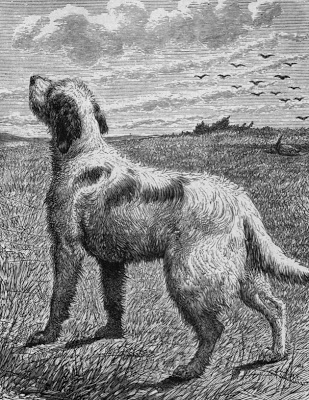
In October 1823, an illustration of a rough-haired dog retrieving a pheasant appeared on the cover of the The Sporting Magazine. The caption beneath the image read “Basto, A Russian Setter”. A description of Basto appears inside.

Basto is of Russian parents, which were highly valued in this country, and their offspring has in no way disgraced the character of these setters! He is distinguished in the lower parts of Surrey and in Sussex as an excellent finder, and of very delicate mouth. Basto brings his game, and has scarcely ever been known to lose a wounded bird, in either corn, furze, or water, which he takes and hunts with the same ease as a smooth-haired pointer hunts a stubble! Basto, like all sporting dogs of Russian blood, is slow, but he often picks up birds, hares, and pheasants, that a fast-hunting pointer has passed in the field. He is about eight years old, and the property of T. Gilliland, Esq.

References to the Russian Setters are relatively common in 19th century English sporting literature, but they are often so highly polarized and contradictory that it is hard to form an accurate picture of what they were really like. In terms of appearance, John Henry Walsh, also known as Stonehenge wrote that:
The actual form of the Russian Setter is almost entirely concealed by a long woolly coat, which is matted together in the most extraordinary manner. He has the bearded muzzle of the Deerhound and Scotch Terrier but the hair is of a more woolly nature, and appears to be between that of a Poodle and the water spaniel
Robert Leighton, who also mentions a “Russian Retriever” in the New Book of the Dog , says of the Russian Setter that:  
There are two varieties of the breed and, curiously enough, they are distinguished from each other by the difference in their color. The dark-colored ones are deep liver and are curly-coated. The light colored ones are fawn, with sometimes white toes and white on the chest; sometimes the white extends to a collar on the neck. These latter are straight-coated, not curly like the dark ones.
Some descriptions read as if they were written by men who had never laid eyes on a Russian Setter. In Biographical Sketches and Authentic Anecdotes of Dogs, Thomas Brown provides a summary of the breed that is clearly no more than bits and pieces taken from descriptions of other pointing breeds. He even seems to confuse Russia with Spain, claiming that the Russian Setter had a cleft nose and was called the 'Doublenosed Pointer'.
There is one peculiarity about him, which is, that his nose is so deeply cleft that it appears to be split in two, on which account he is termed in Russia the Doublenosed Pointer. His scent is said to be superior to that of the smooth dogs. This cleft nose is found to be inconvenient when he is beating in cover, as the face is apt to be torn where the brushwood is thick.
Other descriptions were from more reliable sources such as Edward Laverack, the man who litterally wrote the book on setters.
Russian (behind) English and Irish Setters
These dogs are but little known in this country. The late Joseph Lang's I have repeatedly seen. Two of them were brought down by Mr. Arnold, of London, to my shooting quarters, Dunmaglass. He had given thirty guineas a-piece for them as puppies, and had them very carefully broken by an English keeper. They were not at all good specimens of the class, and, as working dogs, comparatively useless. So disgusted was he with them before he left, that he shot one, and gave the other away. I have never seen but one pure specimen, which was in the possession of the late Lord Grantley, at Rannoch Barracks, head of Loch Rannoch, Perthshire. This dog was a magnificent type of the Russian setter, buried in coat of a very long floss silky texture; indeed he had by far the greatest profusion of coat of any dog I ever saw.
They were good but most determined, wilful, and obstinate dogs, requiring an immense deal of breaking, and only kept in order and subjection by a large quantity of work and whip; not particularly amiable in temper, but very high-couraged and handsome, an enormous quantity of long silky white hair, and a little weak lemon colour about the head, ears, and body ; and their eyes completely concealed by hair.
'Old Calabar' got a brace of these puppies, had them well broken, and took them to France ; but, after shooting to them two seasons, and being disgusted with their wilfulness and savage dispositions (they would take no whip), sold them to a French nobleman for a thousand francs (40/.), and considered he had got well out of them.

Reading through the old literature, it is clear that the terms “Russian Setter” and “Russian Pointer” were used to describe any rough-coated pointing dog in Britain at that time. Similar, if not identical dogs were called Smousbaarden in the Netherlands, Griffons in France and Polish or Hungarian Water Dogs in Germany. Before the late 1800s, none of them were 'pure' or independent breeds. They just represented a type of dog that was found just about everywhere sportsmen took to the field. A rough coat was their most distinctive feature and it was probably the reason men in Britain called the dogs “Russian”. It was commonly believed that people from the frozen eastern regions, and their dogs, were rather hairy and unkempt. In an article from The Farmer's Magazine in 1836, we can see just how politically incorrect many of the writers were at the time.
We may perhaps have seen a dozen of these brutes, which, like the people whence they derived their grossly misapplied appellation, are very uncouth very rough, imperturbably stupid, and, by way of continuing the similarity to the greatest possible extent, will generally be found infected with loathsome vermin.
Thomas Burgeland Johnson's description of what he called the "Russian Pointer" in the 1819 issue of The Shooter’s Companion equally negative. 
Whether he be originally Russian is very doubtful; but he is evidently the ugliest strain of the water-spaniel species; and, like all dogs of this kind, is remarkable for penetrating thickets and bramble bushes, runs very awkwardly, his nose close to the ground (if not muzzle-pegged), and frequently springs his game. He may be taught to set, and so may a terrier, or any dog that will run and hunt, and even pigs, if we are to believe the story of Sir Henry Mildmay’s black sow; but to compare him with the animals which have formed the subjects of the two preceding chapters (setters and pointers), would be outrageous: nevertheless, I am not prepared to say, that out of a hundred of these animals, one tolerable could not be found; but I should think it madness to recommend the Russian Pointer to sportsmen, unless for the purpose of pursuing the coot or the water-hen.

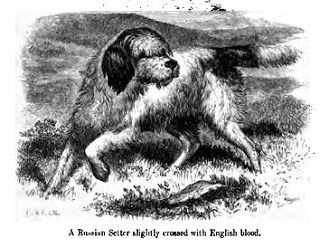
Mixing Russian Setters with other breeds is sometimes mentioned.  The results of a crosses "...between the Russian setter and the smooth pointer" are given in Dogs of the British Islands.
... I must admit that the Russian and pointer cross has produced dogs that for work could not well be surpassed. I may, perhaps, have been fortunate in the specimens seen, but do not speak from one or two, but many. In appearance, however, they are not to be compared to the thorough-bred pointer or setter, though more elegantly shaped than the Russian. There is another peculiarity in this breed worthy of notice. You may go back to the Russian with favourable results. I shot over a brace so bred on the moors last season, that would be hard to beat for range, keenness of scent, and sagacity.
References to Russian Setters in America are scarce, but there are a few and one in particular is quite well known: the first Korthals Griffon to be registered with the AKC, a bitch imported from France, was listed as a "Russian Setter (Griffon)". In The Complete Manual For Young Sportsmen, Henry William Herber (aka Frank Forester) wrote that Russian Setters were:
... rarely or never met with in this country. Could they be procured, I think of all sporting dogs they are the most adapted for ordinary American shooting, and the best of all for beginners. They have less style, and do not range so high as the English or Irish dogs, but that is no disadvantage for America, where there is so much covert shooting.
The Russian Setter never really achieved the status of an independent breed of pointing dog. I must have been just as difficult to stabilize as any other strain of griffon. And without a British Eduard Korthals or Emmanuel Boulet to champion its cause and perfect its breeding, the Russian Setter soon faded from the scene.


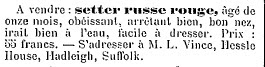
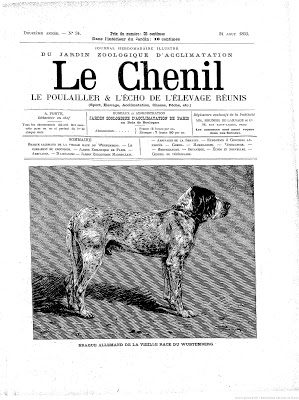
Classified ad the French sporting newspaper Le Chenil, 1884. "For sale, Red Russian Setter, 11 months old, obedient, points well, good nose, works well in water, easy to train. Price: 55 Francs. Contact M. L. Vince, Hessle House Hadleigh, Suffolk


Read more about the breed, and all the other pointing breeds from Continental Europe, in my book Pointing Dogs, Volume One: The Continentals
http://www.dogwilling.ca/index.cfm

Breed of the Week: The Württemberger

Craig Koshyk

The Württemberger, known in Germany as the Dreifarbige Württemberger or Dreifarbige Württembergische Vorstehhund, was a short-haired, tricolored pointing dog that disappeared just after World War I. Exactly where, when and how it came to be is the subject of speculation.


The most common assumption is that the breed was developed in the Württemberg region of southwest Germany in the 1870s. Some sources claim that Gypsies traveling from Russia brought it to the  Kingdom of Württemberg in the early 1800s, but others insist that it was an ancient breed, known in southern Germany for centuries. Whatever their origin, heavy, tricolored pointing dogs were present in large enough numbers in the 1880s and ’90s to catch the attention of Germany’s Delegate Commission which, for a time, recognized them as a breed. But no separate stud book was ever created for Württembergers and they, along with Weimaraners, were registered in the German Shorthaired Pointer stud book. 


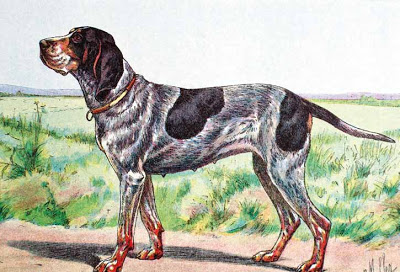
Apparently a Tricolored Shorthair Club (Dreifarbige Kurzhaar Klub) was formed in Germany, but its efforts to gain official recognition for the breed failed. It is not clear exactly why, but it may have been due to the fact that many of the leading dog experts of the time believed that any tricolored coat had to be the result of crossbreeding to either Gordon Setters or some kind of hound, such as the Large Blue Gascony and therefore the breed could not be considered 'pure'.

Physically, Württemburgers were fairly large dogs, up to 70 centimeters at the shoulder with a large head, heavy flews and loose skin. They probably looked like a tricolored Bracco Italiano or Burgos Pointer. A fairly detailed description of the breed was written by J.B. Samat and appears in the book Les Chiens de Chasse, published by the Manufrance company in the 1930s. 
The Württemberger has not yet undergone the same transformation as the real German Shorthaired Pointer which, nowadays, looks nothing like its ancestors. The Württemberger is a fairly tall dog with a heavy appearance, but it is rare to see a well-built and absolutely correct example, for the hunters in Württemberg are not very fussy and have no particular interested in a carefully thoughtout breeding system. However, there are two or three large kennels where the breed is carefully raised and where they have probably been improved in the same way as the other German breeds. The coat is tricolor marked with brown and tan spots and streaks on a blueish background, white with brown ticking with yellow markings above the eyes, on the cheeks, the edges of the ears, the lips, the chest, the inside of the legs and the underside of the tail. 
Other descriptions and images appeared in the late 1800s and early 1900s in sporting journals such as Le Chenil in France. In the book Die deutschen Vorstehhunde, author Manfred Hözel states that the last litter of Württemberger pups was whelped near the city of Nanz, Germany in 1910 and that two pups were “exported to America”. Other authors, however, have written that the breed managed to survive until just before the Second World War.


Read more about the breed, and all the other pointing breeds from Continental Europe, in my book Pointing Dogs, Volume One: The Continentals
http://www.dogwilling.ca/index.cfm

Breed of the Week: The Majorcan Pointer

Craig Koshyk


Of all the breeds I’ve seen and studied, the Majorcan Pointer came as the biggest surprise. Despite finding a good number of historical references to it in the old literature, I was unable to determine if the Balearic Islands’ native pointing breed was still being bred today. And since Googling its name in English, French and Spanish only turned up the same old quotes from the same old books, for a long time I assumed that the breed was extinct. 


But only a few weeks before flying to Spain to photograph Burgos Pointers and Pachónes Navarro, I decided to give it one more shot. This time the words I entered into the Google search field were in Catalan, the other official language of the island of Majorca. I typed ca de mostra and ca de caça, then hit return. Less than an hour later I was on the phone to Sheryl Marchand, my very understanding travel agent, telling her that Lisa and I would need to extend the Spanish leg of our trip. Majorca’s native pointing dog was still alive!


HISTORY
The Balearic Islands are an archipelago off the east coast of Spain.They have been inhabited from at least the time of the ancient Phoenicians and Greeks who probably introduced hunting dogs to the four major islands of Majorca, Minorca, Ibiza and Formentera. Even today, Podengos —a type of hunting dog used throughout the Mediterranean in ancient times—are still found on the islands, used by their owners to hunt rabbits by sight and scent.

We know that pointing dogs have been present on Majorca since at least the 14th century. A number of documents surviving from that era clearly indicate that hunters armed with crossbows used pointing dogs to help them take small game. In fact, the practice seems to have been so widespread and effective that game populations may have been adversely effected. Royal ordinances banning it were issued in 1383 and again in 1392. How pointing dogs got to the island is unknown, but it is reasonable to assume that they were brought over from the mainland and that they share a common origin with the earliest types of pointing dogs that were then being developed on both sides of the Pyrenees Mountains. They were probably bred in fairly small numbers on Majorca and the other Balearic islands, and developed in similar ways to pointing dogs elsewhere. 

By the late 1800s they had gained a reputation as excellent hunting dogs. At least one hunter thought they were the best dogs to be found anywhere. Jules Tallien de Cabarrus was a French doctor and diplomat who had hunted in many parts of the world. In the 1860s he fell ill and was sent to Majorca to recuperate. There, he hunted over Majorcan Pointers and wrote about them in his book, Chasses et Voyages, published in 1863: I repeat and will continue to say that the Majorcan pointing dog is the best and most accomplished that one could possibly find.1

In 1882 he published another book, El Mejor Perro de Muestra, in which he wrote: The Majorcan Pointer...is worth more than all the beautiful spaniels, setters or pointers. I speak from experience since I have used them for over 25 years, nine of which I spent on Majorca, three in Trieste [a city in Italy, but under Austrian rule at the time], and the others in America. And of the 49 dogs that I have had, 29 of the Majorcan breed have passed through my hands, and I have also seen many more besides mine at work.2

Another high profile person who described pointing dogs on Majorca was Archduke Ludwig Salvator of Austria (1847- 1915). He wrote a nine-volume book on the Balearic Islands in which he mentions local hunters using pointing dogs to hunt quail.

In 1911, the Real Sociedad Central de Formento de las Razas Caninas in España (later renamed Real Sociedad Canina de España) was formed. In some of its earliest stud books there are listings for Perdigueros Mallorquínes (Majorcan Pointers). But then the breed seems to fall into near complete obscurity. While a few references are found in the Spanish sporting literature of the 1940s and ’50s, it was not until the mid-1990s that any efforts to establish Majorca’s native pointer as a recognized breed got under way. In 1996 the Club del Ca Mè Mallorquí was formed and a standard drawn up. In 2002 a stud book was established, and in 2004, after six centuries on the island, Majorca’s native pointing breed was officially recognized—sort of. Recognition was granted by the Minister of Agriculture of the Balearic Islands but not (yet) by the Real Sociedad Canina de España or the FCI.

MY VIEW
Before travelling to Majorca, we spent several days on the Spanish mainland with the people involved in the revival and growth of the Pachón Navarro and Burgos Pointer. We discovered that both breeds had faced difficult times in the recent past but were now in the hands of well-organized clubs and were becoming more popular throughout the country. The Majorcan Pointer seems to be following in their footsteps, but efforts to revive it did not really get going until the late 1990s. And the relative isolation and small population of the island mean that it will probably never reach the level of popularity that the Pachón Narvarro and Burgos Pointer now enjoy. Nevertheless, supporters of the Majorcan Pointer are every bit as dedicated to their cause as supporters of Spain’s other indigenous pointing breeds. They also have had the opportunity to observe the progress of the other breeds and to learn from them. 
After we had photographed a number of dogs in the field, Lisa and I went to diner with members of the breed club. While discussing the future of the Majorcan Pointer, club president Francesc Mir Tomàs had this to say: We are very happy with the progress we have made so far. We know this is a long-term project and we want to do it right. We also understand that the most important thing is to breed dogs that are born to hunt, that are authentic Majorcan Pointers. They are an important part of the heritage of this island and the local people support our efforts. Pedro Salva Vidal added, “We are a patient bunch. We will make progress poco a poco.”


1. Jules Tallien de Cabarrus, Chasses et Voyages, quoted in Referencias Históricas, http://www.camemallorqui.org/referencias_historicas.htm (April 13, 2009)

2. Jules Tallien de Cabarrus, El Mejor Perro de Muestra, quoted in José Manuel Sanz Timón, Origenes e Historia Antigua, http://perdiguerodeburgos.info/historia/historia.htm (August 19, 2010)


Read more about the breed, and all the other pointing breeds from Continental Europe, in my book Pointing Dogs, Volume One: The Continentals
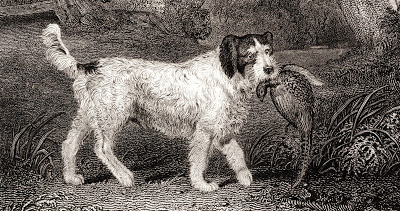
http://www.dogwilling.ca/index.cfm