Contact Us

Use the form on the right to contact us. We should get back to you within 24 hours. If not, it means we are out chasing birds with dogs, shotguns and Canons. In that case we will get back to you as soon as we've finished the roasted Teal and Bordeaux . 


Form Block
This form needs a storage option. Double-click here to edit this form, and tell us where to save form submissions in the Storage tab. Learn more
         

123 Street Avenue, City Town, 99999

(123) 555-6789

email@address.com


You can set your address, phone number, email and site description in the settings tab.
Link to read me page with more information.

Pointing Dog Blog

The world of pointing dogs in words and images, moving and still.

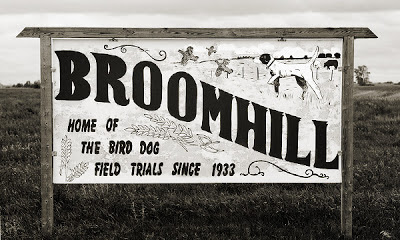
Everybody Knows Where Broomhill's At!

Craig Koshyk

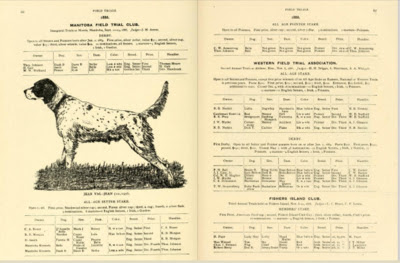
Field trials for Setters and Pointers have been run in Manitoba since 1886 when the Manitoba Field Trial Club held its inaugural Derby and All-Age Stakes near Morris, about 50 miles south of Winnipeg.  


Field trials are still held in Manitoba today, but further west, just outside of Broomhill, a small hamlet that most people in Manitoba have never heard of. But among field trialers, Broomhill is almost as well-known as Grand Junction Tennessee. When I interviewed Hall of Fame trainer and handler Colvin Davis last fall during the Manitoba Championship Trial, I asked him about Broomhill. Here is what he had to say.


Stay tuned for more video of Colvin and more on the history of field trials in Manitoba including first hand accounts from over 120 years ago!


My Next Dog?

Craig Koshyk


Currently I have plenty of dog-power available to me to hunt just about anything. So I am not in the market for another dog right now. But in a year or three, Lisa and I will probably welcome a new addition to the herd. And even though we don't know what breed of dog it will be, we know this: it will have a mainly white coat. Mainly white?  Why?

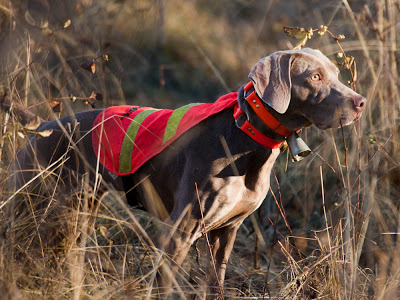
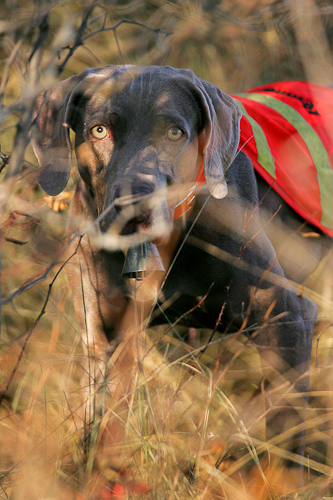
Well it turns out that 50-year-old eyes are not great at seeing dogs with coats that act as camouflage in the field. I now have to put orange vests on my Weims every time we hunt just so I can keep track of them as they hunt or find them on point.

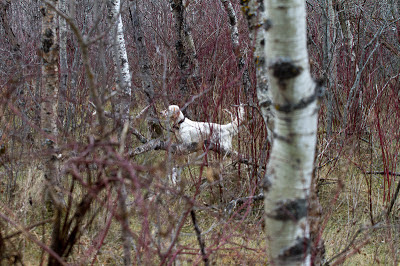
Without a vest, Souris is almost impossible to find in heavy cover,
even though she is wearing a blaze orange collar in this photo.
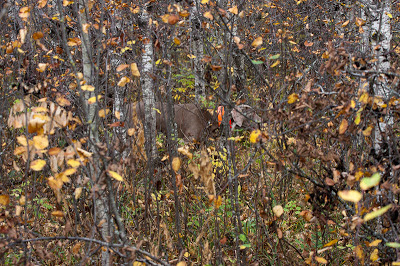
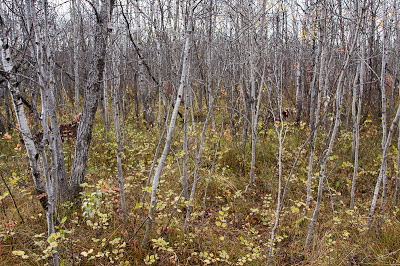
There are actually TWO weims in this shot; one pointing and one backing.
Both are wearing orange collars. Can you find them?
Last season I hunted with a couple of absolutely awesome English Setters brought over from Holland by my good friends Marjolein and Roel Kamman. The Setters are from Italian lines, were bred in France, and have mainly white coats. And even though they run fairly big, fly across fields and sprint through the heavy cover, they are a thousand percent easier to see than my Weims, especially when they are on point.
THIS is why I want a white dog.
They are so much easier to see in heavy cover.
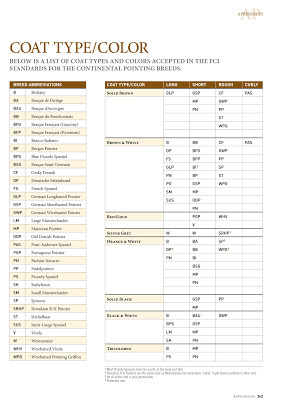
So what are my choices? Well, in Volume One of my book on Pointing Dogs, I include a chart that indicates the various coat types and color combinations available in the Continental breeds.


Looking it over, it seems like the list is actually quite extensive. And when the British breeds (Pointers and setters) are included,  it turns out that there are over 20 pointing breeds in which you can find dogs with a lot of white in the coat. So the long list looks like this: 
  • English Setter, Pointer
  • Irish Red and White Setter
  • Épagneul Français (French Spaniel)
  • Épagneul Breton (Brittanny)
  • Braque du Bourbonnais
  • Braque de l'Ariège
  • Braque Saint Germain
  • Braque Francais (both types)
  • Old Danish Pointer
  • Burgos Pointer
  • GSP 
  • GWP
  • GLP
  • Drentsche Patrijshond
  • Small Munsterlander
  • Large Munsterlander
  • Weim (sort of...see my blog post on the "Whitemaraner")
  • Bracco Italiano
  • Spinone
  • Pachon Navarro
  • Ca Mé Mallorqui
  • Cesky Fousek
By narrowing the list to only those breeds in which the majority of dogs have mainly white coats, it looks like this:
  • English Setter
  • Pointer
  • Irish Red and White Setter
  • Épagneul Français (French Spaniel)
  • Épagneul Breton (Brittanny)
  • Braque de l'Ariège
  • Braque Saint Germain
  • Old Danish Pointer
  • Drentsche Patrijshond
  • Small Munsterlander
  • Bracco Italiano
  • Spinone
And if I limit my search further, say by selecting only breeds that are relatively easy to find, offer a good selection of field-bred lines and are mainly selected for the type of hunting I do (80% upland birds, 20% waterfowl), the list gets even shorter:
  • English Setter
  • Pointer
  • Épagneul Français (French Spaniel)
  • Épagneul Breton (Brittanny)
And, finally, if I narrow it down to breeds with long tails (because I like long tails) only three breeds remain.
  • English Setter
  • Pointer
  • Épagneul Français (French Spaniel)
    So over the next couple of years I will be keeping my eye on those breeds, looking for just the right breeder and just the right litter. In the meantime, I will just enjoy watching videos of them in action. 

    Here's an awesome video of some really nice Épagneuls Français. 


    And here is an incredibly beautiful video of and English Setter in hunting Ptarmigan in Iceland


    And here is a video of famous American Pointer breeder Bob Whele and his Elhew Pointers


    Choices...choices!!


    Happy Birthday Souris-Manon!

    Craig Koshyk

    Souris-Manon (Grau Geist's Let R Rip Du Souris) turned 13 this weekend! So here's to:

    13 years of growing up


    13 years of chillaxing with her buddies


    13 years of guard dog duty 


    13 years of watching over the youngsters


    13 years of cuddling


    13 years of visits to the Vet


    13 years of wear and tear


    13 years of running


    13 seasons of pointing sharptailed grouse
      

    and woodcock

    and ruffed grouse
     

    and jackrabbits

    and huns


    and snipe


    and pheasants


    13 seasons of fetching ducks
     
    and geese
     
    and grouse

    and pheasants

    and jackrabbits


    13 seasons of sitting in duck blinds
     

    and goose blinds

    and canoes


    13 years of videos


    And above all, 13 years of putting a smile on my face


    So here's to many, many more 


    Happy Birthday Souris!


    Popularity. It's complicated.

    Craig Koshyk

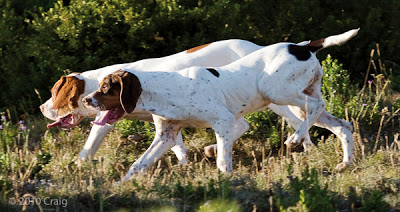
    Portuguese Pointer
    As I alluded to in my last blog post, the term 'rare' is sometimes used by breeders to suggest that their breed is exotic and therefore superior to the run-of-the-mill breeds. But breeders of more common gundogs sometimes use the term 'popular' to promote their breed; the implication being that 'A million owners can't be wrong'.

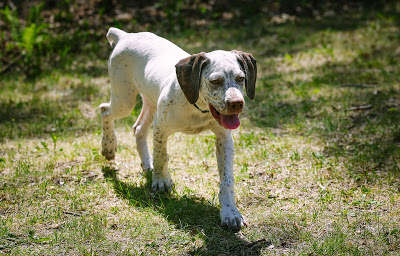
    Picardy Spaniel
    But it turns out that the factors contributing to a breed's rarity or popularity are actually quite complicated. If we really want to understand why a breed is the way it is today, we have to look at history, geography, politics, breed clubs, registries and a bunch of other things, most of which are totally unrelated to how it actually performs in the field as a hunting dog.

    Sometimes it comes down to a breed being in the right (or wrong) place at the right (or wrong) time. Take the Picardy Spaniel for example. It is a superb gundog with great looks and temperament.  It really should be more popular around the world. Unfortunately the breed was developed in a part of northern France that was ground zero for two world wars. Obviously, building a strong population of hunting dogs and attracting the attention of the gundog world is not easy when you are just trying to survive the next artillery barrage. 

    Cesky Fousek
    The Cesky Fousek on the other hand is very popular...in the Czech Republic. But outside of its native land, it is almost completely unknown. Obviously 50 years of cold war and an iron curtain are not exactly conducive to gaining world-wide recognition for a gundog breed.  

    But much of Germany was also turned to rubble during the wars, and half of it also lay behind an iron curtain for much of the 20th century. So why are German breeds like the GSP, GWP, Weim, Munsterlander and Pudelpointer now so popular in many parts of the world? Well it turns out that when hundreds of thousands of Allied servicemen and women are stationed in a foreign country, they tend to notice the local gundog breeds. And when local breeders, desperate to get back on their feet after years of war realize they have a very eager market for their dogs...well, you do the math. 


    English Setter
    And then there is the fact that once a breed gains a certain level of popularity, momentum based on a sort of herd mentality develops. Chances are, if you are a Czech hunter, you've seen plenty of Cesky Fouseks. Your best buddy probably has one and so do a lot of other hunters in your neck of the woods. So naturally, when you decide to get a gundog for yourself, your first thought is probably to get one just like your buddy's or just like the ones you see in the field all the time. 

    I mean, do you really think all those guys and gals you see hunting with Labs or GSP's in the States really took the time to check out the pros and cons of dozens of other breeds before they got their first dog? Fat chance. The vast majority of dog owners can't even name more than three breeds of hunting dogs. Personally, I didn't do a whole lot of shopping around when I chose my breed (Weims). I just happened to see a really good one in the hunting field when I was younger and it stuck in my mind. When I finally got a house and a yard, guess what I got? Yup, the kind of dog I remembered seeing in the field years earlier. 

    Large Munsterlander
    Think about your own area. There are probably one or two breeds that are way more popular than all the others. But why is that?  My hunch is that they are a reflection of the momentum they've managed to build over the years. And chances are, that momentum is there to stay. The popular breeds in your area will probably remain quite popular and continue to build momentum.

    But what would happen if a few top notch breeder/trainer/testers started working with one of the less popular breeds in your neck of the woods? And what if they started achieving FC and VC titles on a bunch of their dogs and what if they formed a really solid club, promoted the breed's virtues and began to place lots of pups in really good hunting homes? My guess is that over time, there would be a new 'most popular breed' in your area. As they say; nothing succeeds like success. Just ask the GSP and Brittany people who had, at one time, breeds that were not even on the radar in North America.


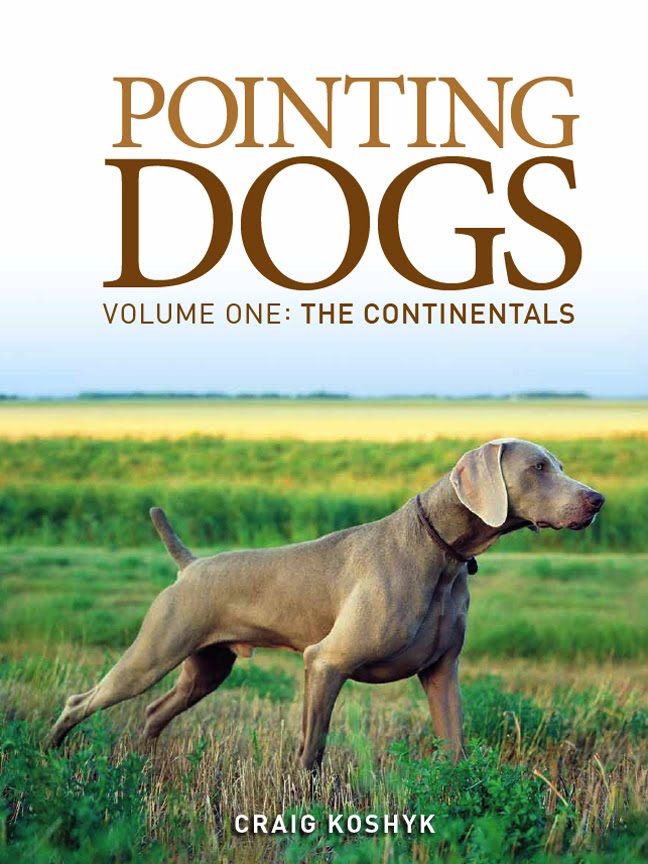
    Enjoy my blog posts? Check out my book Pointing Dogs, Volume One: The Continentals
    http://www.dogwilling.ca/index.cfm


    Rare doesn't mean good...or bad.

    Craig Koshyk

    One of my pet peeves is seeing breeders of less common gundog breeds use the term 'rare' as an advertising hook, as if 'rare' were a synonym for 'good'. On the other hand, it also bugs me when I hear people bad-mouth less common breeds by saying "they must be rare for a reason".
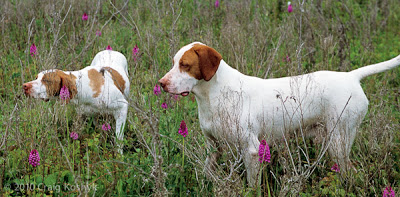
    Braque Saint Germain

    When it comes to gundogs, rare does not mean good, or bad. Breeds become popular or remain rare for many reasons, usually totally unrelated to how good, or bad they actually are. Case in point: the Weimaraner. It is among the most popular gundog breeds in the world. Yet apart from a some superb individuals and a few good lines, as a hunting breed, it is in pretty rough shape overall. Trying to get a decent hunting dog by reaching in and picking a pup from any random Weim litter is like trying to hit a hole-in-one with a nine iron. 

    Compare that to the Braque de l'Ariege, one of the rarest breeds on the planet. Your chances of getting a decent hunting dog out of just about any Ariege litter are pretty darn good since there are no show lines of Braques de l'Ariege and no non-hunting breeders breeding them. Every single Braque de l'Ariege out there right now is a hunting dog. Most are decent, some are excellent, a few are world-class. None are worthless.
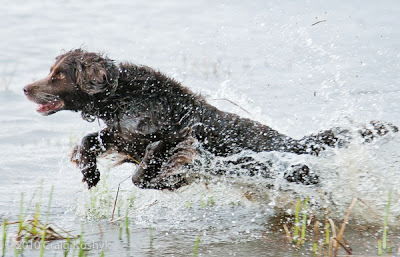
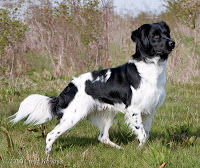
    Saint Usuge Spaniel
    That said, there are some increased risks that come with rarer breeds, but those risks are not usually related to hunting ability or performance. For example, a small, closely-related population means that if a certain genetic problem crops up, a larger percentage of the overall breed can be effected and therefore present a greater risk to a purchaser. Case in point: Alopecia in the Pont Audemer Spaniel. Like other breeds with a curly coat, Ponto's can experience hair loss due to Canine Follicular Dysplasia. It is a purely cosmetic issue unrelated to performance, but it is a problem in the breed. And with so few individuals in the breed and so few lines, the only way to address the problem has been to outcross to unaffected dogs from other breeds like the Irish Water Spaniel.

    Pont Audemer Spaniel
    Another issue that can have a greater effect on a rare breed is club politics. In big clubs, political rifts don't usually have much of an effect on the overall state of a breed. But in small clubs, in-fighting can be disastrous. Case in point: the Braque du Bourbonnais. A few years ago, a sort of leadership putsch occurred. The breed club's former president, the guy who actually re-created the Braque du Bourbonnais almost single-handedly, was forced out. The club is now in a shambles. It has more or less ceased doing anything for the breed (no trials, tests or shows) and the Bourbonnais population in France is in a free fall. In fact there are sometimes more Bourbonnais bred in the US than in France now! 

    Pachon Navarro
    Probably the most daunting task facing anyone interested in a 'rare' breed is actually getting a pup. I often get questions like: "How can I get a (insert rare breed name) puppy? Do I need to fly all the way to (insert name of foreign country)? I don't even speak (insert foreign language). 

    10 years ago, my answer would have been, YES, you need to fly to whatever foreign country the breed comes from and yes, you will need to overcome the language barrier somehow. But nowadays, thanks to the Internet, you can do much, if not all, of what is necessary to get a pup without ever leaving your own home town. But I would still encourage a trip to whatever country the dog is coming from just to experience the culture, food and wine! 

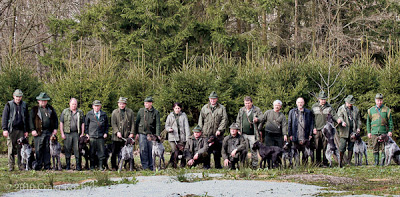
    Members of the Cesky Fousek Club,
    Czech Republic, 2007
    To break it down in a sort of easy step-by-step, here is what I would do (and in fact have done) to get a pup from one of the rarer breeds.

    Stabyhoun
    1. Identify the breed you want and make sure that it is still being bred to hunt. Case in point: the Stabyhoun, a rare 'gundog' breed from Holland. The Stabyhoun is still listed as a pointing breed, but in reality no one breeds Staby's for hunting anymore. In the entire world, there may be a handful of people that use their Staby to fetch the occasional duck. And that's it. Staby's can make fine pets, they have great looks and temperaments, but if you want a hunting dog, look elsewhere. 

    Among the less common breeds, I'd say that all the French breeds represent pretty decent odds of finding a good hunter (the Braque Saint Germain might be sort of iffy). Personally, I would get a Picardy Spaniel in  a heartbeat, I love the French Spaniel and Braque d'Auvergne, I may get a Braque de l'Ariege one day. Both versions of the Braque Francais are great and the Bourbonnais is really coming along nicely in the US. The Portuguese Pointer offers better than decent odds and you can get a good Bracco Italiano or Spinone (from good lines....be careful). For more, see my book, I offer a sort of 'risk level' for all the breeds in it.

    2. Make a connection with a breeder or two. Do it the same way you would here (but maybe with the help of Google Translate). Connect via the breed club or through forums, bulletin boards, Facebook etc. Look for HUNTERS who breed hunting dogs. Engage them on a hunter-to-hunter basis and see if you can see eye to eye. I now have some very dear friends in Europe because we had a sort of 'meeting of minds' about dogs and hunting. I have met many of my Euro friends in person, but there are quite a few that I have never actually met other than online...yet we are now like kindred spirits and have established a very high level of mutual trust and respect. 

    3. Go there to hunt or invite them here to hunt. I've done both. The hunting memories, stories and experiences you collect will be priceless. Get a second job, eat nothing but Kraft diner for a year, do whatever it takes. Just get there. It will change your life.
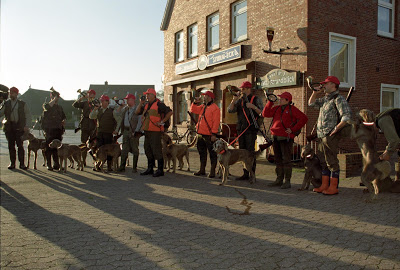
    Baltrum, 2001
    4. Get a pup. Either have it shipped here or (preferably) go there to pick it up. The experience will stay with you forever and a trip to Europe, especially to hunt, will blow your mind.

    Finally, if you need help, just ask. I am happy to help out in any way I can and there are people in every club, in every breed that are willing to take the time to answer questions and help you get a good dog. After all, they are looking for good hunting homes for their hunting dogs. And the rarer breeds really could use a helping hand, especially from North American hunters. After all, where would the Bourbonnais be now without the folks in the US that are doing more for the breed than the parent club in France at the moment!

    UPDATE 1. I've followed up this post with another that explores the reasons some breeds are popular, while others are not. You can read it here.

    UPDATE 2: There is now a Braque du Bourbonnais right here in Manitoba! Check out the photos of Kolbi Chasseur d'Aspen Ridge "Kolbi" with his new family here or click on the photo below.

    https://cdog.exposure.co/kolbi


    Enjoy my blog posts? Check out my book Pointing Dogs, Volume One: The Continentals
    http://www.dogwilling.ca/index.cfm


    Best. Book. Ever.

    Craig Koshyk

    One of my favorite books is Le livre de la chasse (Book of the Hunt) by Gaston Phébus. Written between 1387-89, there are 46 known copies of the original manuscript still around. A few are still in private collections, but most are stashed away in places like the Bibliotheque nationale de France and the Morgan Library.
    I've never seen an original manuscript of the book, but I came across a nice video on the website of the Bibliotheque nationale de France that shows one up close.  In the video, the host offers some interesting background information on the book, and even if you can't understand a word she says (it is all in French), it is still a cool video to watch since you get a sense of the size and thickness of the book and the richness of its illustrations and text.

    Click here or on the photo below to watch the video. 

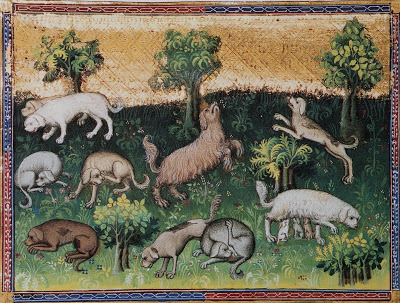
    In the time of Gaston Phébus, there were no breeds of dogs, just general types. The dogs in this image were called 'chiens d'oysels' ('dogs that serve the bird' ie: a hawk or falcon). Illustration from Le livre de la chasse.