Contact Us

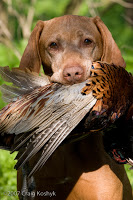
Use the form on the right to contact us. We should get back to you within 24 hours. If not, it means we are out chasing birds with dogs, shotguns and Canons. In that case we will get back to you as soon as we've finished the roasted Teal and Bordeaux . 


Form Block
This form needs a storage option. Double-click here to edit this form, and tell us where to save form submissions in the Storage tab. Learn more
         

123 Street Avenue, City Town, 99999

(123) 555-6789

email@address.com


You can set your address, phone number, email and site description in the settings tab.
Link to read me page with more information.

Pointing Dog Blog

The world of pointing dogs in words and images, moving and still.

12 Things I Learned at Broomhill, Manitoba.

Craig Koshyk

Over the next few weeks, I will be posting some of my photos, videos, thoughts and opinions on pointing dog field trials. Today I'd like to start with what I learned when I attended the Manitoba Championship Trial in Broomhill, Manitoba last September.


1. There is a great big sky over Broomhill.


2. And a lot of big trucks.


And big trailers.


And cool license plates.


3. You meet a lot of nice people at Broomhill.


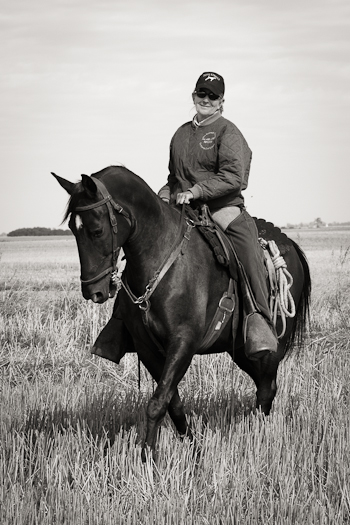
People who love horses.


And wide open spaces.


And each other.


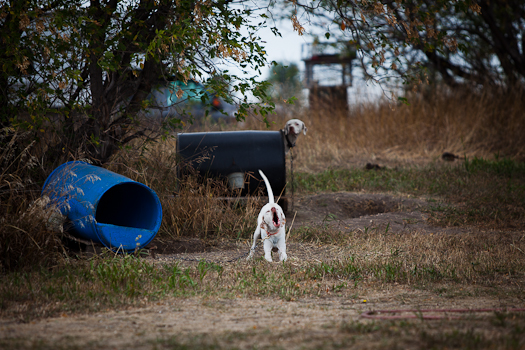
People who really love their dogs.


And dogs who love their people.


4. The dogs only have two speeds: ZOOOM...


And chill.


5. The dogs greet you in different ways.


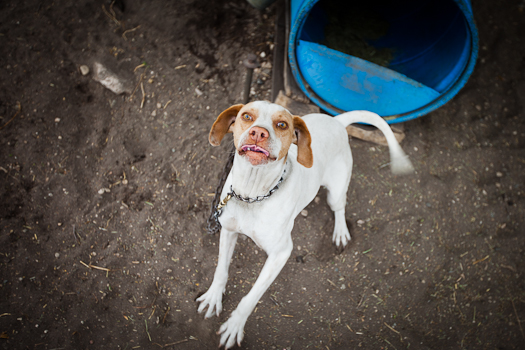
Some are super happy to see you.


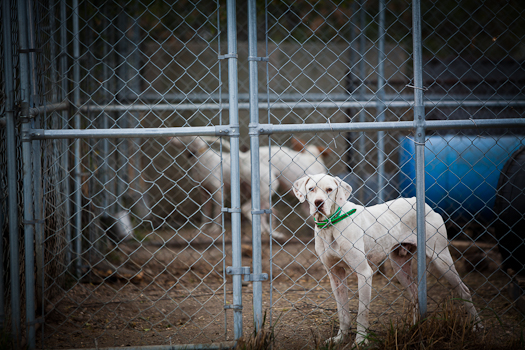
Some aren't quite sure.


Some dogs couldn't care less.


Some think that you are bringing them a nice meaty soup-bone.


And all the young dogs give you the 'take me home' look.


6. All the dogs have awesome dog names.


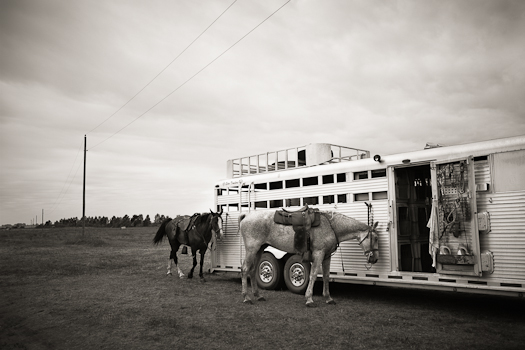
And they travel with horses in trailers.


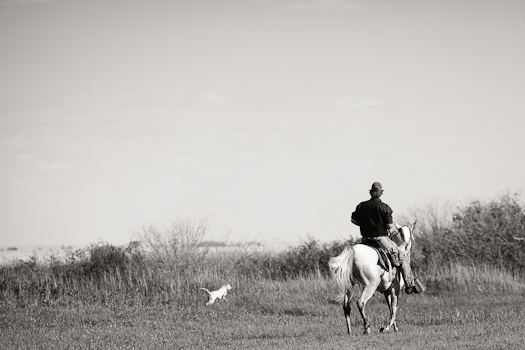
7. Trial folk spend a lot of time in the saddle


And they love every minute of it.


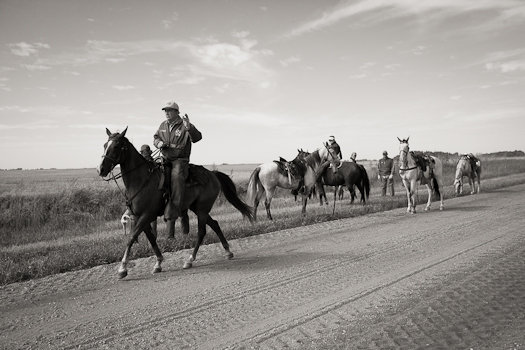
8. Trial judges judge on horseback.


Handlers handle on horseback.


And everyone else follows along to watch...on horseback.


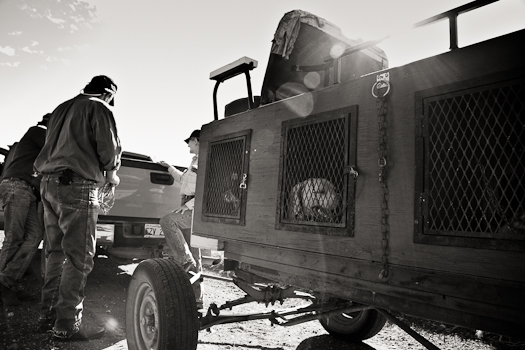
9. Each dog waits for its turn to run.


So they relax in a cool dog-wagon.


10. And when it comes time to run..


They run...


And run


And run... for an hour or more.


11. When they're done, they head back in.


To chill out in the dog-wagon while the others get their turn to run.


12. When everyone's done, it's back to camp.


Near the Broomhill Hilton.


Where all the nice people sit and visit under sage advice written on the wall.


And the dogs go back to day-dreaming...


about running again, under the great big Broomhill sky.


To view a slideshow of these images and more from the Broomhill trial, click here.


Season's End

Craig Koshyk


I just got back from the final hunting trip of the 2012-13 season. My buddy Ross and I had an awesome time in North Dakota chasing roosters with Zeiss, Vinnie, Uma and Maisey. Here's a quick slide show of some of the photos I managed to snap in the -30 weather.


And here's a slide show of the great shots Ross got.


The Tumbling Pheasant

Craig Koshyk

Last Friday, my buddy Ross Cornish and I headed out to the wilds of North Dakota. It was the last weekend of the pheasant season and we had two goals: 1) to hunt pheasants (duh) and 2) to right a massive wrong. 


You see, Ross and I are both professional photographers. But the last time we hunting in North Dakota, just before Xmas, we didn't even bring our cameras! And since winter in North Dakota can actually be quite beautiful  – in a strange, minus-35-with-a-howling-wind kind of way – we'd been kicking ourselves ever since. So when we decided to go back for one last hunt, we made sure to pack our hunting and photo gear.


On day one we got lucky. We shot a limit of roosters by 3 p.m. So we decided to head back to town and take a few photos on the way. About half way back we noticed a farm yard protected by a thick shelter belt of trees. Upon closer inspection, we discovered that the whole place was filled with birds. As we approached, we could see dozens and dozens of pheasants milling about, walking and flying across the road into another stand of trees on the opposite side. So we hatched a plan: one guy would hide in the ditch with his camera while the other guy flushed the birds over him so he could get some shots of the birds in flight.


We pulled into the yard and knocked on the door of the house to ask permission to 'shoot' the birds with our cameras. The lady who answered the door was very friendly (I've yet to meet and unfriendly North Dakotan). She said 'be my guest'.

Ross was up first. He hunkered down on one side of the road while I walked the tree line on the other side 'pushing' the birds towards him. He ended up getting some really nice shots, like this one.


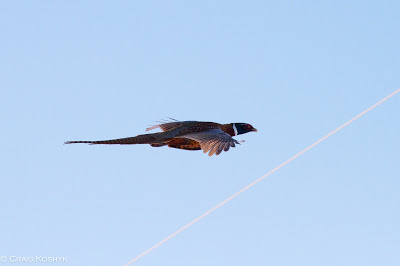
Then it was my turn. I found a spot next to a telephone poll and waited for the birds to fly over me. The first bird was a rooster. When it was about 75 yards away, I lifted my camera and fired off a long burst  of frames with my Canon's high-speed motor drive. Here is one of the first shots from that series.


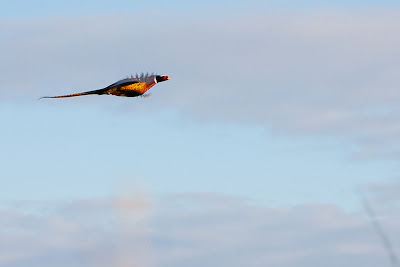
Notice the telephone wire in the bottom right corner? Well, it is one of two wires. The other one is not in the frame; I did not notice it. But neither did that rooster! As I was firing away with my camera, I heard a mighty TWANG! but kept on shooting. Then I saw a puff of feathers and realised that the rooster had flown right into the wire. But he seemed to recover from the hit; I saw him fly away into the distance as the feathers he left behind floated down to the ground. So I turned my attention back to the other birds whizzing past me and got some nice shots like this one:


And this one


And this one


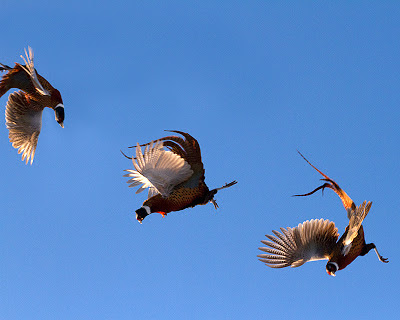
When all the action was over, I told Ross about the tumbling rooster but figured I missed getting any shots of the action. It wasn't until we were back at the hotel reviewing all the images of the day that I noticed I actually did capture the action, at least in part. 

So here they are, three not-quite-in-focus shots of the tumbling rooster, Photoshoped into a single frame. 


History of Pointing Dogs, Part 3: Order & Expansion

Craig Koshyk

This is the third and final part of the History of Pointing Dogs series. Here are links to Part 1 and Part 2.

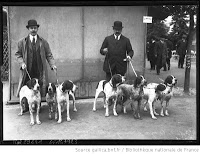
Field Trial Judges, France 1913 
Field trials were first run on the continent in the 1880s. Initially, British breeds, continental breeds and even half-breed mixes would sometimes run in the same stakes. Unfortunately, the results were almost always the same. Pointers and Setters, bred for generations to seek the horizon at a gallop, simply ran circles around the completely out-classed continental dogs that were bred to hunt at a trot, more or less within gun range.

Clearly, unless some adjustments were made to the rules and format, continental breeds were in danger of either turning into just another version of the Pointer or setter, or of disappearing altogether. So it was eventually agreed that British and Continental dogs should run in separate stakes. In many countries, that division is still in place today.
But even as the first trials were being run in the 1880s, questions about their effectiveness as a selection tool were being raised. Hunters in some areas, Germany in particular, questioned the very narrow focus of the events. So they began to organize forest trials, water trials and non-competitive tests designed to evaluate every aspect of what were then called “practical hunting dogs”.

They eventually decided to follow the principles of livestock breeding instead of the horseracing model upon which field trials were based. After all, they were not looking for a one-in-a-million winner to use in highly inbred lines. Their goal was to establish and maintain a strong population of dogs that had all been tested and proven in as many ways as possible. But, in the early days, progress came mainly through trial and error. William Heinrich, a GWP breeder in Germany who shares my interest in the hunting dog history provided me with the following observations about the period:
Despite the fact that many of the men involved in these efforts were highly educated, they had little practical and theoretic knowledge that they could apply to the field of dog breeding. This presented breeders with a number of new challenges. One of them was how to combine different types of dogs into a single breed while retaining the various abilities of each. Today it seems hard to believe that those breeders did not have a very good understanding of breeding principles. After all, Mendel’s experiments, carried out in the 1850s, should have shed tremendous light on the mechanisms of heredity. Unfortunately the general public did not even hear about Mendel’s work until well after the turn of the 20th century. 
When the German versatiles were created, breeders did not even know that there is a genotype behind the phenotype! Reading the old publications, you get a sense of their frustration and despair. Things happened that they did not understand. We can now see that they discovered everything by countless experiments. Our breeds were developed by trial and error. This leaves a wide field for interpretation. That’s why history is so fascinating and why historians never agree.
Hegewald
The system that eventually proved the most effective was one that combined comprehensive testing with strict breeding controls. Several men are credited with coming up with the idea. The most famous is Sigismund Freiherr (Baron) von Zedlitz und Neukirch. Writing under the pen name Hegewald, his untiring promotion of the versatile hunting dog concept is what eventually led to the creation of all the German pointing breeds. He is also credited with helping establish the Deutches Gebrauchshunde-Stammbuch (German versatile dog stud book). But his single most important achievement was the successful battle he fought for the establishment of a performance-based testing and breeding system.

Oberlander
Another leading figure was Carl Rehfus who wrote under the pen name, Oberländer. Like Hegewald, Oberländer was a nationalist. Highly critical of the British pointing breeds and the “Anglomania” in certain circles of German society of the time, he insisted that there was no need to use English blood in the development of the German versatile breeds. He was also very much against the idea of dog shows and wrote scathing articles about the direction that Germany’s dog establishment was taking. Eduard Korthals and his patron, Prince Albrecht of Solms-Braunfels, also worked hard to establish the new system. But Korthals was an internationalist who tried, but ultimately failed, to establish a pan-European versatile dog movement.

By the 1930s, the majority of breeders in Germany were convinced that, for their purposes, a non-competitive testing and breeding system was superior to the field trial and dog show system used elsewhere. But it wasn’t until the 1960s that hunters beyond Germany, and its neighbors to the east, started to understand why.

Pointers and Setters had been in North America since colonial times, and it is likely that a few individual pointing dogs from the continent made their way across the Atlantic with the waves of immigrants in the late 1800s. But serious efforts to establish viable populations of Continental breeds in North America did not really get under way until after the First World War when small but increasing numbers of GSPs, Weimaraners, Brittanies and Griffons began to appear in the US and Canada. But when war again broke out in 1939, everything came to a grinding halt.

After the Second World War, vast areas of Europe lay in ruins, millions of its citizens had lost their lives, and many of the Continental pointing dog breeds were on the verge of collapse. At first, recovery was slow and difficult. Breed clubs had fallen apart, studbooks had been destroyed, and thousands of breeders and their dogs had perished. But almost as soon as the shooting stopped, dedicated men and women across the continent began the arduous task of rebuilding, and in some cases completely recreating, their breeds. 
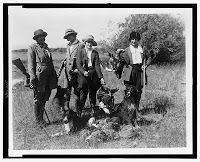
And it wasn’t long before many of the tens of thousands of allied service personnel stationed in Europe found out about the local gundog breeds. By the 1950s they were buying as many as they could get their hands on and shipping them home to booming markets in North America and the UK. In the 1960s, as a growing middle class with more leisure time and disposable income than ever before grew across the western world, interest in the outdoor sports, field trials and dog shows exploded.

As a result of all the interest—and undoubtedly the lure of quick money—dog populations skyrocketed. In less than a decade, breeds that had been completely unknown before the war were now numbering in the tens of thousands. The first attempt to organize non-competitive hunt tests was made in Canada, in 1963, by the All Purpose gun Dog Club of Ontario. The club was mainly made up of field trial enthusiasts who wanted to add a water-work component based on retriever trials to their events. They began by adding some German test regulations to North American field trials rules, but for various reasons the club did not last long. It was disbanded in 1965.
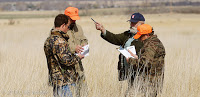
NAVHDA Judges 
Undeterred, former club member Bodo Winterhelt, a German immigrant living in Canada, began to work on a new format. In May of 1969 he and other gundog enthusiasts met to form a new club. Their goal was to create a new system based on elements of German tests that would be modified to better suit North American hunting traditions. One of the first orders of business at the meeting was to choose a name for the club. After much debate, the members chose north American Versatile Hunting Dog Association, or NAVHDA. They also agreed to focus on recruiting owners of hunting dogs to the new club instead of trying to convince field trial enthusiasts to adopt a new format. John Kegel, at whose home the first meeting was held, wrote that at the end of the first meeting no one had any idea of just how big the club would eventually grow. Once my liquor supply was exhausted, everyone left not knowing that they had started a new movement that soon would expand to the United States and make history in the hunting dog world. 

The first NAVHDA tests were held in October of 1969 and May of 1970. Growth for the new club was slow at first. Field trials, which had been run in North America for nearly a century, dominated the sporting dog scene, and it was very difficult to convince people that there were others ways to evaluate the hunting abilities of gundogs. Even well-known dog trainer and writer, David Michael Duffey, could not quite get his head around the idea of non-competitive testing. Writing in the January, 1973 issue of Outdoor Life magazine he described NAVHDA testing as ... a form of field trialing that’s relatively new and strange to North American sportsmen and a somewhat alien concept... not likely to spread like a prairie fire in the next few years.

Duffey was correct in predicting a slow start to the new club, but things picked up steam in the late 70s and 80s and by the 1990s, it was growing rapidly. Today, NAVHDA has a membership of over 5,000 sportsmen and women. Its 65 chapters in the US, and nine in Canada, run a total of over 300 tests each year in which over 2,000 dogs are evaluated. What began as a small club with only a handful of early supporters is now a dominant force on the versatile pointing dog scene in North America.
JGHV Test
Meanwhile, in Europe, the fall of the Berlin wall in 1989 led to the reunification of breeds that had been separated 50 years earlier. Then, in the mid-1990s, the Internet came along. It was the most significant development on the gundog scene since the invention of gunpowder. Today, there is hardly a breed club in the world that does not have a web presence. For many individual breeders having a website is just as important as having a heat lamp over the whelping box. 

Almost overnight, the Internet stimulated renewed interest in many of the established breeds and breathed new life into breeds that had been struggling for years. These leading-edge technologies have also contributed to the transformation of the gundog scene. We now produce puppies via artificial insemination and test their DNA to screen for health concerns. We vaccinate our dogs and feed them store-bought food. We transport them in airliners and four-wheel drive trucks and we keep track of them in the field with the help of satellites floating in the sky above.

But there are some threats looming on the horizon. The most significant among them is the alarming decline of outdoor sports in much of the western world. In many regions, increasingly restrictive hunting laws are being passed and anti-hunting movements are gaining ground. Access to hunting areas is harder to come by and even field trial clubs and testing organizations are having a tough time finding suitable grounds for their events. And sadly, as older hunters pass on and fewer youngsters take their place in the hunting field, the hunting culture for which our pointing dogs were designed may one day fade away.

Yet, in spite of it all, some things will never change. We will always love our pointing dogs, and through them, forever seek a closer connection to the natural world.

Me and Uma, our Pont-Audemer Spaniel


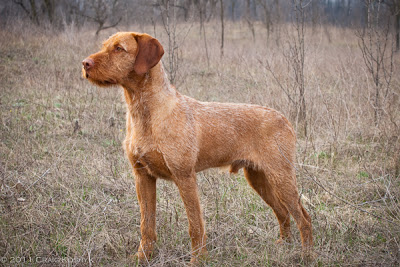
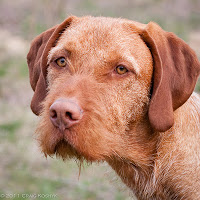
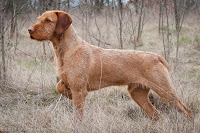
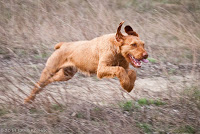
Breed of the Week: Hungarian Wirehaired Vizsla

Craig Koshyk

At first glance, the story of the Wirehaired Vizsla seems fairly ordinary— Hungarian hunters created the breed in the 1930s and ’40s by crossing smooth-haired Vizslas with German Wirehaired Pointers. But if you consider what was going on in that part of the world during the breed’s formative early years, the story turns out to be anything but ordinary.


HISTORY
Hungarian pointing dogs with rough coats are mentioned in writings as far back as 1886. By the early 1900s, “prickly coats” and long-haired1 coats were occurring in litters of smooth-haired Vizslas as a result of the rampant crossbreeding going on in Hungary at the time. Eventually, when the first standard for the Vizsla was drawn up, only the smooth coat was allowed. However, it is clear that some breeders continued to breed rough-coated dogs—probably because they found them to have an advantage in colder, wetter regions. Then, in the late 1930s, two breeders, József Casas and László Gresznarik, decided to make it official. They bred two Vizsla bitches to a solid brown German Wirehaired Pointer named Astor z Potattal. The best pups from the resulting litters were then crossed.

József Vasas and László Gresznarik where not just everyday hunters or breeders looking to build a better mousetrap in some far off corner of Hungary, both men were well-respected gundog experts. Gresznarik, in particular, was known throughout the region as an experienced breeder of German Wirehaired Pointers, Cesky Fouseks and other breeds. In Slovakia, Koloman Slimák—another well-known figure who would eventually go on to create the Slovak Pointer—also began to work on a wire-haired version of the Vizsla shortly after Vasas and Gresnarik got the ball rolling. However, it appears he may have used a slightly different recipe. According to some sources, he German Wirehaired Pointers, Irish Setters, and Pointers into his own line of smooth-haired Vizslas.

The part of Europe in which all three men lived and worked was not an out-of-the-way backwater. In fact, it stood front and center on the world’s stage several times during the early years of the breed’s development. In 1920, the signatories of the Trianon Peace Treaty completely redrew the map of the entire region. Hungary lost almost 70 percent of its former territory, including much of its northern highlands. Suddenly, millions of Hungarians found themselves citizens of a brand new nation: Czechoslovakia. Eighteen years later, on the eve of the Second World War, the situation was reversed. Hungary regained most of the land it had lost in 1920, and was given a large chunk of southern Slovakia. During the Second World War, the front lines of battle passed over the region twice, completely devastating much of it. After the war, Czechoslovakia was reestablished and the borders were once again redrawn.

It is hard to fathom how men like Vasas, Gresznarik, Slimák and others involved with the Wirehaired Vizsla could have continued their breeding efforts during those tumultuous times. But somehow they did and, somehow, the Wirehaired Vizsla survived—barely. Like its smooth-haired cousin, it had come close to extinction during the war, but its supporters rallied just in time to save it after the hostilities ceased. During the 1950s, a state-run kennel was established for both versions of the Vizsla and, by the 1960s, the breed had recovered well enough to be recognized by the FCI. Since the 1970s there has been slow but steady growth for the Wirehaired Vizsla in Europe and North America, but the breed is still far less popular than its smooth-haired cousin. Although still considered a rare breed, the popularity of the Wirehaired Vizsla is growing. There are now breeders in France, the Netherlands, Germany, Czechoslovakia, Denmark, Sweden, the US, Canada and the UK. Approximately 200 pups are whelped annually in Hungary, and an additional 100 to 150 more by breeders elsewhere.

MY VIEW
The first time I ever saw a Wirehaired Vizsla was at an informal training day arranged by a group of enthusiasts right here in Manitoba. The only Vizslas I’d seen before had smooth, short coats, so i was quite surprised to see one that looked like it needed a shave! I was soon corrected by the dog’s owner who told me that the Wirehaired Vizsla is a completely separate breed.

Watching that young dog work through the mud and reeds of a local marsh—we were training for an upcoming NAVHDA test—was a real treat. He had a lot of drive and his coat looked ideally suited to the cover. Over the next few years, I saw other Vizsla here and there, but I never really got the chance to speak to any breeders or owners. It wasn’t until Lisa and I travelled to Hungary, and met an extraordinary young woman, that we finally began to learn more about the breed.


Zsófia Miczek
does not look like your typical gundog breeder. In fact, she looks like she should be on a movie set or at a fashionable café in downtown Budapest. Her pretty face, blond hair, and youthful personality do not exactly shout “hard-core hunter”. But looks, as they say, can be deceiving. Not only is Zsófia perfectly at home in the hunting field, she’s a familiar face on the field trial, hunt test and dog show circuit in Hungary and beyond. In fact, she’s the founder one of the most successful Vizsla lines in the world.


Lisa and I met Zsófia at her home just outside Budapest and spent the better part of a warm spring day with her and her dogs in the field. Having photographed a number of smooth-haired Vizsla the day before, we were curious to see how the two breeds compared. The first thing we noticed, obviously, was the harsh, wiry coat. It seemed to be a slightly lighter shade of “russet gold” than the coat of the smooth-haired Vizslas, but still very appealing. Some coats were longer than others. Zsófia mentioned that breeders have now achieved better consistency in this regard, but that her oldest dog had the “old style” coat— noticeably longer and softer than the others. Dogs from more recent generations had harsh, flat-lying coats with just enough facial furnishings to give them a distinguished look without being too fuzzy. In the field, the dogs were all business. They showed a lot of desire as they hunted at a medium gallop out to about a hundred meters. They responded instantly to Zsófia’s whistle as she handled them across the rolling terrain.

Compared to the smooth-coated Vizslas, the Wirehairs seemed a tad bigger with a stronger, more forceful stride. In terms of character, they were a lot like their smooth-haired cousins: happy, friendly and eager to hunt. The strongest personality that day actually belonged to Zsófia. She is a fiercely competitive young woman determined to prove herself and her dogs in the male-dominated gundog scene in Hungary. Lisa asked her if all Hungarian women were so strong-willed and tenacious. Zsófia smiled, and replied:
I don’t think Hungarian women are known for being particularly tough. I guess I am just an unusually strong woman. I have had to deal with the fact that being blond, female and young is a disadvantage in this sport, because most judges and competitors are men, who just can’t accept my success. It’s as if some of them do everything they can to prove that I am not as good as my record shows. Emotionally, it is very difficult and I have a hard time accepting it because, if there is one thing I hate, it is discrimination. But I am not going to step back. I will continue to prove the quality of my dogs, no matter what! 
To me, Zsófia’s reply perfectly echoed the kind of determination the breed’s creators must have had in the early days. It is nice to know that the Vizsla is still in the hands of such tenacious people today.

Here is a video of one of Zsófia’s dogs working a (planted) quail.


1. pups with long-haired coats—a disqualifying fault in both standards—still pop up from time to time in litters produced by smooth-haired or wire-haired parents. 
2. Gresznarik owned the “Selle” kennel until the 1960s. It was taken over by Stefan Hrncár in 1971.


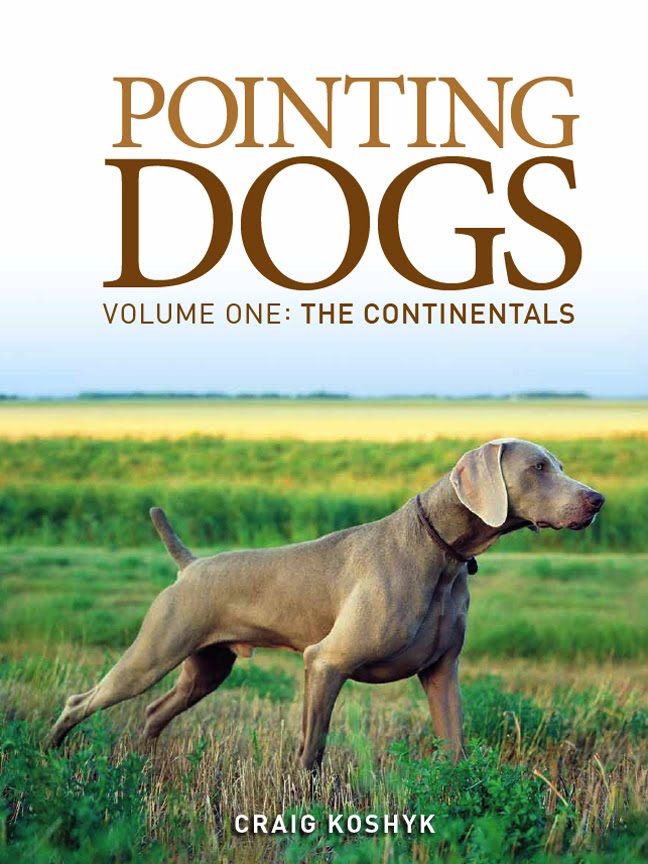
Read more about the breed, and all the other pointing breeds from Continental Europe, in my book Pointing Dogs, Volume One: The Continentals
http://www.dogwilling.ca/index.cfm

Breed of the Week: The Vizsla

Craig Koshyk

Hungarian is not related to most of the other European languages. In an interesting parallel, it is said that Hungary’s national dog, the Vizsla, is not related to the other western European pointing breeds. Some sources claim that the Vizsla came from Asia minor, just like the Hungarian language. However, unlike the rigorous studies that support a non Indo-European origin for the Hungarian language, the evidence for an ancient, Asian origin for the Vizsla is pretty slim.

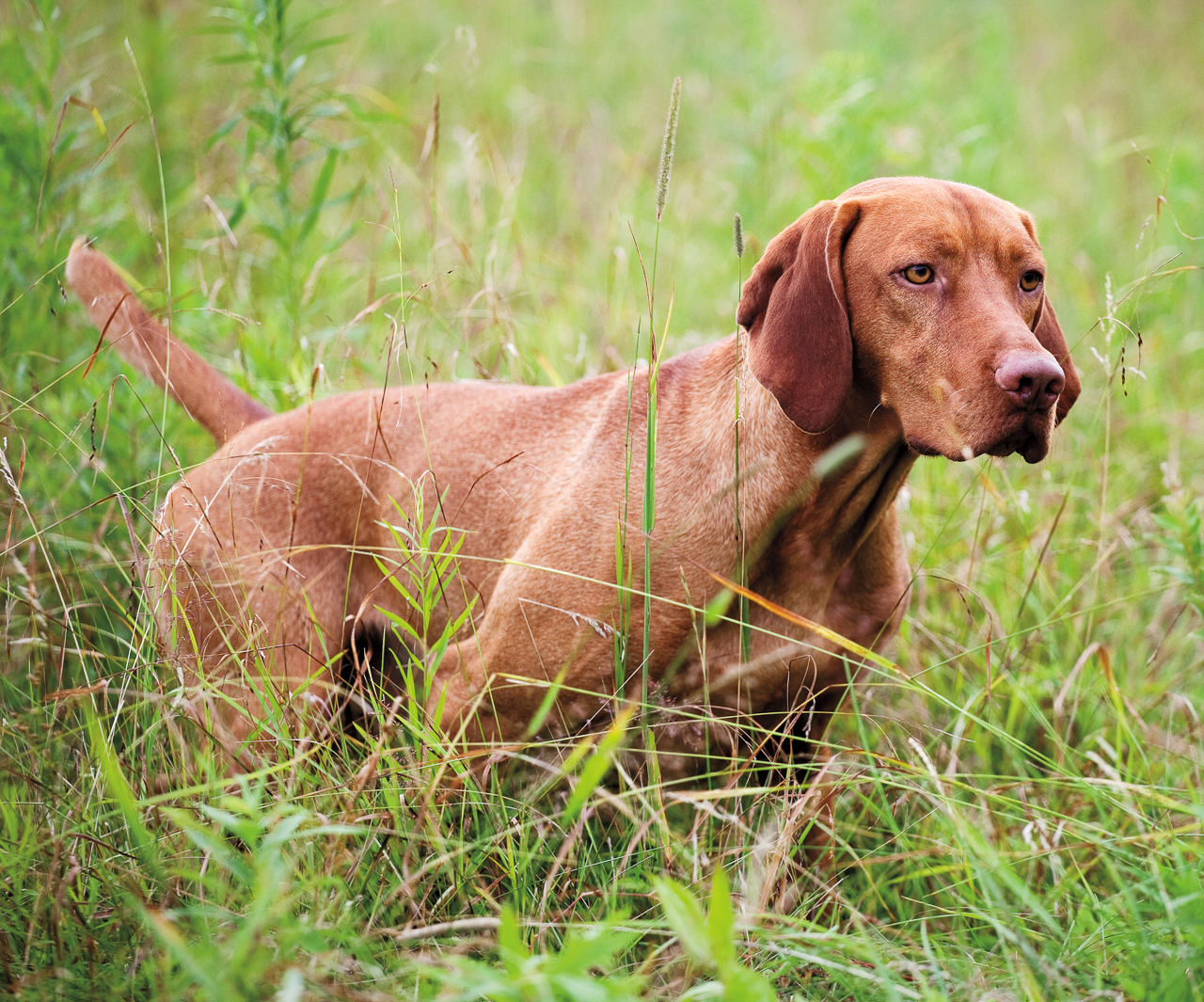
Vizsla-20100717183719-Edit©2010 Craig Koshyk.jpg

History
Coming up with an accurate timeline for the development of the Vizsla is not easy. Many of its published histories read more like wishful thinking than scholarly analysis. Claims that the Vizsla has been purebred for over a 1,000 years or that ancient rock carvings depict Vizslas hunting with hawks are repeated endlessly in books, magazines and especially on the internet— without any attempt to substantiate them or to even put them into an historical context. For example, many authors claim that references to the Vizsla can be found in a 14th century manuscript known as the Vienna Illuminated Chronicle. (1)

If true, such a reference would certainly support the idea that the Vizsla is indeed an old breed of hunting dog. However, no one seems to mention that the Chronicle is written entirely in Latin and that the word Vizsla appears nowhere in it. But it does contain illustrations of hunting scenes, some featuring dogs. And if you squint hard enough and use your imagination, you may see one or two dogs that have a vague resemblance to the modern Vizsla. The problem is, they have a vague resemblance to just about every other short-haired hunting breed. They could be anything from Foxhounds to a Ridgebacks. Yet, somehow, a number of authors have concluded that not only are the dogs definitely Vizslas, but the illustrations actually prove that the breed has been kept pure for centuries! Even the AKC falls into this trap with an absolutely ridiculous statement on its website: Apparently, the breed was a favorite of early barons and warlords who, either deliberately or by accident, preserved its purity through the years. (2)

How an organization that exists to help keep dog breeds ‘pure’ can suggest that early barons and warlords accidentally preserved a breed’s purity is beyond me. Fortunately more level-headed people have taken a closer look at the history of the breed. One of the best analyses that i’ve been able to find is in an article written by Géza Frank Say in The Hungarian Review, Vol. 1, Issue 1, 1971:

A thousand years ago the Magyars occupied the land that is now known as Hungary. These people were hunters accompanied by various breeds of dogs, among them a “yellow dog” used for hunting. This information, however flattering, needs thorough research... This writer...regrets not being in the position to elaborate on the early history of the Vizsla due to a lack of available literature. That there was a “yellow dog” is an undeniable fact.

Okay, the ancient Magyars had yellow dogs; fair enough. Were they similar to the modern Vizsla? I doubt it. My hunch is that they were actually some kind of hound similar to the modern Erdelyi Kopóv (Transylvanian Hound) or Slovenský Kopov (Slovakian Hound) or a sighthound similar to the Magyar Agár (Hungarian Sighthound).

The yellow dogs were undoubtedly used to hunt small game such as hare, upland birds and waterfowl that they flushed for hawks and falcons, and some of the dogs were probably taught to “set” when hunting with a net. At some point, they began to be called Vizslas, but even today the word “Vizsla”—whose etymology is still pretty murky—is a term used to describe a type of dog, not a particular breed. Like the French term chien d’oysel, it may have originally been used to describe any dog that “served the bird” but nowadays it is used like the French term braque. Vizsla simply means “pointing dog”. (3)

In any case, efforts to develop a modern breed of pointing dog in Hungary did not get under way until about the middle of the 18th century when Hungarian hunters, like hunters across Europe, started to shoot birds on the wing. They probably began by crossing whatever local dogs were on hand to the pointing dogs that were spreading across Europe from Spain, France, Italy and, later, from England. By the mid-1800s there was probably a fair number of locally bred pointing dogs called Vizslas, and by the 1880s we find the first records of Magyar Vizslas (Hungarian pointing dogs) in public competition. In 1881 a field trial club was even established for the breed and hosted its first trial near Budapest in 1882. Several Vizslas were entered but it is not known if they were purebred or, as some speculate, actually crossbred with German Shorthaired Pointers or English Pointers.

Whatever they were, they failed to spark much interest in the format among Vizsla breeders. By 1886, the field trial club was disbanded. At around the same time, new hunt tests were being developed in Hungary, but not many Vizslas appear to have participated. It seems that Austro-Hungarian hunters were abandoning their native breeds in favor of the more fashionable English Pointers and Setters. By 1900 there were so few Vizslas left in Hungary that many worried the breed could disappear completely. Fortunately, a few dedicated supporters decided to take action. They searched the country for any Vizsla that appeared to be of “pure” blood and managed to find about a dozen. Out of necessity, they crossed them with other breeds. It is not known which breeds they used, but it is very likely that Transylvanian hounds (Erdelyi Kopóv), German shorthairs, English pointers and Irish setters were used.

Unfortunately, despite these efforts, the breed’s decline continued. By 1914 it was nearing extinction. Then, in November 1916, in a last ditch effort, Dr. Tibor Thuróczy published an article in the hunting magazine Nimród Vadász Újság appealing to his fellow hunters to save the Magyar Vizsla. He succeeded in rallying enough support for the cause and breeding efforts were renewed. In 1920 the breed received another tragic setback. With the signing of the Trianon Peace Treaty, Hungary lost huge parts of its territory to Czechoslovakia, Romania and Yugoslavia. Many Vizslas remained outside of Hungary and were lost to breeders trying to revive the breed. But the situation did lead to increased nationalism in Hungary and patriotic Hungarian breeders redoubled their efforts. They established the Hungarian Vizsla Club and the first stud book for the breed in 1920. The first official standard was published in 1928 and in 1935 the FCI recognized the breed. In 1936 the stud book for the breed was closed. Crossbreeding was no longer allowed from that point forward and the breed was declared “pure”.

By 1940, the population of Vizslas in Hungary was approaching several thousand, and it looked like the breed was out of the woods. Then, yet again, the ravages of war dealt the Vizsla another near-fatal blow reducing the population to dangerously low levels. The club disbanded, and the original stud book was destroyed by fire. In 1947, reconstruction of the breed got underway in a state-sponsored breeding farm at Gödöllő, east of Budapest. Dogs with known pedigrees, and those without pedigrees but meeting all the criteria for appearance and hunting ability, were used to create the modern Vizsla. In 1956, a new Hungarian Kennel Club was established, and accepted by the FCI in 1963. 

By the 1970s, performance tests and trials had once again been established and breeders started selecting for dogs with a sleeker, more athletic build and a faster, more dynamic working style. The Vizsla’s popularity grew enormously, both at home and abroad, with clubs forming throughout Europe and North America. Unfortunately, along with very rapid and uncontrolled growth came the inevitable development of show and pet lines within the breed. Today, most Vizslas are still naturally gifted, easily trained gundogs. However, the breed continues to struggle with a growing popularity among non-hunters, even in the its native land.

1. The full name is Chronicon Pictum, Marci de Kalt, Chronica de Gestis Hungarorum.
2. American kennel club, “vizsla history”, www.akc.org/breeds/vizsla/history.cfm 
3. For example, in Hungarian, the name for the German Shorthaired Pointer is Német Vizsla and for the Braque Français is Francia Vizsla.

Read more about the breed, and all the other pointing breeds from Continental Europe, in my book Pointing Dogs, Volume One: The Continentals

http://www.dogwilling.ca/index.cfm