Contact Us

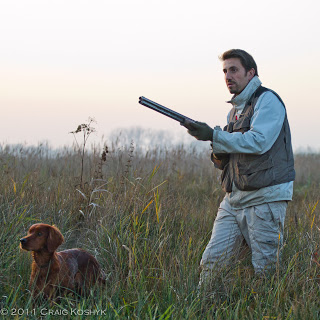
Use the form on the right to contact us. We should get back to you within 24 hours. If not, it means we are out chasing birds with dogs, shotguns and Canons. In that case we will get back to you as soon as we've finished the roasted Teal and Bordeaux . 


Form Block
This form needs a storage option. Double-click here to edit this form, and tell us where to save form submissions in the Storage tab. Learn more
         

123 Street Avenue, City Town, 99999

(123) 555-6789

email@address.com


You can set your address, phone number, email and site description in the settings tab.
Link to read me page with more information.

Pointing Dog Blog

The world of pointing dogs in words and images, moving and still.

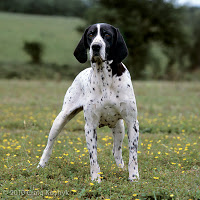
Breed of the Week: The Braque de l'Ariège

Craig Koshyk
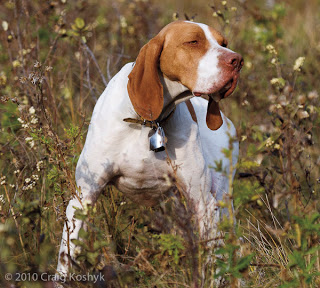

Gaston Phébus, author of one of the greatest books on hunting ever written, le Livre de la Chasse, ruled over a region which is now part of southern France. Once known as Foix and Béarn, his lands were renamed during the French revolution, parts of them becoming the modern French département of Ariège.

HISTORY
The Braque de l’Ariège is a fairly modern variant of the classic continental pointing dog. According to a history compiled by Bernard Senac-Lagrange in 1940, and echoed in the FCI standard, the breed came from...
...the old French braques, which in the 19th century were crossed with braques of Meridional (southern) stock of white and orange coat, to give them more lightness and activity.
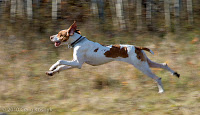
Jean Castaing, in a detailed analysis of all available records including first person accounts, disputes Senac-legrange’s story and argues that the Ariège was actually created by crossing old style Braques Français with Braques Saint Germain. No matter what its true origins, everyone seems to agree that large white and orange pointing dogs were being bred in the Ariège region of southern France as early as the mid-1800s. 

On June 9th, 1905 at a dog show sponsored by the Société Canine du Sud-Ouest, a number of eminent dog experts met to write a standard for the breed which by then had been named the Braque de l’Ariège. Interestingly, they also employed the services of the well-known sculptor Henry Villard, who created a life-sized model of the ideal Braque de l’Ariège. The sculpture apparently still exists, stored somewhere at the School of Veterinary Medicine in Toulouse.
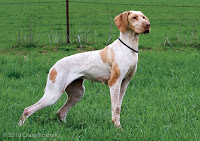
The breed’s popularity rose steadily in the first two decades of the 20th century, but not without controversy. Some breeders, intent on competing with British breeds, began to infuse large quantities of English Pointer blood into their lines of Braque de l’Ariège. Others began to select for an all-white coat. The results eventually proved disastrous. Cases of albinism began to appear and, as the breed took on a more English Pointer-like working style, it began to lose many of the qualities that hunters in the South of France wanted in their dogs; namely a more moderate pace and range.

It soon became obvious that breeders had gone too far and that something had to be done in order to return the breed to a more classic braque style. So the club decided to allow cross-breeding to a related breed. But before they did, they sought advice from Paul Mégnin, one of the most respected authorities on hunting dogs of the day.
The club did me the honor of asking for my opinion. I left aside the Braque Saint Germain, and even the Braque Français, and I suggested the Bracco Italiano that, to me, seemed to be quite similar to the Braque de l’Ariège: very braque in type, white and orange or white and brown coat, and the samehunting style.1
Mégnin even went so far as to help make arrangements for Ariège club members and breeders to visit Italy in order to select possible stud dogs. Unfortunately, the plan never got of the ground. One or two dissenting club members succeeding in eventually stifling the entire project, basing their objections on the fact that the Bracco Italiano has dewclaws on its hind legs and the Braque de l’Ariège should not. Mégnin was outraged.
What can be simpler than removing the rear dew claws at birth? ... The removal of rear dew claws is legal, easy and safe, and after two or three or four generations [of selection], the rear dew claw can disappear and never come back. But all was abandoned, and today where is the Braque de l’Ariège and what has become of it?2
By 1937 Senac-Lagrange could only find a small handful of dogs that fit the breed standard and declared in a pamphlet that the Braque de l’Ariège had all but died out. Throughout the 1940s and ’50s, registrations with the Société Centrale Canine declined until they stopped completely. Castaing wrote in 1960 that the breed:
...has completely disappeared...a victim of the two great scourges that always threaten our native breeds: on the one hand excessive inbreeding to maintain a secondary characteristic [i.e., an all-white coat]...and on the other hand an abusive level of foreign blood that altered its essential characteristics.3
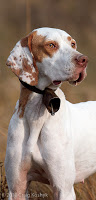
For almost three decades the Braque de l’Ariège remained in a sort of limbo. No one seemed to be breeding them, let alone registering pups. But the SCC did not officially declare the breed extinct or remove its standard from the list of French breeds eligible to compete in shows and trials. Then, in 1987 a small group of hunters met in Toulouse, a city just outside of Ariège. They had come together to launch an effort to find out if the Braque de l’Ariège was truly extinct or if there were still a few remaining dogs living in the remote hills of southern France.

After months of searching, they managed to find several dogs that matched the breed description very closely. It turned out that a few hunters in Ariège and the neighboring département of Haute Garonne had continued to breed the orange and white braques after all! From these dogs, the best ones were selected to serve as foundation stock for an ambitious project designed to resurrect the Braque de l’Ariège.

A new club for the breed was established in 1989 and a breeding program was put in motion. The first litters produced dogs with many of the qualities that the Braque de l’Ariège was originally known for: tremendous desire, a good nose, lots of point, a resistance to heat and sure footing in the mountains, but it took a few more generations to regain the classic look of the breed.

Today, the Braque de l’Ariège is well on its way to a complete revival, but is not quite out of the woods just yet. The population is still very low and almost exclusively in France. Nevertheless, it continues to gain converts among French hunters and has earned the respect of field trailers and judges. A few have even made their way outside of France and as of this writing one is now in the hands of an enthusiastic hunter in the US.

MY VIEW
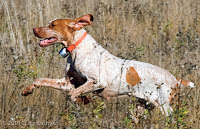
My interest in the Braque de l’Ariège was piqued when I read an article about the breed in a French hunting magazine. Intrigued, I searched the Internet for people i could contact in the hopes of one day seeing one of these rare dogs for myself. I was pleasantly surprised when the president of the club immediately replied to my request for information.

Jean-François Berho lives in southwestern France among the rolling foothills of the Pyrenees Mountains. In 2002, with typical Basque hospitality, he invited Lisa and me to stay with him for a few days. We happily accepted, and I’m glad we did. Not only did we get to see his dogs in action in some of the most beautiful countryside I had ever seen, we also became very good friends.

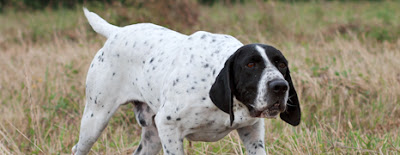
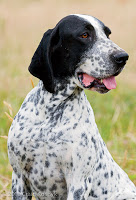
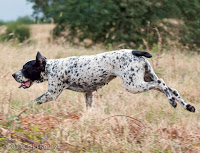
My first impression of Jean-François’ dogs was that they resembled the Bracco Italiano, but with a sleeker, less hound-like appearance. In the field, they were surprisingly agile. Lutin, a male from one of the earliest litters produced by the revival program absolutely plowed through the cover. His daughter Ohry, was just as intense in her search, but faster. I took a lot of photos that day and formed the impression that the Braque de l’Ariège is something very special.
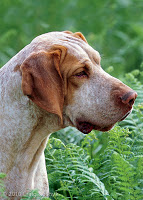
But, then again, we were in the foothills of the Pyrenees Mountains, watching a couple of experienced dogs run on their home turf under ideal conditions. The wine we were drinking—an absolutely sublime Jurançon—also added to the ambiance. Under those circumstances I would have probably found anything with four legs and a tail to be an awesome gundog!

Fortunately, 18 months later I got the chance to spend some more time with Jean-François and his dogs, but this time in Canada. For 14 days straight we worked stubble fields, pastures and forests of central Manitoba, hunting snipe and grouse. What I saw in that time confirmed my initial impressions of the breed: they can be damn good gundogs. One, in fact, turned out to be exceptional.

Ohry, the daughter of Lutin, who we first met in France, arrived in Canada after a nine-hour transatlantic flight and hit the field the very next morning. Within minutes of being cast off into a type of terrain she had never worked before, to find a species of game bird she had never smelled before, she absolutely nailed a point that made the hair on the back of my neck stand up. Before moving in to flush, Jean-François and I paused to admire the unique scene before our eyes: a Braque de l’Ariège backed by my Weimaraner on the prairies of Manitoba. Suddenly, a bird flushed. We shot. It tumbled. I don’t recall which dog made the retrieve, but it was the first bird of many that we shot over Ohry in the two weeks she was here. 
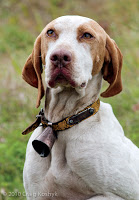
During her stay I saw enough of Ohry to conclude that she was one of the best, maybe the best gundog I have even had the privilege to hunt over. Her ability to find birds astonished me. Her desire was off the charts. Her run was the most amazing combination of strength and grace that I have ever seen. If I could clone her, I would.

In the years since then, I hunted over another half dozen Braques de l’Ariège and saw a few more in field trials in France. While none ever measured up to Ohry—few dogs could— they did prove to me that a good Braque de l’Ariège can hold its own against any other Continental breed. And in case you haven’t guessed it by now, I am a fan of the breed. I may even own a Braque de l’Ariège someday, and if I do I think I will name him Gaston Phébus.


1 Quoted in Jean Castaing, Les Chiens d’Arrêt, 144
2 Ibid.
3 Jean Castaing, Les Chiens d’Arrêt, 146


Read more about the breed, and all the other pointing breeds from Continental Europe, in my book Pointing Dogs, Volume One: The Continentals

http://www.dogwilling.ca/index.cfm

The History of Pointing Dogs Part 2: Progress

Craig Koshyk


The French revolution began in 1789. When it was Over 11 years later, Napoleon was in power and nearly every aspect of French life, including hunting and dog breeding, had changed forever. Some of the changes were positive. The revolution had given the average French citizen the right to hunt. But for the dogs kept in the kennels 
of aristocrats, the revolution spelled disaster. Many were slaughtered outright and others were stolen, but most were simply released to roam the countryside.
...Braques and Spaniels, reared with the greatest care in the castle kennels, became the property of the first comer. They were sent wandering through the country like wolves and foxes, and they interbred. Great brachs, beautiful spaniels, grey-hounds and sheep- dogs—all these wandering bands of the canine race were fused in a mixture, in a maze impossible to follow...6
For many years after the French Revolution, dog breeding on the continent was a complete free-for-all. There were no breeds, as we know them today. There were only general types of dogs —short, long and rough-haired — basically landraces that had developed in isolated areas. But there were no breed standards, no tests or trials and no long-term breeding plans. Hunters simply mixed and matched their dogs as they saw fit. And, for the most part, they were quite satisfied with what they had.
They often have perfect dogs because they hunt a lot and they kill a lot but the breed of dog is not important... ninety-nine out of a hundred would not hesitate to cross a good short-haired dog with a good long-haired bitch, of any breed of Épagneul or Griffon.7
It took many decades after the revolution for order to come to dog breeding on the continent. When a systematic approach was finally adopted in the 1880s, breeders made rapid progress. And they were spurred on by what can only be described as a British canine invasion.

In 1567 the first dog encyclopedia was published in England. In De Canibus Britannicis, author John Caius describes a new kind of dog that had recently come to England from France.
.... they are speckled all over with white and black, which mingled colors incline to a marble blue, which beautify their skins and afford a seemly show of comeliness.
He goes on to describe, “the dogge called the Setter”: 
...when he has found the bird, he keeps sure and fast silence,
he stays his steps and will proceed no further, and with a close, covert, watching eye, lays his belly to the ground and so creeps forward like a worm... this kind of dog is called Index, Setter, being indeed a name most consonant and agreeable to his quality.
A century and an half later, short-haired pointing dogs from Spain, Portugal and France were brought to the British isles by soldiers returning from the War of Spanish Succession. Most of the dogs were apparently large and slow-moving, but some were said to be smaller and faster. They quickly found a home in the kennels of British sportsmen, who set about breeding and modifying them to suite their tastes. Soon, as Arkwright wrote, “nearly every family of position had its own breed of Pointers”.

In the 1780s, the work of the English agriculturalist Robert Bakewell led to a major leap forward in agricultural production and the breeding of livestock. When applied to hunting dogs, his techniques quickly led to improvements in all areas of performance and appearance. And breeders, spurred on by the desire to one-up their peers, used the techniques to quickly develop lines of outstanding dogs. In his wonderful book "Pointers and Setters", Derry Argue wrote:
If the sixteenth and seventeenth centuries were the ages of discovery, this was the great age of innovation and competition... The country gentleman was now expected to keep stables of English thoroughbreds, carriages, packs of hounds, hundreds of game cocks out at walk, and kennels of fighting dogs, fox hounds, and pointers and setters all matched for type and color. This was life with style. To keep up with his neighbors he strove to keep better dogs, to acquire a better shotgun and to shoot more birds.8
By the mid-1800s, benefiting from years of political stability, increasing industrialization and modern breeding methods, the British were light-years ahead of everyone else. Their Pointers and setters were faster, further ranging and, above all, far more uniform in their looks and abilities than all others. They were, in the language of the day, “highly bred” and when they began to appear on the European mainland after the defeat of Napoleon in 1815, it was as if a bomb went off in the Continental hunting scene.

Hunters from France to Hungary, from Spain to Denmark soon fell in love with the elegant British dogs. Many turned their backs on their native breeds while others rushed to breed their dogs to the first Pointer or setter they could get their hands on. But some wanted nothing at all to do with the new imports, fearing that they were simply unmanageable. Even more interesting was the reaction of the English when they first encountered the Continental pointing dogs.
There is, however, one thing which cannot escape notice the very first time one shoots in company with French sportsmen, and that is their dogs. There is no medium class of animals with them; they are either good or bad, broken or unbroken, eminently useful or worse than useless. The latter form the more numerous class, of course. As for the good ones, they are pre-eminently useful, and it is astonishing what they can do.9
Some so-called German Pointers are, however, perfect monsters in size. I have seen one which was as big as a small donkey. When this fellow came past you at a trot he shook the very ground, at least I used to say so to his owner. 10
The different hunting styles of the Continental dogs were, of course, reflective of traditions of the countries in which they were developed.
The French nation loves sport, or rather the pursuit and capture of animals, passionately. It is, however, true that my countrymen shoot for the pot rather than for sport, and will as a rule overlook a fault in their dog so long as a wounded partridge or hare does not get away...11
In his sport the average German does not belie his Teutonic origin and his close relationship to his English brother. Sport for him is not for show or for the pot, as with some Oriental and other races. Like Englishmen, he is refined in his pleasure, not cruel to animals, a thorough sportsman, who loves his sport for its own sake.12
Game and hunting techniques also influenced how dogs were bred and used on the Continent and it was becoming increasingly clear that the average Continental hunter was different from the average English sportsman. More often than not, he was a middle-class professional or even a member of the working class and, to him, the best dogs were those that could do a variety of tasks.

Partridges are found nearly everywhere, their distribution following about the same rules as hare. They are shot in August and September. ...driving in the English way is not unknown but the regular German way is to walk them up with dogs, generally one dog to every gun, that acts as pointer and retriever alike. English pointers and retrievers were largely introduced thirty or forty years ago but as the average German hunter is not, like his col- league in England, rich enough to keep a variety of dogs and men, and as the grounds as a rule are less extensive, sportsmen tried to train them for both purposes, but had good results in rare cases only. French griffons and poodle pointers (sic) have answered better, but best of all is the old German heavy close-haired dog crossed with English pointer blood. The old dog was rather slow but very intelligent, and the cross improved his staying powers, endurance, and scent. ...In summer he must act as a bloodhound on the trail of a wounded roe, retrieve ducks in the water and act as a spaniel for woodcock and snipe. In September he must take no notice whatever of hares and retrieve them without noticing partridges. This is no tall story; quantities of dogs do it, and all well-trained ones should do it. 13
Many of the English accounts also point out how little concern the average Continental hunter had for pure breeding. 
In fact, the French pay very little attention to the breed of their dogs, as a walk or ride through any large town will at once satisfy you, and I could find more mongrel-bred ones in one day, in the town of Calais, than could be found in England in seven days.14
French sportsman and dog expert, Adolphe De la Rue, actually witnessed the very beginning of the widespread and indiscriminate period of crossbreeding in France that would lead to the development of entirely new breeds, and threaten others with extinction.
I remember that it was on one of the opening days, so noisy and numerous, that I saw for the first time a large black pointing dog
of the kind that appeared in France in 1814 with the English army. The dog was so highly regarded that his owner did not know who to answer first. All of his neighbors had the dog cover their bitches, even if the bitches were épagneuls. Based on what I saw, I can conclude that these thoughtless crosses were taking place more or less everywhere, a dog of a foreign breed would appear, everyone would take a liking to it and want one of its kind. 15
As the number of dogs bred on the continent rose, quality declined. It seems that the main goal of many breeders was to produce as many pups as possible, as quickly as possible.
I knew a forester that had a dog and a bitch, they were adequate, brother and sister; he told me that he had sold in a single year, two litters from them, each with eleven pups, at the age of two months.16
Even worse, a seemingly endless number of “rediscovered” breeds kept cropping up. After judging a dog show in Paris in 1884, Ernest Bellecroix published a plea for reason:

Last year we were crushed under a completely unexpected number of classes. In all the species, native or foreign, new breeds, until now unknown, were discovered. ...there were 145 classes! ... Of all these different classifications, which one is the proper one? We have no idea. Therefore...we request that the Society that has the difficult task of improving the breeds of dogs determines these breeds once and for all and clearly defines their characteristics. Even the owners of dogs sometimes had no idea what kind of dogs they owned or bred and often would enter them into the wrong class at a dog show or field trial. 17
Several years later, an even harsher review was published. It illustrates just how extreme some of the opposition to the native breeds had become. Describing what he’d seen at the 1891 dog show in Paris,
 a Mr. Des Mureaux wrote:
We are shown an animal, usually horrible, and we are told: Here is the last specimen of an admirable breed, unfortunately wiped out —if only it were!—and that it should be reconstituted. I therefore... propose to offer a dose of strychnine to every one of these ugly four- legged beasts and I would give a prize to the first one to disappear.18
Fortunately, not everyone was ready to throw the baby out with the bath water. Influential personalities like James de Coninck in France, Ferdinando Delor in Italy, and above all, Hegewald and Oberländer in Germany, spearheaded a sort of countermovement to the anglophilia running rampant among hunters on the continent. They realized that for all the speed, endurance and style of the British dogs, they were not perfect. What breed is?  For some types of game and terrain, the native breeds were much better suited. But the greatest source of motivation may have been growing nationalism and a renewed interest in the traditional ways of hunting. Many hunters were beginning to realize, just in time, that their native breeds were a vital part of their nation’s sporting heritage and deserved their attention.

When I asked Wilhelm Heinrich, a friend and fellow gundog history buff in Germany about Hegewald he wrote: 
In 1871, when the unity that many generations of Germans had waited and fought for had finally been achieved, Hegewald was in a perfect position to bring this “national awakening” into the hunting and dog scene. There were similar protagonists in the arts, industry, and science. In the hunting and dog scene, Hegewald was the man. His writings perfectly capture the spirit of the “New Germany” with its rapidly increasing economic and military power. He wrote from 1880 to about 1900; mainly articles in various newspapers and magazines. His writings where a mix of romanticism and nationalism and stories about the “German forest and forester” and the “ennoblement of the blood toward a noble German dog”. Through them, he captured the imagination of the young second German Empire. 
These men also realized that if the old breeds were to survive, and new ones created, they had to find a way to identify the best individuals among them to use as breeding stock. The first system they adopted was based on the British concept of head-to-head competition in the show ring and open field.


Footnotes:
6 Frederick George Aflalo, ed., Sport in Europe, 127
7 A. de La Rue, Mis de Cherville, Ernest Bellecroix, Les Chiens d’Arrêt Français et Anglais, 40
8 Derry Argue, Pointers and Setters, 35
9 Lewis Clements, Shooting, Yachting and Sea-Fishing Trips, at Home and on the Continent, Volume 1, 302
10 Lewis Clements, Shooting, Yachting and Sea-Fishing Trips, at Home and on the Continent, Volume 2, 93 13 Ibid., 
11 Frederick George Aflalo, ed., Sport in Europe, 125
12  Ibid., 147
13 Ibid., 161
14 Nimrod (Charles James Apperley), The New Sporting Magazine, (Volume 5, 1833): 9

15 A. de La Rue, Mis de Cherville, Ernest Bellecroix, Les Chiens d’Arrêt Français et Anglais, 31 
16 Ibid., 44
17 Ernest Bellecroix, Le Chenil (May 1, 1884) 
18 Mr. Des Mureaux, Le Chenil (June 4, 1891)


Breed of the Week: The Braque D'Auvergne

Craig Koshyk

The Massif Central is a mountainous region in south central France where Gallic tribes battled Roman invaders in the 3rd century and heroes of the French Resistance fought Nazi occupiers and their Vichy collaborators in World War two. It is among the least populated areas in all of Western Europe and is home to one of France’s best-loved gundog breeds, the Braque d’Auvergne.


History
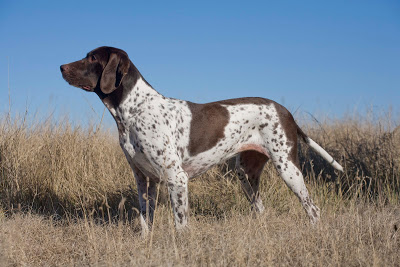
The history of The Braque d’Auvergne has all the elements of a great adventure novel. It goes something like this: On June 12th, 1798 Napoleon tricked his way onto the island fortress of Malta turned his troops against the ruling Knights of St. John and forced their leaders to capitulate. He then banished the knights from the island and dissolved their order. According to legend, some of the knights returned to their native France and brought with them a type of black and white pointing dog They had discovered on the island. Those dogs eventually developed into the modern Braque d’Auvergne. It is a great story, but there is a problem: it is not true.


In 1944, dog expert Paul Mégnin published the results of his enquiry into the origins of the breed. Among the holes he poked in the Maltese Knight story is the fact that their order was never actually disbanded. The Knights did indeed disperse after the battles of 1798, but the order survived in Russia and Italy and was eventually restored, even in France. Mégnin also discovered that, despite a thorough search conducted by the order’s own archivist M. Chauvelot, no mention of any kind of hunting dogs is to be found in the records. Even the incredibly detailed tome Histoire des Chevaliers de Malte, written in 1726 by the Abbot René Aubert de Vertot, is completely devoid of any reference to hunting dogs on the island. Mégnin even interviewed the ancestors of Commander de Fargues, a Maltese Knight originally from the Auvergne region. None of them had ever heard of their forefather bringing back black and white dogs from Malta. And, despite Mégnin’s myth busting, the Knights of Malta story is still repeated today, although serious scholars simply discount it as nothing more than a charming fairy tale. 

Most experts now believe that the Braque d’Auvergne is another regional variant of the classic old braque found throughout much of France. The black and white coat, they contend, comes from either scent hounds and/or pointing breeds. Even the breed’s FCI standard sort of sidesteps the Maltese origin, saying: Descending from a multi-pointer common source, derivation has been made by a selection to which the Knights of Malta might have participated. 

Whatever the origin, a type of black and white pointing dog had been known in the Auvergne and Cantal regions for generations. It was generally referred to as the Braque d’Auvergne, or the Braque Bleu d’Auvergne due to its blue-black coat. In 1913 a club was formed and the breed’s standard accepted by the Société Central Canine (SCC, the French kennel club). In the 1920s and ’30s growth was slow but steady as the breed gained a reputation as a tough, hard-working gundog. 

But like all the other gundog breeds, the Braque d’Auvergne fell on hard times during the Second World War and by the 1950s was in serious trouble. There were very few breeders left and some of them had taken to crossing English Pointers into their lines in an effort to develop a lighter, faster version of the breed. Fortunately the breed’s parent club was able to restore order and the situation had improved in the 1970s as a new generation of breeders began to make their mark in field trials and interest in the breed increased among the public. By the 1980s and ’90s an average of 300 Braque d’Auvergne pups were being whelped every year. That number remains more or less constant today.

My View

Prior To 2005 I had only seen Two Braques D’Auvergne in the flesh. They were nice dogs, but one was a very young pup and the other was a 14-year-old female, long retired from the hunting field. It was not until I travelled to France and met with one of the country’s leading breeders that I had the opportunity to see how they work in the field.

When we arrived at the home of Bernard Fuertes in the South of France, we already knew he was a serious dog breeder. But when we actually went inside his house we realized just how serious he really was. Bernard’s spacious living room looked like a trophy store showroom. Every square inch of wall space was covered with awards, plaques, medals and ribbons. Every table held its limit of trophies and cups. And yet, the majority of the collection was still in storage in the basement! Clearly this was a man who had dedicated much of his life to breeding great dogs and proving them in competition. And after seeing some of his dogs in the field, we could only agree with the judges who awarded him all those trophies. Bernard has some very good dogs!

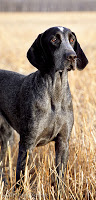
I’ve always liked the look of the Braque d’Auvergne. They are sleek, strong and muscular with a unique head shape and deep, rich coloring. The males are especially handsome; their heads have even more character than the females. Compared to some of the other Braques, the Auvergne seems ton be stronger, more solidly built, and a more down-to-earth kind of dog. In action, they were faster than I expected. I had always read about their methodical pace and relaxed way of working. But all of the Auvergnes I saw ran at a medium gallop and covered about 75 meters on either side. Their points surprised me as well; more stylish and intense than I had anticipated and, needless to say, rock-solid.


I did not get a chance to see any of Bernard’s dogs work in the water, but I was told that Braques d’Auvergne are excellent swimmers and take to the water easily as pups. Overall, I found the dogs to be solid, dependable workers that showed a lot of desire. I can see why many hunters in France really like the breed. They are a sort of “out of the box” gundog that doesn’t take a lot of effort to train or handle. There are now a few breeders of Auvergnes in the US and Canada, and I could easily see the breed gaining a certain amount of popularity, particularly among pheasant, grouse and woodcock hunters, and even guys like me who hunt a bit of everything and can appreciate a hard-hunting but cooperative gundog.

Read more about the breed, and all the other pointing breeds from Continental Europe, in my book Pointing Dogs, Volume One: The Continentals.


Read more about the breed, and all the other pointing breeds from Continental Europe, in my book Pointing Dogs, Volume One: The Continentals
http://www.dogwilling.ca/index.cfm

Breed of the Week: The Old Danish Pointer

Craig Koshyk

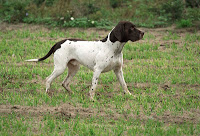
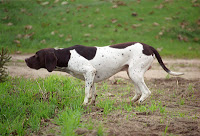
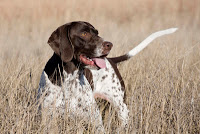
Denmark is home to a classic breed of pointing dog with a unique look and interesting history. Virtually unknown outside its native land, the Old Danish pointer is represented by a small but dynamic club, and is still mainly bred by and for hunters.


History
As in many other European countries, the right to hunt in Denmark was reserved for the aristocracy until a number of reforms in the 18th century opened the fields and forests to the common man. And like their counterparts elsewhere, when ordinary Danes gained the right to hunt, they began to develop their own breeds of hunting dogs. They started with the kinds of dogs found locally. These probably included farm dogs of various types that had always helped commoners take game, even when such an act could cost a man his life. 

And there were probably a few descendants of local aristocrats’tracking dogs and running hounds still around as well. Some of them may have been what were known as “kitchen dogs”—individual hounds removed from large packs and used to hunt smaller game for the kitchen. And finally, according to just about every history of the Old Danish Pointer, so-called Spanish Gypsy dogs are said to have played a key role in the development of the breed.

Before I began my research into the Old Danish Pointer, I had assumed that the Spanish Gypsy dog story was true. But the more I looked into it, the more I began to have doubts. After all, the history of Gypsies in northern Europe is not exactly a study in social harmony and multi-culturalism. Digging deeper, the holes in the story became increasingly obvious. I now believe that the Spanish Gypsy dog story is probably a myth. Here’s why.

Gypsies first made their way to Denmark by ship in the early 1500s. They are said to have come from Scotland, where King James IV had given them a letter of safe passage to travel to Denmark, which was under the rule of his uncle, King Hans. Some sources suggest that the Gypsies had originally travelled to Scotland from Spain, but no one knows for sure. What we do know is that other groups of Gypsies also moved into Denmark around the same time from what is now northern Germany, the Czech Republic and Romania.

By 1536, the political climate in Denmark had turned against the Gypsies. They were no longer allowed to enter the Kingdom, and those already there were given three months to leave. In 1589, the King decreed that any leader of a Gypsy band found on Danish soil would be put to death. As late as the mid-1800s, Gypsies were still being persecuted. The lucky ones were simply deported. But some were killed in organized “Gypsy hunts” in which “hunters” were given rewards for the capture, or even murder, of any Gypsy man, woman or child. 

This organized persecution of Gypsy peoples began in Denmark a century before the Old Danish Pointer was even created, and continued throughout much of the breed’s development. How Gypsy dogs could have played any significant role with the Old Danish Pointer is hard to fathom. But somehow they have become part of the breed’s lore. Even the history section of the Old Danish Pointer’s FCI standard (#281) mentions them:

The origin of the breed can be traced back to about the year 1710 when a man named Morten Bak ... through eight generations was crossing Gypsy dogs with local farm dogs and in this way established a pure breed of piebald white and brown dogs ...

Morten Bak
Not much is known about Morten Bak, other than that he was from Glenstrup, a town in northern Denmark. During Bak’s lifetime many of the harsh laws against Gypsies were still on the books, so it is hard to understand how he would have had access to any Gypsy dogs at all, let alone enough to breed them for eight generations. And, even if he did, would he have freely admitted using dogs from people his government considered outlaws? Then there is the fact that any dog owned by a band of Gypsies probably did not point. In Bak’s day, pointing dogs were still rather rare in northern Europe and only well-to-do hunters could afford the newly invented flintlocks to shoot birds on the wing. So are we to believe that, in Bak’s day, Gypsies and their dogs were wandering around the Danish countryside shooting game over pointing dogs with cutting-edge firearms? 

Personally, I believe the whole Spanish Gypsy dog story needs to be taken with a very large grain of salt. There are just too many holes in it to be plausible. But the Old Danish Pointer does look like a Spanish Pointer, and it does point. So, what did Bak use to create it? To find the answer we need to consider the historical context of the time and examine a common thread found in many breed histories: war.

From 1701 to 1714, much of Europe, including Denmark, was involved in a conflict now known as the War of Spanish Succession. A so-called Grand Alliance made up of English, Dutch and Austrian armies set out to prevent the French Bourbon king from taking the Spanish throne. There were significant battles in Spain and the Netherlands. From 1704 to 1709, Danish auxiliary troops fought alongside the Austrian army in some of those battles.

Morten Bak lived very near a number of important Danish ports where soldiers and sailors would have disembarked upon their return from battle. Some of them may have brought Spanish dogs back to their homeland. After all, there is little doubt that English soldiers did exactly that when they returned to England from Spain after the war. So, I believe that Morten Bak probably did use Spanish dogs. But he did not get them from roving bands of Gypsies. He would have found it much easier to get them from Danish soldiers returning from the War of Spanish Succession sometime after 1709. By crossing them to local hunting dogs, he would eventually create at a type of dog that earned the name Bakhund (Bak Dog). It is not known for how long he continued to breed his Bakhunde, nor how far they spread during his lifetime, but by the mid-1800s, aided by the writings of poet Steen Steensen Blicher, the breed’s popularity began to rise. The following is Blicher’s own description of what the dogs looked like at the time: 
The size is more varied than in any other breed. There are huge dogs like bull-biters, small ones like spitz dogs, and short-haired, long-haired, single-nosed and cleft-nosed dogs. We reject the black ones, because the breed is not pure, and because they are difficult to see at a distance on the moors. ... So the best ones left for use are the white ones (either all white, or, which is most common, with brown color on the ears and head) and the piebald that is with brown specks all over the body.

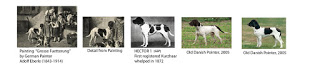
Some sources claim that in the 1860s a number of Old Danish Pointers were sent to Germany where they contributed to the development of the German Shorthaired Pointer. Naturally, such claims are mainly from the Danish side of the border. I have yet to come across a single German source that confirms them. However, the first time I saw an Old Danish Pointer, I immediately thought of the early photos of German Shorthaired Pointers that show them as heavier and shorter of leg than they are today. Considering the close proximity of the two countries, and the fact that they went to wartwice— over the areas of Schleswig and Holstein in the mid-1800s, it is reasonable to assume that the Old Danish Pointer and the German Shorthaired Pointer could have contributed to each other’s development in the early days.

In any case, by the beginning of the 20th century, it was clear that the German Shorthaired Pointer was growing by leaps and bounds and that the Old Danish Pointer was in decline. The Second World War reduced the population even more, threatening its very survival. After the war, an effort to restore the breed got underway. A breed club was established in 1947, and its members initiated an organized breeding program. By the 1960s, the population had increased significantly, and in 1963 the Old Danish Pointer was added to the official list of the FCI’s Group 7 for Continental Pointing Dogs. In the 1980s, thanks to Danish television personality Poul Thomsen and his Old Danish Pointer named Balder, the breed became well known in its homeland. Marianne Harild Sørensen, a breeder of Old Danish Pointers, explains:
Poul Thomsen had a nature program on TV. The program always started with him sitting at his desk and Balder in a basket next to the desk. So everyone saw this nice, quiet dog that would just lie there. Needless to say, everyone wanted to have a dog like Balder, so the numbers of puppies whelped rose quickly to over 400 per year. On the one hand, it was a good thing. The breed got some publicity. But on the other hand, it was a total disaster. The breeding wasn’t controlled in any way. The quality of many of the dogs was not good. Poul Thomsen wasn’t a breeder so he is not really to blame, but he and Balder did have an effect on the breed. 
Today, the Old Danish Pointer has a small but devoted following in Denmark. The population is relatively stable and the breed is in the hands of an active and well-organized parent club. There are also breeders in Sweden, Germany and Holland. Thankfully, the tendency among most of them is to select dogs based on their working abilities.


Read more about the breed, and all the other pointing breeds from Continental Europe, in my book Pointing Dogs, Volume One: The Continentals
http://www.dogwilling.ca/index.cfm


The History of the Pointing Dog, Part 1: Origins

Craig Koshyk

This question of genesis has sparked so many discussions that it would be presumptuous to claim that I could offer a decisive explanation. To venture into that subject would be, after all, to penetrate the realm of the impenetrable. — Jean Castaing

Bird dogs circa 1400 
On June 16th, 2009 American President Barack Obama appeared in a televised interview. About half way into the program, a fly began buzzing about his head as he was answering a question. Despite repeated attempts to scare it away, the very persistent fly eventually landed on the President’s hand. Ed Pilkington, writing in the next day’s edition of the English newspaper the Guardian, described Mr. Obama’s reaction:
His body went rigid and he cast his eyes down toward the fly that had settled on his left hand. At this point he looked swathed in the stillness that comes from absolute concentration...
Then, with lighting speed, the President swatted the fly and exclaimed, “I got the sucker!” Naturally, the rather humorous event was reported around the world. I saw it on the evening news and watched it again on Youtube the next day. But it wasn’t the swift presidential action that caught my attention. It was what Mr. Obama did immediately before he swatted the fly.

He paused.

He did exactly what you and I — and most other predators — do just before we pounce on our quarry.

We pause.


Thousands of years ago, hunters must have observed that same behavior in many of the animals around them, including their dogs. Eventually, they found a use for it. As new weapons and hunting techniques developed, a dog’s natural tendency to pause, and its willingness to be trained to remain motionless, became useful for certain kinds of hunting. 

So hunters began to train their dogs to stand or lay down in the presence of game, and then selected them for a longer and longer instinctive pause. Eventually, they developed dogs that would freeze and remain rigidly still, without a command, at the mere scent of game. They had created the pointing dog.

In ancient Greek and Roman times, people used many different types of hunting dogs, from powerfully built scent-hounds to sleek sight-hounds. Some authors have tried to argue that the Greeks, Romans and even the Egyptians also bred pointing dogs
to be used with hawks and falcons. But none of the claims has
ever withstood the scrutiny of expert analysis and nowhere in the ancient literature are there any unequivocal references to pointing dogs. After researching the question for many years, William Arkwright concluded that:
Egypt appears to have left no foreshadowing of a pointing dog
in her records, and the treatise on venery by Sid Mohamed Al Mangali (the tenth century), translated by M. Pharaon (1880) is taken up with hunting and hawking, without even a prophetic hint of the “partridge-dog”—though this author’s range is so wide as to embrace both ants and elephants! 1
Jean Castaing points out that the methods used by ancient hunters simply did not require a dog to pause before setting upon its quarry, so ancient hunters did not train or select their dogs to do so. And while the current evidence suggests that canis familiaris, the domestic dog, ultimately traces its origins to somewhere in Asia, it is telling that hunters there never developed a single breed of pointing dog. Even today, central Asian and middle eastern hunters who still practice the ancient forms of hunting with hawks and falcons do not use dogs to point game.

Most histories of pointing dogs naturally concentrate on where and when they first came to be. They generally support the conclusion that it was not until the end of the high middle ages that hunters in the region that is now parts of Italy, Spain and Southern France began to train their dogs to stand still or lay down in the presence of game. But to me, an even more intriguing question is why?

If we accept the premise that pointing dogs began to appear more or less simultaneously in various regions of southern Europe, we have to wonder what common motivator could have inspired hunters to begin training and eventually selecting their dogs to stop in the presence of game.

Some authors speculate that it was the growing popularity of hunting with falcons and hawks that led to the creation of the chiens d’oysel (dogs of the bird) mentioned by Gaston Phébus. But Phébus clearly states that those dogs were expected to flush game for the bird. He wrote that the chiens d’oysel, which he also called espaignolz...
... put up all manner of birds and animals, but their true calling is the partridge and the quail; a fine thing for a man with a good goshawk or falcon, lanner or saker, or for flushing small birds for the sparrow-hawk. (Emphasis added). 
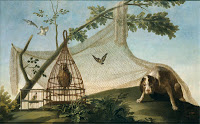
It has also been speculated that the use of nets eventually led to the development of pointing dogs. But nets had been used to trap or snare game for thousands of years. They were nothing new in the 12th century and were generally not the sort of net that could be thrown. To capture birds, hunters would suspend large nets between trees or even narrow mountain passes and wait for the birds to fly into them.
In some areas of France, hunters still use the same techniques today. Smaller nets, light enough to be thrown by an individual or to be held between two people, were also used to capture birds but the practice was not common enough to explain why there was such a sudden interest in pointing dogs and why hunters would go to such lengths to train and select them.

Something else had to be going on at the time. As we shall see, it was the first in a series of profound changes in the social and political landscape of Europe that would eventually lead to the development of the pointing dog, as we know it today.

It may be hard to imagine now, but the concept of the “individual”, the cornerstone of our modern society, did not really emerge until the end of the Middle Ages. From the 12th to the 14th century, a sort of pre-industrial revolution occurred in Europe, and specialized classes of craftsmen and merchants were created. These men formed guilds and other enterprises that tended to emphasize the identity and specialization of their members. No longer was a man just a general labourer — he was a shoemaker, a baker, a lawyer, 
a banker. He was an individual. And, as such, he began to think beyond the immediate needs of the clan, toward his own needs 
and pleasures. 

In addition to this new way of thinking, craftsmen had also developed the financial resources that allowed them to not only pursue pleasures such as hunting, but to do so in a way that emphasized style and quality over efficiency and quantity. Mediaeval hunting literature makes this abundantly clear. The most influential treatises of the time were written by men who understood the importance of style, technique and honor in hunting. 

And even though they were written at a time when people were still mainly living off the land, they are filled with the same yearning for a deeper connection to the natural world that inspires hunters today. After all, hunting over a pointing dog is like fly-fishing: a supremely inefficient way of putting large quantities of meat on the table and essentially the pursuit of individual sportsmen. And that is, I believe, the key to understanding the genesis of the pointing dog. It was not created to help the individual hunter feed his family. It was created to help him achieve a deeper connection to the natural world. It continues to serve that purpose today.


But understanding why pointing dogs were developed does not answer the question of “how?” What methods did hunters use to train, and then select, dogs to stop in the presence of game? And what kind of dogs did they start with?

During the Middle Ages, there were many types of dogs available to southern European hunters: herding dogs, tracking dogs, sight-hounds, running hounds and, since pure breeding and closed stud books would not be invented for another five centuries, every conceivable mix among them. But none of those kinds of dogs had more than just a hint of pointing instinct. So hunters had to start with dogs that, as Castaing puts it, were predisposed to becoming pointing dogs

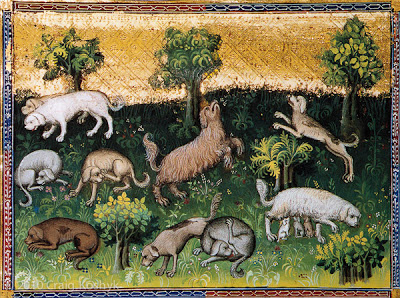
The most likely candidates came from among the running hounds and tracking hounds. Most illustrations from the Middle Ages show running hounds to be similar to the modern Harrier or Foxhound, but with shorter legs and a broader, flatter face. The tracking or trailing hounds were similar but usually larger with bigger heads and loose, hanging skin. Both types came in every color and hair type and usually hunted in packs. They were known for their excellent nose and their ability to run great distances without tiring—two essential qualities of modern pointing dogs.

Within each pack, certain individuals would be singled out for special care and training. They were called Lymers or Lyam Hounds (Limier in French, Leithund in German). The technique of using a Lymer was known as “harbouring”. A Lymer and its handler would be sent into the forest at dawn to track an individual animal, most often a large deer. Their job was to follow its trail, discover where it was browsing or resting and then report back to the chief huntsman. The deer would then be hunted by the pack. If the deer managed to escape, the Lymer was once again brought in to find its trail and the hunt would resume. 

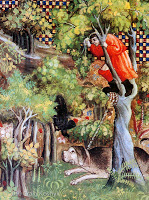
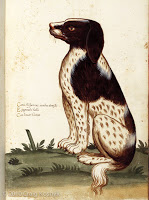
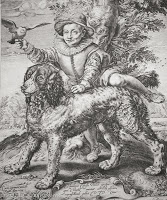
In both form and function, Lymers had many things in common with modern pointing dogs. Old illustrations show that they looked similar to the modern Bracco Italiano and Burgos Pointer and they were said to have great endurance and an excellent nose. But most significantly, Lymers were selected to work alone, with an individual hunter and were often trained to stop and lay down in the presence of game as shown in the illustration on the right.

Jean Castaing and William Arkwright both conclude that all the shorthaired pointing Breeds, the braques, ultimately trace back to the Lymer. But what about the long-haired pointing dogs, the espaignolz? Where did they come from? In Le Livre de la Chasse, Gaston Phébus wrote that: There is a kind of dog called the chien d’oysel or espaignolz because it comes from Spain, however many there may be of them in other countries.

These lines seem to offer rock-solid evidence for a Spanish origin. But were the espaignolz and chiens d’oysel similar to the long-haired pointing dogs and épagneuls we have today? Based on the descriptions and illustrations in Le Livre de la Chasse the answer is: probably not. Phébus actually wrote that they should not be too hairy. And illustrations from the time show that many espaignolz and chiens d’oysel were actually short-haired. Paul Mégnin wrote that: 
The Spanish origin deduced from a sentence by Gaston Phébus needs to be examined with caution; it was not about long-haired spaniels, for in the Phébus manuscript found in the Mazarin Library are two miniatures representing chiens d’oysel or espaignolz, one is standing, the other semi crouched, but these are short-haired dogs with tufted tails. The chien d’oysel or espaignol is therefore not the source of our spaniel. 2
But if spaniels don’t have a Spanish origin, where did they come from? Jean Castaing believed that they might have developed from dogs that originally came from further north, were the colder climate would have favoured long-haired dogs. But he concedes that they were flushing dogs at first and must have been transformed into pointing dogs later, probably by hunters in the Mediterranean region.

No matter what their true origin, dogs that were used to find and indicate the location of game by standing still or lying down were, at first, trained to do so. Perhaps the earliest passage referring to how it was done is found in De Animalibus, written by Albertus Magnus (Albert the great) living in Padua, Italy in 1270:
The dogs, however, that are used for birds seem to have these (powers) more from training than from sense of smell, though they derive them from both. They are taught in this manner: they are first led round some caught partridges pretty often and at length by threats learn to go round and round them; but they get to find the partridge by scent, and thus at the beginning they set (ponunt) pretty often at the indications of the captive bird. 3

The best known books offering detailed instructions in the training of early pointing dogs are the 16th century Diálgolos de la Monteria written by an unknown author and Arte de Ballesteria y Monteria by Alonzo Martinez de Espinar. Both treatises reveal that dogs were not only trained to stand still to indicate the location
of game, but were very often trained to circle the game, almost like a Border Collie circles a herd of sheep. Dogs that stood still were called perros de punta (pointing dogs) and those that circled were called perros de vuelta (circling dogs, vuelta means “to turn round”). Since both techniques served to indicate where the birds or rabbits were hiding, Spanish hunters eventually adopted the term perros de muesta for all pointing dogs (“muesta” means “indication” or “sign”).
Dogs have three methods of pointing: some simply point, others only circle the game, and others again do both. ...Among these circling dogs there are two ways of showing game: one by going round it and never standing on point. ...there are others that go round and point with the wind indicating the game, and these are the best, as they plainly show the sportsman where the game is. 4
By the 16th century, pointing dogs had become fairly common in many regions. In fact, they became so popular in some places that more and more ordinances were issued to limit their use or prohibit it altogether. And their popularity only grew with the appearance of a new invention that allowed the hunter to shoot birds on the wing: the arquebuse. It ushered in a new era of hunting, an era in which the pointing dog would be perfected.

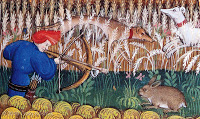
Prior to the invention of firearms small and light enough to be carried by a man and agile enough to be used to shoot birds on the wing, partridges and quail were usually shot on the ground by hunters armed with crossbows. This method required extremely well-trained dogs that may or may not have had any real instinct to point. When firearms were invented, dogs that were carefully trained to circle or point game were no longer a necessity; a flushing dog could be used.
They (partridges) are shot on the wing with an arquebuse and for that reason they do not exist in such numbers as formerly, nor are there any longer such pointing dogs (perros de muestra) to find them and point them with cleverness so great that large quantities of them could be killed with a cross bow. In those days the sportsmen were most dexterous, now such are wanting; for, as game is killed more easily, nobody wishes to waste time training his dogs as the man has not to shoot the partridges on the ground, and the only use he has for dogs is to flush the game and that takes no training, as the dog does it naturally. 5
While a flushing dog can be very effective, a pointing dog can cover more ground. It can also give a shooter more time to get ready for the shot. So it is not surprising that hunters continued to train dogs to point, even if it was no longer strictly necessary. And since they also continued to select for a longer, stronger pause, they eventually arrived at dogs that would point naturally, without any training at all.

As isolated populations of these new pointing dogs acquired unique combinations of characteristics that differentiated them from other populations, they became landraces. But the event that would ultimately lead to pointing dog breeds was another revolution. But this time, the revolution was a violent one. And it was followed by a century of chaotic, indiscriminate breeding that only came to an end when order was restored by outside forces.


1. William Arkwright, The Pointer and His Predecessors, 3
2. Quoted in Jean Castaing, Les Chiens d’Arrêt, 65
3. Quoted in William Arkwright, The Pointer and His Predecessors, 7-8
4. Ibid., 46-47
5. Ibid., 39-40