Contact Us

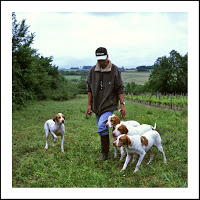
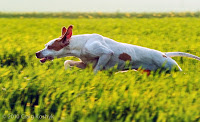
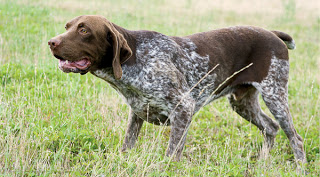
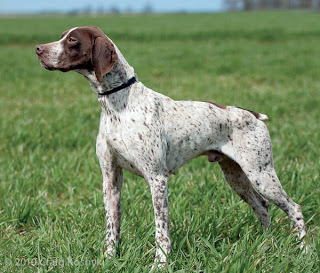
Use the form on the right to contact us. We should get back to you within 24 hours. If not, it means we are out chasing birds with dogs, shotguns and Canons. In that case we will get back to you as soon as we've finished the roasted Teal and Bordeaux . 


Form Block
This form needs a storage option. Double-click here to edit this form, and tell us where to save form submissions in the Storage tab. Learn more
         

123 Street Avenue, City Town, 99999

(123) 555-6789

email@address.com


You can set your address, phone number, email and site description in the settings tab.
Link to read me page with more information.

Pointing Dog Blog

The world of pointing dogs in words and images, moving and still.

Breed of the Week: The Cesky Fousek

Craig Koshyk
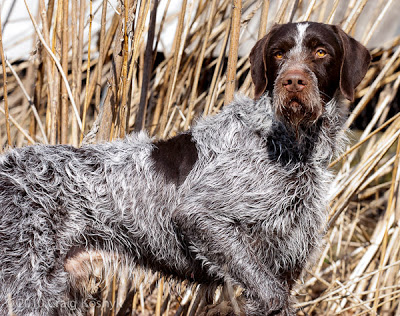

Looking back on the years I spent in public school, I realize that the history lessons I was given were based on the notion that the world was made up of England, Canada, the US and France—in that order. The rest of the globe was considered “foreign land”, worthy of no more than a couple of questions
 on a multiple-choice quiz. So, like most Canadians, and I suspect most Americans,
 I graduated from high school having never heard of such a place as Bohemia.

It wasn’t until I was in university that I learned that Bohemia is a region of the Czech Republic, a country with a fascinating history, rich culture and something especially appealing to a young university student: world-class beer. Years later, when I began the research for this book, I also learned that the Czech Republic even had its own breed of versatile gundog. That was all the motivation I needed to save my money for a budget flight to Prague. How could I resist the lure of an exotic land where history, culture, beer and gundogs awaited me?

HISTORY
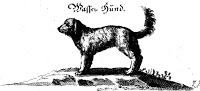
"Wasserhund" (water dog)
From Der Vollkommene Teutsche Jäger
Officially, the Cesky Fousek it a relatively new breed on the versatile gundog scene. FCI recognition was not granted until 1964. Nevertheless, references to Bohemian hunting dogs, generally assumed to be the Fousek’s ancestors, can be found in documents dating as far back as the 14th century. So, is the Cesky Fousek a modern creation? Or is it the grandfather of all rough-haired continental pointing dogs?

Those who argue in favor of an ancient origin invariably quote a 14th century letter written by a nobleman named Vilem Zajic of Valdek:
In the year 1348, King Charles IV presented to the Margrave of Brandenburg, Ludwig, fine hounds known as Canis bohemicus for the Margrave’s hunting pleasure.
The author’s use of the term Canis bohemicus (Bohemian dog) is considered proof that hunting dogs native to Bohemia existed at the time. However, Zajic makes no mention of their color, size, coat type or even the kind of hunting they were used for; they could have been tracking dogs or sighthounds or water dogs. It is unlikely, though, that they were true pointing dogs. In the mid-1300s, hunters still had to train their dogs to set or point for the net. The few dogs that did have a natural tendency to point were just starting to appear in Italy, Spain and southern France at the time. Nevertheless, we can assume that Bohemia was indeed home to some kind of hunting dog talented enough to warrant the attention of its great king.

Another frequently cited reference is found in a fascinating book, Der Vollkommene Teutsche [Deutsche] Jäger (“The Complete German Hunter”). Written by Johann Friedrich von Flemming around 1724, this richly illustrated two-volume encyclopedia mentions rough-haired dogs from Bohemia used mainly for water work. However, once again, no other details are provided. Like Zajic of Valdek, Flemming was describing a type of dog, not a specific breed. By 1724, some of
 the Bohemian dogs may have even had a natural inclination to point. Most, however, were probably still used as flushers and retrievers.
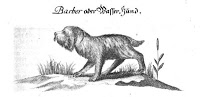
"Barber (Barbet) or Water Dog"
From Der Vollkommene Teutsche Jäger
It wasn't until 1883 that a specific reference to a Czech Rough-haired dog appeared and, for the first time, clearly identified it as a pointer. In a six-volume set entitled Huntsmanship - Handbook for Hunters and Hunting Friends, author Josef Vilém Černý provides a description of the Český Ohar, a brown and white or all-brown, medium-sized, rough-haired Czech pointing dog. Three years later, the word Fousek appears in the record. It is found in an official Czech registry for purebred dogs that lists 19 Pointers, 17 English Setters, nine Irish Setters, 17 Gordon Setters, two Griffons, 81 German Shorthaired Pointers, and 41 Hrubosrstých ohařů - Fousků (Rough-haired pointing dogs – Fouseks). And, finally, in that same year, the words Český and Fousek were formally combined when a group of hunters and breeders in a town south of Prague decided to form a club. They named it the “Society for the Rough- Haired Pointer – Český Fousek – of the Czech kingdom based in Písek”.

At the time, crossbreeding was still a fairly common practice among hunters who simply wanted a good hunting dog. So the Cesky Fouseks of the late 1800s were more of a type of dog than a pure breed. There was probably considerable variation among them in terms of appearance, but in general they must have had similar qualities as versatile gundogs and were much appreciated by Czech, German and Austrian hunters.

Depending on where they were bred, they went by different names. The Czechs used the term Český Fousek. In Germany, experts such as Dr. Hans von Kadich used Stichelhaar or Straufhaarige Hühner- hund and breeders such as Franz Bontant from Frankfurt, called them “Hessian Rough-beards”. Despite the different names in use, all agreed that the dogs came from the area encompassing Bohemia, Moravia, Brandenburg and Hesse.

The political upheaval of the early 20th century was particularly violent in Eastern Europe. For the Cesky Fousek, it was nearly fatal. As war raged across the region, breeding came to a standstill. At war’s end in 1918, the Austro-Hungarian Empire had ceased to exist and a new nation, Czechoslovakia, had been proclaimed. But the Fousek was nearly extinct.
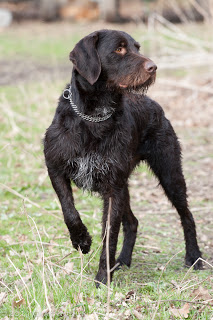
In 1924, a new association was formed with the expressed purpose
of restoring the breed, but there were very few dogs left. Even worse, due to massive importations of English Pointers, Setters, and German Shorthaired Pointers, the Cesky Fousek had been relegated to a sort of second-class status among hunters. Undaunted, the few remaining Fousek enthusiasts continued their efforts. When, in 1931, they drafted a new breed standard and enacted new breeding regulations, the Fousek seemed to be on the road to recovery. But in 1939, war once again broke out in the region, and the breed was dealt another devastating blow.

After the Second World War, efforts to revive the breed got under way once again. The association of breeders, which somehow managed 
to remain intact throughout the war, issued new guidelines for its members. The Cesky Fousek was to be bred only by and for hunters, and the top priority of all breeders should be to retain the excellent hunting abilities and character in their dogs. Due to the breed’s small population and narrow genetic base, crossbreeding to other breeds such as German Shorthaired and Wirehaired Pointers was permitted for a time. However, when Czechoslovakia joined the FCI in 1957, and the breed
club sought recognition for the Cesky Fousek, the stud book was closed and the club was required to prove that they had at least three generations of “clean” lines, free of any foreign blood. The breed also faced strong resistance from the VDH (German Kennel Club). The Germans opposed the idea of recognizing a breed they considered to be genetically identical to the Stichelhaar.

It was not until 1964, after an in-depth report on the origins of the Cesky Fousek was submitted to the FCI and the club had finally met all the requirements for pure breeding, that the breed was officially recognized as pure and independent, and its standard, FCI No. 245, adopted. Today, the breed is still represented by a strong and dynamic club in its native land where approximately 500-600 pups are whelped annually. Breeders are also active in Slovakia, Austria, Germany, France, Holland, the US, Canada and New Zealand. Slowly, but surely, the word is getting out about the Cesky Fousek, and its reputation as a dynamic, cooperative gundog is growing around the world.

WHAT'S IN A NAME
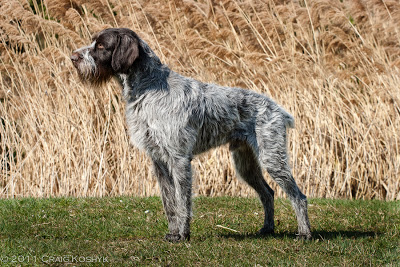
The breed's name is pronounced: CHESS-key Foe-sek (Foe rhymes with toe). Ceský means “Czech”. “Fousek” is derived from the Czech word fousy, meaning facial hair or whiskers, and refers to the breed’s prominent moustache and beard. Strictly speaking, Cesky Fousek refers to a male dog. A female is a Ceska Fouska (Chess-ka Foe-ska). The FCI translates the name as the Bohemian Wire-Haired Pointing Griffon.

MY VIEW
If there is one thing we’ve learned after years of travelling to Europe to photograph gundogs, it’s this: breeders generally don’t live in downtown Paris, Madrid or Prague. In fact, many of them live so far off the beaten track that even our GPS unit has had to ask for directions.

Fortunately, Lisa and I speak French, and we can get by in Italian and Spanish. So, when we travel to France, Spain or Italy, we usually have no problem communicating with the locals. In Germany, the Netherlands and Denmark, we stick to English, and hope that the people we meet there don’t take offense when we mangle a few words in their native tongue.  But as we planned our first trip to Eastern Europe, I realized that neither of us could even say “hello” in Czech, Slovak or Hungarian, and that the trilingual pocket dictionary we purchased wouldn’t be of much help beyond the train station. Clearly, we had to find an interpreter, an English-speaking local willing to spend several days driving across eastern Europe with a couple of dog-crazy Canadians. Thanks to an international gundog forum on the internet, I found the perfect person. Not only did she speak English, Czech and Slovak, she turned out to be just as dog-crazy as we are!

Hana Dufkova is a delightful young woman and an accomplished dog trainer. She accompanied us throughout our travels in the Czech Republic, Slovakia and Hungary. Her interpreting services were invaluable. By eliminating the language barrier, she helped us gain a deeper understanding of the cultures in which the versatile dogs of the region were developed.
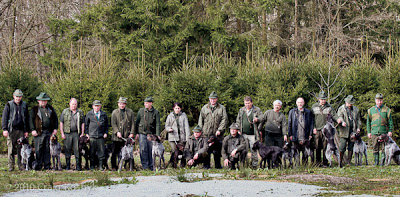

The first event we attended with her was arranged by the members of the Klub Chovatelů Českých Fousků, the Cesky Fousek’s parent club near the town of Hluboká nad Vltavou.  After coffee and breakfast beers (yes, we drank beer at 9:00 a.m. After all, when in Rome...) we headed to the field for a photo session. We started with a group shot of about a dozen handlers and their dogs. My first impression was that, compared to some other wire-haired breeds we’d seen, there was less variation in the Fousek. They all had harsh, flat-lying wire-haired coats and good furnishings. Heights only varied by a few centimeters, and all the dogs had a no-nonsense, athletic build. Every dog we approached greeted us with a wagging tail and kind, friendly expression. Even the sternest looking males—quite impressive specimens, actually—seemed more likely to lick your hand than to growl.

In the field, the Fouseks reminded me of the Stichelhaars and German Wirehaired Pointers I’d seen in Germany.They covered the ground at a medium gallop at a close to medium range. Without exception, they were very well trained. This was obvious when we began to take some retrieving photos. All of the dogs made happy deliveries of whatever their owners asked them to fetch. Even the biggest and stinkiest fox tossed into the forest was handled easily. At the water, we watched as several dogs were sent in for retrieves. There were no breakneck leaps into the pond, but there was no hesitation either —just a workmanlike effort to get the job done.

After spending an enjoyable day with members of the breed’s parent club, I began to realize that the Cesky Fousek is a lucky breed. It is firmly in the hands of a well-organized group of dedicated hunters, and its fortunes are on the rise outside of its native land. But I still had one more expert to interview. He had been unable to attend the meeting at the clubhouse, but had agreed to meet with us the next day at his clinic north of Prague.

Dr. Jaromir Dostal is considered one of the world’s leading authorities on the Cesky Fousek. A geneticist by profession, he supervised the program designed to maintain the breed’s genetic diversity. But that’s not the reason I mention him here. I mention him because of something Lisa and I said to each other — simultaneously —after our interview with Dr. Dostal.

“Did you see his eyes?”

It was a look we had seen before; a certain fiery sparkle, a radiant glow on the faces of a handful of men we had met in our travels. They were men with decades of experience who had spent countless hours in the fields with their dogs. They had each dedicated much of their lives to a breed of gundog that, without their help, may have fallen into the abyss. We saw the years of ups and downs etched into their faces, and would sometimes hear notes of sadness as they spoke to us about the struggles they’d endured. But, when the light was just right, and the conversation turned to the great dogs they had known, they became young men again, their eyes transformed by an inner glow, their faces beaming.

We saw that look in Dr. Dostal’s eyes that day. Since then, I remember it every time I think about the Cesky Fousek, a lucky breed, indeed.

Dr. Jaromir Dostal
1940-2010


Read more about the breed, and all the other pointing breeds from Continental Europe, in my book Pointing Dogs, Volume One: The Continentals

http://www.dogwilling.ca/index.cfm

Breed of the Week: The Cesky Fousek

Craig Koshyk


Looking back on the years I spent in public school, I realize that the history lessons I was given were based on the notion that the world was made up of England, Canada, the US and France—in that order. The rest of the globe was considered “foreign land”, worthy of no more than a couple of questions
 on a multiple-choice quiz. So, like most Canadians, and I suspect most Americans,
 I graduated from high school having never heard of such a place as Bohemia.

It wasn’t until I was in university that I learned that Bohemia is a region of the Czech Republic, a country with a fascinating history, rich culture and something especially appealing to a young university student: world-class beer. Years later, when I began the research for this book, I also learned that the Czech Republic even had its own breed of versatile gundog. That was all the motivation I needed to save my money for a budget flight to Prague. How could I resist the lure of an exotic land where history, culture, beer and gundogs awaited me?

HISTORY
"Wasserhund" (water dog)
From Der Vollkommene Teutsche Jäger
Officially, the Cesky Fousek it a relatively new breed on the versatile gundog scene. FCI recognition was not granted until 1964. Nevertheless, references to Bohemian hunting dogs, generally assumed to be the Fousek’s ancestors, can be found in documents dating as far back as the 14th century. So, is the Cesky Fousek a modern creation? Or is it the grandfather of all rough-haired continental pointing dogs?

Those who argue in favor of an ancient origin invariably quote a 14th century letter written by a nobleman named Vilem Zajic of Valdek:
In the year 1348, King Charles IV presented to the Margrave of Brandenburg, Ludwig, fine hounds known as Canis bohemicus for the Margrave’s hunting pleasure.
The author’s use of the term Canis bohemicus (Bohemian dog) is considered proof that hunting dogs native to Bohemia existed at the time. However, Zajic makes no mention of their color, size, coat type or even the kind of hunting they were used for; they could have been tracking dogs or sighthounds or water dogs. It is unlikely, though, that they were true pointing dogs. In the mid-1300s, hunters still had to train their dogs to set or point for the net. The few dogs that did have a natural tendency to point were just starting to appear in Italy, Spain and southern France at the time. Nevertheless, we can assume that Bohemia was indeed home to some kind of hunting dog talented enough to warrant the attention of its great king.

Another frequently cited reference is found in a fascinating book, Der Vollkommene Teutsche [Deutsche] Jäger (“The Complete German Hunter”). Written by Johann Friedrich von Flemming around 1724, this richly illustrated two-volume encyclopedia mentions rough-haired dogs from Bohemia used mainly for water work. However, once again, no other details are provided. Like Zajic of Valdek, Flemming was describing a type of dog, not a specific breed. By 1724, some of
 the Bohemian dogs may have even had a natural inclination to point. Most, however, were probably still used as flushers and retrievers.

"Barber (Barbet) or Water Dog"
From Der Vollkommene Teutsche Jäger
It wasn't until 1883 that a specific reference to a Czech Rough-haired dog appeared and, for the first time, clearly identified it as a pointer. In a six-volume set entitled Huntsmanship - Handbook for Hunters and Hunting Friends, author Josef Vilém Černý provides a description of the Český Ohar, a brown and white or all-brown, medium-sized, rough-haired Czech pointing dog. Three years later, the word Fousek appears in the record. It is found in an official Czech registry for purebred dogs that lists 19 Pointers, 17 English Setters, nine Irish Setters, 17 Gordon Setters, two Griffons, 81 German Shorthaired Pointers, and 41 Hrubosrstých ohařů - Fousků (Rough-haired pointing dogs – Fouseks). And, finally, in that same year, the words Český and Fousek were formally combined when a group of hunters and breeders in a town south of Prague decided to form a club. They named it the “Society for the Rough- Haired Pointer – Český Fousek – of the Czech kingdom based in Písek”.

At the time, crossbreeding was still a fairly common practice among hunters who simply wanted a good hunting dog. So the Cesky Fouseks of the late 1800s were more of a type of dog than a pure breed. There was probably considerable variation among them in terms of appearance, but in general they must have had similar qualities as versatile gundogs and were much appreciated by Czech, German and Austrian hunters.

Depending on where they were bred, they went by different names. The Czechs used the term Český Fousek. In Germany, experts such as Dr. Hans von Kadich used Stichelhaar or Straufhaarige Hühner- hund and breeders such as Franz Bontant from Frankfurt, called them “Hessian Rough-beards”. Despite the different names in use, all agreed that the dogs came from the area encompassing Bohemia, Moravia, Brandenburg and Hesse.

The political upheaval of the early 20th century was particularly violent in Eastern Europe. For the Cesky Fousek, it was nearly fatal. As war raged across the region, breeding came to a standstill. At war’s end in 1918, the Austro-Hungarian Empire had ceased to exist and a new nation, Czechoslovakia, had been proclaimed. But the Fousek was nearly extinct.

In 1924, a new association was formed with the expressed purpose
of restoring the breed, but there were very few dogs left. Even worse, due to massive importations of English Pointers, Setters, and German Shorthaired Pointers, the Cesky Fousek had been relegated to a sort of second-class status among hunters. Undaunted, the few remaining Fousek enthusiasts continued their efforts. When, in 1931, they drafted a new breed standard and enacted new breeding regulations, the Fousek seemed to be on the road to recovery. But in 1939, war once again broke out in the region, and the breed was dealt another devastating blow.

After the Second World War, efforts to revive the breed got under way once again. The association of breeders, which somehow managed 
to remain intact throughout the war, issued new guidelines for its members. The Cesky Fousek was to be bred only by and for hunters, and the top priority of all breeders should be to retain the excellent hunting abilities and character in their dogs. Due to the breed’s small population and narrow genetic base, crossbreeding to other breeds such as German Shorthaired and Wirehaired Pointers was permitted for a time. However, when Czechoslovakia joined the FCI in 1957, and the breed
club sought recognition for the Cesky Fousek, the stud book was closed and the club was required to prove that they had at least three generations of “clean” lines, free of any foreign blood. The breed also faced strong resistance from the VDH (German Kennel Club). The Germans opposed the idea of recognizing a breed they considered to be genetically identical to the Stichelhaar.

It was not until 1964, after an in-depth report on the origins of the Cesky Fousek was submitted to the FCI and the club had finally met all the requirements for pure breeding, that the breed was officially recognized as pure and independent, and its standard, FCI No. 245, adopted. Today, the breed is still represented by a strong and dynamic club in its native land where approximately 500-600 pups are whelped annually. Breeders are also active in Slovakia, Austria, Germany, France, Holland, the US, Canada and New Zealand. Slowly, but surely, the word is getting out about the Cesky Fousek, and its reputation as a dynamic, cooperative gundog is growing around the world.

WHAT'S IN A NAME
The breed's name is pronounced: CHESS-key Foe-sek (Foe rhymes with toe). Ceský means “Czech”. “Fousek” is derived from the Czech word fousy, meaning facial hair or whiskers, and refers to the breed’s prominent moustache and beard. Strictly speaking, Cesky Fousek refers to a male dog. A female is a Ceska Fouska (Chess-ka Foe-ska). The FCI translates the name as the Bohemian Wire-Haired Pointing Griffon.


MY VIEW
If there is one thing we’ve learned after years of travelling to Europe to photograph gundogs, it’s this: breeders generally don’t live in downtown Paris, Madrid or Prague. In fact, many of them live so far off the beaten track that even our GPS unit has had to ask for directions.

Fortunately, Lisa and I speak French, and we can get by in Italian and Spanish. So, when we travel to France, Spain or Italy, we usually have no problem communicating with the locals. In Germany, the Netherlands and Denmark, we stick to English, and hope that the people we meet there don’t take offense when we mangle a few words in their native tongue.  But as we planned our first trip to Eastern Europe, I realized that neither of us could even say “hello” in Czech, Slovak or Hungarian, and that the trilingual pocket dictionary we purchased wouldn’t be of much help beyond the train station. Clearly, we had to find an interpreter, an English-speaking local willing to spend several days driving across eastern Europe with a couple of dog-crazy Canadians. Thanks to an international gundog forum on the internet, I found the perfect person. Not only did she speak English, Czech and Slovak, she turned out to be just as dog-crazy as we are!

Hana Dufkova is a delightful young woman and an accomplished dog trainer. She accompanied us throughout our travels in the Czech Republic, Slovakia and Hungary. Her interpreting services were invaluable. By eliminating the language barrier, she helped us gain a deeper understanding of the cultures in which the versatile dogs of the region were developed.


The first event we attended with her was arranged by the members of the Klub Chovatelů Českých Fousků, the Cesky Fousek’s parent club near the town of Hluboká nad Vltavou.  After coffee and breakfast beers (yes, we drank beer at 9:00 a.m. After all, when in Rome...) we headed to the field for a photo session. We started with a group shot of about a dozen handlers and their dogs. My first impression was that, compared to some other wire-haired breeds we’d seen, there was less variation in the Fousek. They all had harsh, flat-lying wire-haired coats and good furnishings. Heights only varied by a few centimeters, and all the dogs had a no-nonsense, athletic build. Every dog we approached greeted us with a wagging tail and kind, friendly expression. Even the sternest looking males—quite impressive specimens, actually—seemed more likely to lick your hand than to growl.

In the field, the Fouseks reminded me of the Stichelhaars and German Wirehaired Pointers I’d seen in Germany.They covered the ground at a medium gallop at a close to medium range. Without exception, they were very well trained. This was obvious when we began to take some retrieving photos. All of the dogs made happy deliveries of whatever their owners asked them to fetch. Even the biggest and stinkiest fox tossed into the forest was handled easily. At the water, we watched as several dogs were sent in for retrieves. There were no breakneck leaps into the pond, but there was no hesitation either —just a workmanlike effort to get the job done.

After spending an enjoyable day with members of the breed’s parent club, I began to realize that the Cesky Fousek is a lucky breed. It is firmly in the hands of a well-organized group of dedicated hunters, and its fortunes are on the rise outside of its native land. But I still had one more expert to interview. He had been unable to attend the meeting at the clubhouse, but had agreed to meet with us the next day at his clinic north of Prague.

Dr. Jaromir Dostal is considered one of the world’s leading authorities on the Cesky Fousek. A geneticist by profession, he supervised the program designed to maintain the breed’s genetic diversity. But that’s not the reason I mention him here. I mention him because of something Lisa and I said to each other — simultaneously —after our interview with Dr. Dostal.

“Did you see his eyes?”

It was a look we had seen before; a certain fiery sparkle, a radiant glow on the faces of a handful of men we had met in our travels. They were men with decades of experience who had spent countless hours in the fields with their dogs. They had each dedicated much of their lives to a breed of gundog that, without their help, may have fallen into the abyss. We saw the years of ups and downs etched into their faces, and would sometimes hear notes of sadness as they spoke to us about the struggles they’d endured. But, when the light was just right, and the conversation turned to the great dogs they had known, they became young men again, their eyes transformed by an inner glow, their faces beaming.

We saw that look in Dr. Dostal’s eyes that day. Since then, I remember it every time I think about the Cesky Fousek, a lucky breed, indeed.

Dr. Jaromir Dostal
1940-2010


Read more about the breed, and all the other pointing breeds from Continental Europe, in my book Pointing Dogs, Volume One: The Continentals
http://www.dogwilling.ca/index.cfm

Breed of the Week: The Braque Saint Germain

Craig Koshyk

The Braque Saint Germain is the fastest and widest ranging of all the Continentals. It has the nose of an English Pointer, the strength of a Braque Français and a character that’s an ideal blend of the two… in theory.


Unfortunately, tracing the history of the breed and reviewing its current situation is like following the tracks of a roller coaster. From a royal beginning in the court of a french king to a series of gut-wrenching ups and downs, the breed has flirted with fame, fortune—and extinction—for nearly two hundred years.

HISTORY
The story of the Braque Saint Germain is often reduced to a Reader’s Digest version involving an English pointer named Miss and a Braque Français named Zamor. But it doesn’t take much research to discover that the story is only slightly more plausible than the one about Adam and Eve. Okay, maybe that is an exaggeration. After all, we know that Miss and Zamor did actually exist and that they did produce pups with white and orange coats and pink noses. But to conclude that the entire breed traces back to a single pair of dogs is a bit much. On the other hand, the story does explain how the breed got its name.

Sometime around 1820, Count Alexandre de Girardin, the chief huntsman of the French royal court, is said to have presented two English Pointers, named Miss and Stop, to King Charles X of France. According to well-known dog expert Adolphe de la Rue, who actually hunted over the two dogs, they were excellent hunters, especially Miss who he considered “far superior to our Braques”.

As the reign of Charles X crumbled under the strain of middle-class revolt in 1830, the king was forced to abdicate. His royal kennels were dismantled and many of his dogs given away. Stop died before he could be bred. But Miss was bred several times, having been given to M. de Larminat, the chief inspector of the Compiègne Forest, north of Paris. Her first litter was sired by an épagneul allemand marron—a brown “German spaniel”. The pups were said to have been of little value and were given away. A short while later, Miss was bred again, this time to a brown and white Braque Français named Zamor who belonged to the Count de l’Aigle. The first litter from Miss and Zamor produced seven pups, four of which had short white and orange coats and pink noses. It is believed that the two also produced other litters and that many of the pups were distributed among the foresters working under M. Larminat. Larminat sold two pups to Adolphe de la Rue.
I had a bitch and a dog from Miss and Zamor; at seven months of age they would point and retrieve naturally. The education of these ravishing animals gave me no trouble at all.
De la Rue goes on to explain that many of the pups eventually ended up in the area that would ultimately give the breed its name:
In the royal forest service, the foresters often changed residences;
it was in these movements of personnel that the forest officials of Compiègne moved to the forest of Saint Germain and they took their dogs with them. [The dogs] pleased the Parisian hunters with their elegance, their color and their qualities... Fashion and fads have such power over them that the good, excellent braques of their fathers went out of style; they only valued the white and orange dog, which from that time took on a name that has remained: the dog of Saint Germain.
From the dogs’ new home in the forest of Saint-Germain-en-Laye, just west of Paris, their reputation grew and the name Braque Saint Germain took hold. For about 20 years, from 1830 to 1850, the breed enjoyed a period that De La Rue called the “most beautiful chapter of its history”. As its reputation grew among the well-to-do Parisian sportsmen, so did demand for Saint Germain pups. But the good times did not last long. By the 1860s, unscrupulous breeders had entered the scene selling any dog with an orange and white coat as a “Braque Saint Germain”. Even one of the country’s greatest dog experts, James de Coninck, was fooled.
I saw a purebred female English Pointer win a dog show as
a Braque Saint Germain and I was sold a son of hers as a Saint Germain. I admit that when it comes to dog shows, it is fairly difficult to distinguish where the English Pointer ends and the Saint Germain begins. 
 One thing that a lot of histories of the breed overlook is that orange and white braques had existed in France for many years before Miss and Zamor were ever bred. They were simply thought of as braques du pays (country braques) along with all the others. But with the rise in popular- ity of the Saint Germain, any dog with a white and orange coat began to be bought and sold as if they were Braques Saint Germain. De Coninck wrote that:
It is hard to say that all the Saint Germains of today are descended from those [first] dogs because all orange and white Braques are called “Saint Germains”. And since the crossing of an orange and white dog with another dog, as was the case for Miss, generally results in other orange and white dogs, they fabricated them with a bit of everything.
Much of the confusion was resolved when a breed club was formed in Paris in 1913. Its mission was 
to promote the “use of the Braque Saint Germain in France and elsewhere”. However, an official standard had not yet been adopted. Inevitably, breeders proceeded in different directions and two types of Braque Saint Germain began to appear. One had the look of a rough-and-tumble “meat dog” with a sturdy build: rounded chest, long low-set ears and a thick tail. This larger, coarser type of Braque Saint Germain was a trotter, lacking the speed, range and grace of its English Pointer ancestors. The other type was clearly more elegant. It was smaller, finer boned, had shorter high-set ears and galloped fast and wide.

Disaster struck in 1914 with the First World War decimating the breed. Numbers declined, breeders disappeared and the club fell apart. An attempt to reform it seems to have been made years later, circa 1932, but it was not until well after the Second World War that any kind of organized breeding started up again.

Nevertheless, by the 1950s and ’60s several good lines of Braques Saint Germain had been developed. A few outstanding dogs began to make their mark in shows and occasionally in field trials. But the breed had a hard time gaining much more than a small cult following among French hunters. The parent club struggled with internal dissension and a lack of focus. In the 1980s it counted only 23 members and for a time was dissolved. Even after the club managed to reform a few years later, the Braque Saint Germain failed to capture the attention of serious sportsmen, despite the fact that a few dedicated breeders were posting significant wins in field trials.

In 2001, under the direction of a new president
and executive committee, serious efforts finally got underway to address the breed’s precarious situation. A national meeting and breed show took place near Paris. Remarkably, it was the first time in the breed’s history that the club actually managed to organize such an event. Field trials were run and, perhaps most importantly, the club approved a limited number of crosses to English Pointers to widen the breed’s dangerously narrow gene pool.

Unfortunately, in what seems to be a never-ending cycle, the parent club was once again racked by infighting. Some prominent breeders left for greener pastures or got out of dog breeding altogether. The number of Braques Saint Germain pups whelped each year dropped from an average of about 100 to a low of just over 30 in 2004. The situation seems to have improved lately, but only marginally. In 2009 a total of 109 pups were registered with the SCC (the French Canine Society). But the main issues still remain: too few serious breeders, too few dogs in the hunting field and next to none running in trials or tests.

SELECTION AND BREEDING
The Braque Saint Germain and the Pudelpointer are the only breeds of Continental gundogs whose English Pointer heritage is fully recognized and, indeed promoted, as a positive aspect. Prominent breeder Xavier Thibault, whose Feux Mignons line has produced some of the breed’s best performers, explains:
The Braque Saint Germain has always been considered a half-blood. It should have a blend of characteristics from the Braque and the English Pointer. Unfortunately, the English Pointer characteristics are sometimes not as pronounced as they should be so very occasionally we need to refresh the lines. But breeding English Pointers into the Braque Saint Germain is not really crossbreeding. It is a renewal of the original blend.
With authorization from the Club du Braque Saint Germain and the SCC, such a renewal took place in 2003, and an English Pointer was bred to a Braque Saint Germain. A special pedigree was issued with the parents’ breed clearly listed on it.
What is important to understand is that this sort of breeding can produce excellent result quite quickly. But the real challenge is in maintaining the improvements that are seen in the first generation. For me, the really crucial selection starts with the second generation. We did not cross to the English Pointer to give the breed any more run or a better nose just so that it could win trials. We did it to regain some of the qualities that the breed had lost over the years and to increase the genetic variability within our lines. The Saint Germain should be able to win in trials, but it must also remain a hunting dogs created by and for hunters. 
Almost all Braques Saint Germain are bred in France. Numbers of pups produced can vary quite a bit from year to year, but on average about 80 to 90 pups are whelped in france, and never more than a handful elsewhere.

TESTS AND TRIALS
In order to be more competitive on the field trial scene in France, nearly every breed of pointing dog has benefited from more or less “discreet” crosses to English Pointers and Setters. Yet, for some reason the only Continental breed that is supposed to run nearly as fast and far as the English Pointer, and the only one to have been given official permission to cross to English Pointers, is almost never seen in competition! When I asked Xavier Thibault about his days as virtually the only Braque Saint Germain breeder to run his dogs in trials, he said:
A lot of judges and even other competitors would tell me how pleased they were to see a Braque Saint Germain in competition. It was such a rare thing. Today, no one enters all-breed trials; only a few handlers run in the trials sponsored by the breed club. That is not the way to improve a breed. You need more dogs running in open [all-breed] competitions to make any progress. I may get back into competition; I don’t want to see this wonderful breed die out.
The breed’s parent club organizes one or two field trials and tests per year. A few Braques Saint Germain have run in German tests with good results. As far as I know, none has yet been tested in NAVHDA.

Here is a short video of a photo session I had with some very nice Braques Saint Germain in the Charente region of France. 


Click here for another post I wrote about the Braque Saint Germain. Click here for photos and more information (in German) on the breed.


Read more about the breed, and all the other pointing breeds from Continental Europe, in my book Pointing Dogs, Volume One: The Continentals
http://www.dogwilling.ca/index.cfm

Breed of the Week: The Braque Français Part Two

Craig Koshyk


GASCONY TYPE
PYRENEAN TYPE
FORM
Both types of Braque Français are built for work. The Gascony type is more muscular, has a larger head, longer, lower-set ears and a more pronounced dewlap. The Pyrenean type can resemble a German Shorthaired Pointer in some ways, but has a different head shape and is generally smaller than the average GSP. The main difference between the two types of braque français is size. A male Gascony can be as much as 22 cm taller than a Pyrenean female, at least on paper. In reality, the difference is not that great and the preferred sizes for both differ by about 10 cm.

Coat and Color
Both breeds are short-haired but their standards mention that the Gascony type should have a coat that is rather thick and well-furnished, while the coat of the Pyrenean type is described as finer and shorter than that of the Gascony type. The coat color for both is usually a brown and white roan or white with brown patches. The standard also permits what is effectively a tri-colored coat: chestnut brown marked with tan (above the eyes, at the lips, and on the legs). It also mentions an all-brown chestnut coat, but none of the breeders or owners I’ve spoken to has ever seen a coat without at least some white in it.
Traditionally, the brown and white roan coat was the most common, but over the last 20 years the trend has been toward a white coat with large brown plates, or spots.

FUNCTION
Like their appearances, The differences between the hunting styles of the two types are greater on paper than they are in the field. Both are strong, dynamic workers, solid pointers and natural retrievers. The main differences are speed and range.

Field search
The Pyrenean type is faster and generally runs fairly wide. But the Gascony is far from being a bootlicker. They generally run at a medium gallop out to about a hundred meters in open terrain. Jean-Paul Oustrain, a long-time breeder of Gascony type Braque Français, says:
In the past, the Gascony was more or less a trotter, and some still are. But most of them gallop now, especially in trials. Of course, they do not run like the Pyrenean type, and we don’t want them to. We want them to be able to keep up a good, strong pace all day long, and not tire out after just a half hour. Above all, we want a dog that shows a lot of passion in its search, whatever the pace. 
American breeder Wade Landreville describes the search of the Pyrenean type:
The ones I have encountered run big and fast. I would describe them as high performance hunting dogs that are capable of performing well in walking field trials and hunt tests. 
Pointing
Both types are very solid pointers that typically develop early. Michel Gélinas, a breeder in Québec and the first person to import Braques Français to North America, uses his dogs for banding woodcock in the spring. 
Both types can be strong, natural pointers. But my current dog, a young Gascony, is the most cautious, careful dog I have owned. It normally takes two or three seasons for me to develop a good woodcock banding dog. But she got the hang of it in her first season, and she was just a pup.
Retrieve
Both types are considered to be excellent retrievers. Jean-Paul Oustrain believes that this is one of the strengths of the Gascony type.
They are born retrievers. We rarely have any issues of hard mouth and they are excellent trackers of wounded game.
Tracking
Mine love to unravel a track left by running pheasants. My male will track and relocate on running birds, which makes pheasant hunting with him very exciting. I once witnessed him track a rabbit in a manner that would make hound owners drool—and I speak from experience as a Beagler! (Wade Landreville)
Water Work
French breeders generally tend to put less emphasis on water work than breeders in other countries. Nevertheless the Braque Français takes to water easily.
I was pleasantly surprised when I saw my second Braque Français, Addie, take to the water very enthusiastically with an aggressive entry. She is passing this on to her offspring as well. My friend has a pup from her that has as much confidence in the water as any German Shorthaired Pointer or German Wirehaired Pointer I have ever seen. (Wade Landreville)
MY VIEW
GASCONY TYPE
Throughout our travels, Lisa and I have come across a number of Braques Français, most often the Pyrenean type. We’ve seen them in Québec, Ontario, Minnesota and, of course, in France. But it wasn’t until we traveled to the breed’s historic heartland that we saw the Gascony type.

Near the town of Astaffort in southwestern France we met with Jean Paul Oustrain, who raises, trains and hunts with the larger of the two types of Braques Français. Just as the breed has always been passed from one generation to the next in the Gascony region, Jean-Paul got his first dog from his uncle. When I was young I hunted with my father and my uncle who had a Braque Français. When I was old enough to hunt on my own my uncle gave me a dog; naturally it was also a Braque Français. 

My first impression of the Gascony types was that they were indeed larger than the Pyrenean types we’d seen, but not as much as I had anticipated. They were also faster and more agile than I thought they would be. They showed a strong, medium gallop out to 75 meters or so. When they hit bird scent, they slammed on point. When two ran together, they backed each other naturally.

In terms of their appearance, they definitely had a more old-fashioned look to them, but it is clear that the Gascony type has been modernized in the last 20 to 30 years. The skin is tighter, the head less houndy and, while they are still powerfully built dogs, they no longer look like the old photos

I’ve seen that show them as similar to the Burgos Pointer or even the Bracco Italiano. They are handsome dogs, with just enough of the classic look to give them the distinguished bearing of a serious gundog that knows how to get down to business.

PYRENEAN TYPE
Then there are the Pyrenean types we’ve seen. Whether running in trials in northern France or working the lush fields of Québec or Minnesota, every one showed the zippy, slam-on-point kind of style that a lot of hunters look for. And that, I believe, is the secret to the success of the breed. Both types appeal mainly to hunters. There are virtually no show-breeders of either type, no puppy mills breeding them by the dozen, no political battles between opposing clubs or fights over which is the “true” standard. There are just hunters and field trialers who have found a breed of gundog that is born to run, hunt and fetch, and that comes in two flavors: small and fast, and big and sturdy.


Read more about the breed, and all the other pointing breeds from Continental Europe, in my book Pointing Dogs, Volume One: The Continentals
http://www.dogwilling.ca/index.cfm

Breed of the Week: The Braque Français Part Two

Craig Koshyk


GASCONY TYPE
PYRENEAN TYPE
FORM
Both types of Braque Français are built for work. The Gascony type is more muscular, has a larger head, longer, lower-set ears and a more pronounced dewlap. The Pyrenean type can resemble a German Shorthaired Pointer in some ways, but has a different head shape and is generally smaller than the average GSP. The main difference between the two types of braque français is size. A male Gascony can be as much as 22 cm taller than a Pyrenean female, at least on paper. In reality, the difference is not that great and the preferred sizes for both differ by about 10 cm.

Coat and Color
Both breeds are short-haired but their standards mention that the Gascony type should have a coat that is rather thick and well-furnished, while the coat of the Pyrenean type is described as finer and shorter than that of the Gascony type. The coat color for both is usually a brown and white roan or white with brown patches. The standard also permits what is effectively a tri-colored coat: chestnut brown marked with tan (above the eyes, at the lips, and on the legs). It also mentions an all-brown chestnut coat, but none of the breeders or owners I’ve spoken to has ever seen a coat without at least some white in it.
Traditionally, the brown and white roan coat was the most common, but over the last 20 years the trend has been toward a white coat with large brown plates, or spots.

FUNCTION
Like their appearances, The differences between the hunting styles of the two types are greater on paper than they are in the field. Both are strong, dynamic workers, solid pointers and natural retrievers. The main differences are speed and range.

Field search
The Pyrenean type is faster and generally runs fairly wide. But the Gascony is far from being a bootlicker. They generally run at a medium gallop out to about a hundred meters in open terrain. Jean-Paul Oustrain, a long-time breeder of Gascony type Braque Français, says:
In the past, the Gascony was more or less a trotter, and some still are. But most of them gallop now, especially in trials. Of course, they do not run like the Pyrenean type, and we don’t want them to. We want them to be able to keep up a good, strong pace all day long, and not tire out after just a half hour. Above all, we want a dog that shows a lot of passion in its search, whatever the pace. 
American breeder Wade Landreville describes the search of the Pyrenean type:
The ones I have encountered run big and fast. I would describe them as high performance hunting dogs that are capable of performing well in walking field trials and hunt tests. 
Pointing
Both types are very solid pointers that typically develop early. Michel Gélinas, a breeder in Québec and the first person to import Braques Français to North America, uses his dogs for banding woodcock in the spring. 
Both types can be strong, natural pointers. But my current dog, a young Gascony, is the most cautious, careful dog I have owned. It normally takes two or three seasons for me to develop a good woodcock banding dog. But she got the hang of it in her first season, and she was just a pup.
Retrieve
Both types are considered to be excellent retrievers. Jean-Paul Oustrain believes that this is one of the strengths of the Gascony type.
They are born retrievers. We rarely have any issues of hard mouth and they are excellent trackers of wounded game.
Tracking
Mine love to unravel a track left by running pheasants. My male will track and relocate on running birds, which makes pheasant hunting with him very exciting. I once witnessed him track a rabbit in a manner that would make hound owners drool—and I speak from experience as a Beagler! (Wade Landreville)
Water Work
French breeders generally tend to put less emphasis on water work than breeders in other countries. Nevertheless the Braque Français takes to water easily.
I was pleasantly surprised when I saw my second Braque Français, Addie, take to the water very enthusiastically with an aggressive entry. She is passing this on to her offspring as well. My friend has a pup from her that has as much confidence in the water as any German Shorthaired Pointer or German Wirehaired Pointer I have ever seen. (Wade Landreville)
MY VIEW
GASCONY TYPE
Throughout our travels, Lisa and I have come across a number of Braques Français, most often the Pyrenean type. We’ve seen them in Québec, Ontario, Minnesota and, of course, in France. But it wasn’t until we traveled to the breed’s historic heartland that we saw the Gascony type.

Near the town of Astaffort in southwestern France we met with Jean Paul Oustrain, who raises, trains and hunts with the larger of the two types of Braques Français. Just as the breed has always been passed from one generation to the next in the Gascony region, Jean-Paul got his first dog from his uncle. When I was young I hunted with my father and my uncle who had a Braque Français. When I was old enough to hunt on my own my uncle gave me a dog; naturally it was also a Braque Français. 

My first impression of the Gascony types was that they were indeed larger than the Pyrenean types we’d seen, but not as much as I had anticipated. They were also faster and more agile than I thought they would be. They showed a strong, medium gallop out to 75 meters or so. When they hit bird scent, they slammed on point. When two ran together, they backed each other naturally.

In terms of their appearance, they definitely had a more old-fashioned look to them, but it is clear that the Gascony type has been modernized in the last 20 to 30 years. The skin is tighter, the head less houndy and, while they are still powerfully built dogs, they no longer look like the old photos

I’ve seen that show them as similar to the Burgos Pointer or even the Bracco Italiano. They are handsome dogs, with just enough of the classic look to give them the distinguished bearing of a serious gundog that knows how to get down to business.

PYRENEAN TYPE
Then there are the Pyrenean types we’ve seen. Whether running in trials in northern France or working the lush fields of Québec or Minnesota, every one showed the zippy, slam-on-point kind of style that a lot of hunters look for. And that, I believe, is the secret to the success of the breed. Both types appeal mainly to hunters. There are virtually no show-breeders of either type, no puppy mills breeding them by the dozen, no political battles between opposing clubs or fights over which is the “true” standard. There are just hunters and field trialers who have found a breed of gundog that is born to run, hunt and fetch, and that comes in two flavors: small and fast, and big and sturdy.


Read more about the breed, and all the other pointing breeds from Continental Europe, in my book Pointing Dogs, Volume One: The Continentals
http://www.dogwilling.ca/index.cfm

Breed of the Week: The Braque Francais Part One

Craig Koshyk

Around the turn of the century as breed clubs were defining and refining the look and working style of their dogs, they had to make a decision: should they allow breeders to “modernize” their lines by selecting for smaller, lighter, faster dogs? Or should they strive to maintain the breed’s older, more classic form and hunting style? In 1919, the Club du Braque Français came up with a unique solution: they would do both.

Pyrenean type
HISTORY
There is a tendency among many breed historians to emphasis a Spanish origin for the pointing dog. Histories of the English pointer and German Shorthaired pointer in particular state that Spanish dogs were major contributors to their makeup. But what is overlooked is the fact that all pointing dogs ultimately trace back to a region that encompassed lands on both sides of the Pyrenees mountains, including parts of modern-day France.

During the earliest period of pointing dog development, from the 13th to the 16th century, French monarchs ruled the birthplace of the pointing dog, the Kingdom of Navarre. The region only returned to Spanish rule in the mid-1500s and, even then, the area on the north side of the Pyrenees remained under French control and eventually became part of France. So, one could easily argue that French dogs contributed just as much, if not more, than Spanish dogs to the pointing breeds we have today. 

Jean Castaing certainly believed this to be true, explaining that the dogs in the region were called French, Spanish or Navarrese Pointers, depending on who you were talking to. 
The names fit the dogs perfectly well in each country, but it is obvious that the breed came from Navarre and that it spread over the two sides of that country, which is the nucleus. The proof is that to this day [1960] in the foothills of both slopes of the Pyrenees, the purest type of Braque has been maintained, almost without selection, as a product of the local area. Further south the Burgos Pointer, which bears a strong resemblance, was established. And further north in our country, the various breeds that derived from it were formed.
Castaing was referring to the classic southern pointing dog’s large, short-haired brown and white coat; it’s long ears; and it’s loose fitting skin. As a gundog, it was highly regarded by French hunters and renowned for its ability to work all day, especially in hot, arid regions. It hunted with the classic style that had proven so valuable to hunters for centuries.
.. [The old braques] searched slowly, at a trot, even walking sometimes. But they often hunted all day long, for days on end, under a blazing sun, on rocky, thorny ground, hilly and cut into small parcels, separated by hedges; in winter they slogged through the sticky mud, on marshy ground, in woods choked with brambles. How could these dogs have been built other than like good foot soldiers? If they had been horses, they would have been much closer to Percherons than the winners at the Chantilly racetrack.

Gascony type
For many years these braques du pays (country braques), as they were most often called, were fairly common throughout much of France. When small populations of them became isolated and took on a different look or hunting style, they developed into regional varieties and eventually into separate breeds. But as wave after wave of English dogs arrived in the mid to late 1800s, the old style braques fell out of favor and retreated to their place of origin, the south of France, where traditional hunting styles were still maintained.

As interest grew in rustic, close-working, classic gundogs in the early 1900s, a sort of counter-movement developed in France. But by then two distinct types had emerged among the old braques. On the one hand were dogs bred by hunters eager to retain the classic, heavy gundog of their fathers and grandfathers. On the other were dogs bred by hunters who wanted a faster, wider- ranging version of the classic braque that would be better equipped to hunt increasingly scarce game and to compete with other pointing breeds in field trials. When a club was formed in 1919, it was obvious that a decision needed to be made. Which version should the club support? Should the breed, which had now been given the name Braque Français, retain the old- fashioned rustic look and hunting style? Or should it be “modernized” into a lighter, faster version?

Gascony type
The president and founder of the club, Dr. Castets, thought that things had already gone far enough
and that the Braque Français should remain closer
to the classic type in terms of size and working style. Others, led by Mr. Senac-Lagrande, who succeeded Dr. Castets as president, felt that efforts to breed more modern dogs should continue. The debate was not unique to the Braque Français. Conservative and progressive camps were found in just about every other club at the time. But the Club du Braque Français came up with a unique solution: they would follow both directions and establish
two standards. One for dogs with the more classic look and working style and one that would allow for smaller, finer boned dogs that were selected to be faster and wider ranging.

Like all the other French breeds, the Braque Français fell on hard times as the Second World War raged across much of its homeland. Its population declined and some lines were completely wiped out. It took un- til the mid-1960s for the breed to get back on its feet and until 1967 for the two standards to be recognized. In 1975 the two types of Braques Français, till then known as the Grand (large) and Petit (small), were officially named Gascony and Pyrenean.

Today the Pyrenean type is the most popular braque in France with close to 600 pups born there every year. It has also developed a small but devoted following in Canada and the US. The Gascony type on the other hand is till quite rare. Despite gaining more popular- ity in recent years, breeders still only produce a few dozen pups per year, almost all of them in France.

Both types have been modified since the club was established and both are now lighter and faster than in the past. The Pyrenean type in particular continues to be modernized. Some dogs are approaching the speed and range of some Pointers and even taking on a more pointerized look, especially the head which, on some dogs, clearly reveals a British connection.

Pyrenean type
WHAT'S IN A NAME:
Explaining the breed name should be straightforward. After all, Braque basically means “(shorthaired) pointing dog” and Français means “French”. However, things get complicated when we consider that there are two Braques Français, each with a name that describes its size and region of origin.

The more common of the two types is named for the Pyrenees Mountains. In its FCI standard, it is the Braque Français Type Pyrenées. Some sources also add the words petite taille meaning “small size”. The English translation is “French Pointing Dog Pyrenean Type”.

The larger type is named for 
the Gascony area in Southern France. The name in its standard is Braque Français Type Gascogne. Some sources also add the words grande
 taille meaning “large size”.
 The English translation is “French Pointing Dog Gascony Type”. 

Since the Pyrenean type outnumbers the Gascony type by 100 to 1, most breeders
 and hunters drop the “type” portion of the name and just say Braque Français, knowing that everyone will assume they are talking about the more common type.

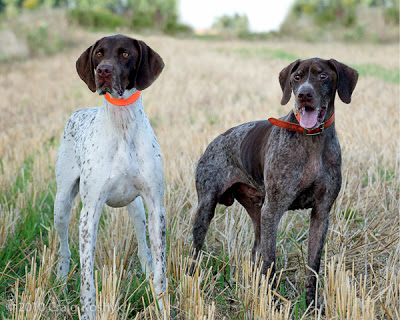
On the left is a female Gasony type, on the right a male Pyrenean type.
The two types differ mainly in size, head shape, range and pace. 
The different coat patterns seen in the photo are found in both types.

NEXT WEEK: Part Two, Form and Function


Read more about the breed, and all the other pointing breeds from Continental Europe, in my book Pointing Dogs, Volume One: The Continentals
http://www.dogwilling.ca/index.cfm