Contact Us

Use the form on the right to contact us. We should get back to you within 24 hours. If not, it means we are out chasing birds with dogs, shotguns and Canons. In that case we will get back to you as soon as we've finished the roasted Teal and Bordeaux . 


123 Street Avenue, City Town, 99999

(123) 555-6789

email@address.com


You can set your address, phone number, email and site description in the settings tab.
Link to read me page with more information.

Pointing Dog Blog

The world of pointing dogs in words and images, moving and still.

More Shades of Grey for the Weimaraner

Craig Koshyk

When I check the stats on hits to this blog, my posts about Weimaraners consistently rank at the top of the list, especially if they deal with the breed's coat colour. This morning I received a comment on one of the posts that posed a couple of questions that I felt deserved more than just a few lines to answer. So I decided to write an entire article in reply. 
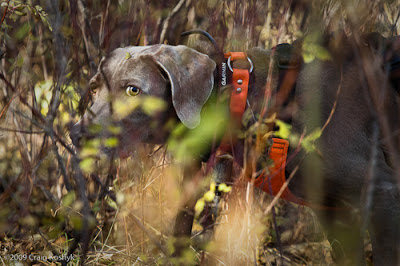
Souris-Manon. The Grandest of the Grand Old Ladies!

Here is the comment:

I just got a Weimaraner that is all white/blonde in color. He came from a litter of nine in which 4 were his color, 4 were silver and 1 was blue. The Sire was silver and the dam was blue. I performed a DNA test to confirm that he is indeed a purebred weim and the results came back as 100%! However, despite having scientific evidence backing my boys purebred status, I have all sorts of weim breeders on Facebook getting very nasty with me when I post a pic on the weim site of my boy...they claim that I have been duped and am naive to think that he is purebred and that DNA tests aren't always right. Could you please tell me exactly what occurred scientifically for my boy to be born the color he is...is it the same occurrence genetically as the piebald weims? Thanks.

And here is my long-winded reply:

Congratulations on the new pup! I am sure he is a sweet-heart and that you'll have a ton of fun with him. And welcome to the world of the Weimaraner where, as you are finding out, things tend to get a bit heated when non-standard colours are discussed.

I am not a geneticist so I cannot tell you with any degree of scientific accuracy how your boy's coat colour came to be. And I am sure that even a canine geneticist would not be able to help you without doing some pretty extensive testing of your pup and a whole bunch of its relatives. So the only option for us here is to look at the possibilities and then place odds on how likely they are to be true.
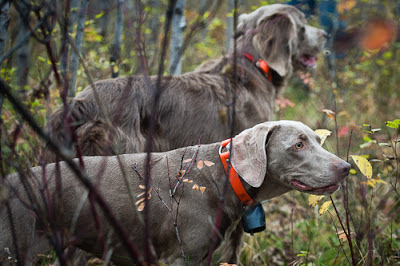

Souris-Manon and Quell each pointing a woodcock (and I missed both birds!)

Could it be a gene mutation like the one that I wrote about here?  

Maybe. 

Genes mutate all the time and clearly, Dr. Epplen's research showed that in at least one case, a de novo (new) mutation in a Weim pup did indeed result in a purebred Weimaraner with a grey and white (piebald) coat. So could it happen again? Sure, there is a one in a million (or billion or something) chance of it occurring again...in a single pup. But in 4 pups? Well that would make the odds one in a million (or billion or something) to the fourth power. In other words, about the same odds as me landing a hot date with Beyonce. So I don't think that the coat on your pup and its three siblings is related to the same kind of genetic mutation event that caused the piebald coat in Dr. Epplen's study.

Could it be due to a throwback to the old days? Does the (real) history of the Weim offer any clues about how your dog's coat colour could occur? 

Maybe.

Today, we all know that there is only one officially accepted Weimaraner colour (silver-grey) but it was not really standardized until later on. Reading the literature from the first phase of the Weim's development, from about 1880 to just before the first world war (1914), we can see that there was actually quite a bit of discussion about what the 'correct' colour for the breed should be. In the early years the most common non-standard colours discussed were white, yellow and yellow-red. For example, here is what the breed standard in 1884 said:

White markings are common in most dogs, on the chest and toes. It is however, desirable to eliminate these in breeding. Yellow burned (tan markings) dogs are to be discarded completely. 

By 1935 however, it seems that those markings were still there.

...the reddish-yellow shade on the head or legs, which nowadays occurs seldom, to be regarded as a fault; however a Weimaraner with reddish-yellow coloring should not receive more than 'good' when tested...if outstanding for hunting purposes, he should not be excluded from breeding

Clearly, genes for yellow or yellow-red where part of the genetic make-up of the Weim's coat, at least in the early days. So could your pup's coat colour be due to a one-in-a-billion chance of old, rare yellow genes suddenly aligning in it's DNA? Maybe. But I doubt it.

You see, the yellow and yellow red shades discussed in the old literature involved markings in the coat, specifically on the head and legs. Those markings are in fact still with us today. Although very, very rare, they are called "dobe" markings (as in Doberman) and they look like this:
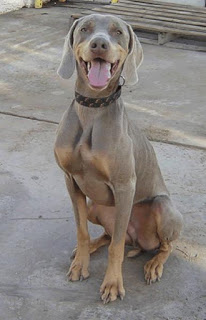

Not my photo. This could actually
be a Doberman x Weim mix.
Used for illustration purposes only.
Your dog seems to be self-coloured (ie: the entire coat is all one colour, not 'marked' with a different colours on the head, legs and chest). So if the yellow or yellow red genes that were in the background of the Weim are responsible for your pup's coat colour, then they would have had to not only lay dormant for over a century and then, by pure luck, happen to find the right combination to appear, but they would also have to mutate in some way and go from just 'markings' to affecting the entire coat....of four pups! Is it possible? Maybe (I am not a geneticist) but I would put the odds at around a gajillion-gajillion to one.

So, if we eliminate the possibility of a mutation and of a throwback to the early days (and I think we can in both cases), what else could result in such a coat?

Occam's razor would lead us to the very real possibility that the genes responsible for your pup's coat were introduced by an external source at some point in the past. In other words, somewhere in your dog's ancestry, there is at least one non-Weim ancestor that brought in the genes for the white/blond coat your pup has.

Where, when and how could this happen? I have no idea. What I do know is there is no such thing as a 'pure' breed. All breeds have a bit of this and a bit of that in them. That is how they were created and every now and then, by accident or on purpose under the light of the moon, a bit more of this or bit more of that gets added into the mix.
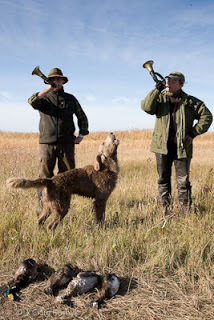
AAAOOOOO!!!!!

You said that one of the parents is a blue Weim. They are handsome dogs, I've written about them here. And it is pretty well accepted nowadays that the blue coat is the result of a bit of this or that getting into the breed in the US (the most common theory is that is was from a Doberman). So we know that there is at least one source of 'outside' genetic material in your pup. As an aside, it has been estimated by the owner of the Weimaraner pedigree data base that 99.9% of Weims in the world today have the original 'blue' weim somewhere in their pedigree as well.

But could there be another source of outside genes, ones that could lead to a white/blond coat? Of course. In fact, I believe that the vast majority of all the Weims out there with non-standard colors (and even some with the standard color) are the result of something happening behind the woodshed in the past. Gene mutations like the one described by Dr. Epplen are extremely rare. Cross breeding (accidental or otherwise) is not.

But what about the pedigrees of our dogs? What about the records that show they are pure?

Dr. Epplen, the same fellow who did the DNA article on the piebald weim published another study on Weims that (among other things) looked into the accuracy of the Weimaraner pedigree information stored in Germany. The results indicated that:
Tracing patri- and matrilineages, several entries in the Weimaraner stud book cannot be reconciled with the male-only, Y chromosomal neither the female-only, mt inheritance patterns, respectively.
In other words, the pedigree record in the homeland of the breed, where there is a system with the most rigorous checks and balances and the most tightly controlled stud book on the planet is not 100% accurate. So how accurate is the pedigree information outside of Germany, in free-wheeling North America were there are far fewer rules, no breed wardens and a much stronger tradition of 'anything goes'?  Pedigrees are not perfect. Some are accurate, some less so, and some are pure fiction.

But what about the DNA breed testing results that say he is a purebred Weim? 

I am not sure what breed DNA testing service you used, but I assume it was one of the many such services that are now being sold online and through vet clinics. I don't want to go into all the details here, and it really is quite a rabbit hole to go down if you google it, so I will just link to an article written by a guy who does not pull his punches when it comes to such things, Terrierman, in which he says:
Breed DNA tests are not too different from Gypsy Fortune telling, Fortune Cookies, the I-Ching, Numerology and Tarot Card reading. 
Unfortunately, unlike DNA parentage tests which can tell you with near 100% accuracy who your pup's mother and father are, tests for breed-specific DNA markers are generally not nearly as reliable and are not really designed to determine if a dog is purebred or not. They are mainly designed to narrow down the ancestry of mixed-breed dogs and in almost all cases where purebred samples are sent in, the result are the same: yup! your dog is what you say it is.
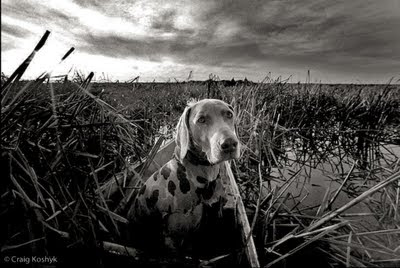
Felix in neoprene at the Libau marsh on opening day, 1999.

Bottom line: As a guy on the sidelines who just wants everyone to have a dog that puts a smile on their his or her face, here is what I think is going on.
1. You have a very cute pup that deserves 100% of your love and devotion.
2. Anyone who says nasty things about you or your pup is not worth your time or attention.
3. The most likely explanation for your pup's white/blond coat is that genes from outside the breed were introduced into its lineage at some point in the relatively recent past. Your pup is therefore probably not a 'purebred' Weimaraner and only you can decide how much that actually matters.
Me and the Amazing Maisey.
Personally, I don't think it matters at all and I get the feeling that it will not really change the way you feel about your pup. He deserves, and I am sure he will receive, 100% of your love and devotion.

The only issue you may have in regards to his lack of 'purity' is if you feel that you were defrauded by the breeder. I have no idea where you got the pup or under what circumstances, but if you were specifically told in no uncertain terms that your pup is 100% purebred and guaranteed to be from purebred parents and grandparents etc., well then you may have grounds for a complaint. But remember, the breeder may believe that the parents are purebred because that is what the person they got them from told them...and so on down the line.

In reality, without video evidence or a written confession, it would be impossible to determine exactly how and where the outside gene event happened and who knew about it at the time. So tread very carefully in that regard. It might not be worth picking a fight with anyone at this point. The most important thing is that you now have a pup that deserves 100% of your love and devotion.

Where I would speak out and where I would have deep concerns is if you see any effort by anyone out there to launch some sort of super duper, rare, cool new white/blond colour of Weimaraner. It is not because the colour is unattractive - your pup is super cute and will be a stunning adult. And it is not because the white/blond dogs themselves are bad or undeserving of loving homes - your pup should be the light of your life. But as you are finding out, the Weim world (and the entire purebred dog world) can be an unforgiving place, and you can go insane by tilting at its windmills. So any effort to launch a new designer colour of Weim is guaranteed to end in misery for everyone involved.

Here is my advice: 
  • Love your pup. 
  • Take care of your pup. 
  • Give him the fantastic life he deserves and forget about what nasty people have to say. Your pup doesn't give a rat's ass about them, why should you?


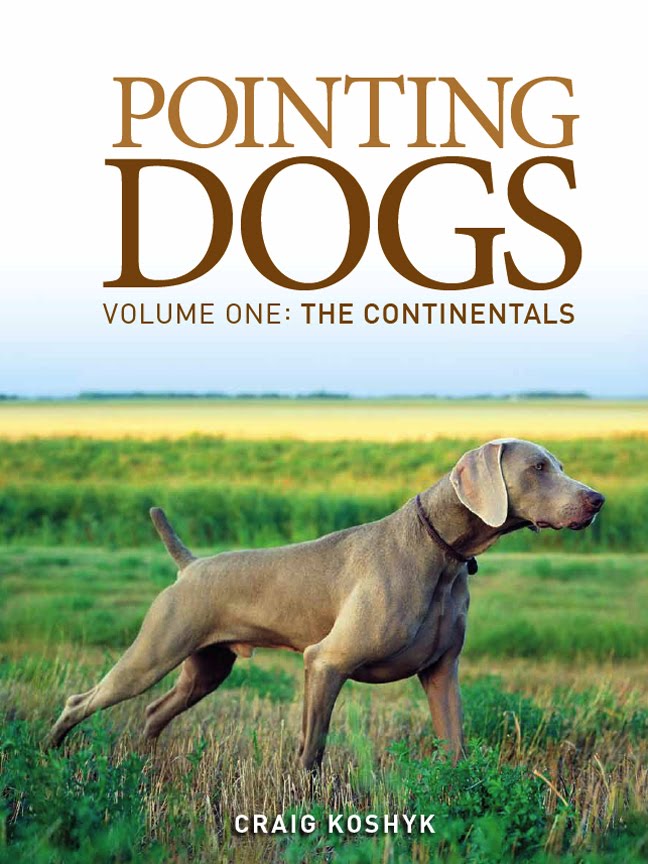
Enjoy my blog posts? Check out my book Pointing Dogs, Volume One: The Continentals
www.dogwilling.ca


Kent Bismuth Ammo Delivers!

Craig Koshyk

kentcartridge.jpg

Full disclosure: I am NOT an expert when it comes to shotguns, shotgun ammo, ballistics and the art of wing shooting. I shoot a few rounds of clays every summer and pattern my guns and chokes once in a blue moon. Beyond that, I just take the same guns to the field every year and feed them the best ammo I can afford. So the following review of Kent's new Bismuth cartridges is the opinion of a hunter who just wants his gun to go boom! when he pulls the trigger so that delicious game will end up on his dinner plate... nothing more, nothing less.

A while ago I wrote about my desire to go completely lead free for all my hunting and my journey down the rabbit hole of trying to find lead-free, non-steel ammo for my beloved Darne shotguns. I then updated one of the posts with the following great news: Owners of vintage guns rejoice! ... Kent Cartridge recently announced "the rebirth of an old favorite" by introducing their new Bismuth Premium Shotshells

Here is a video from Kent Cartridge that explains the development of Bismuth shot shells and the improvements that have been made in the new loads.

Just before the 2017 season opened, I managed to get my hands on a good supply of the new Kent ammo in 12 and 20 gauge loads. Since then, my wife and I have been using it exclusively. We've taken snipe, woodcock, ruffed grouse, sharptailed grouse and a few ducks and geese. My wife even shot a scotch double* ON GEESE with her 20 gauge loaded with #5s! I wrote about that amazing shot and posted some photos here. (*two birds with one shot).

1000w.jpeg

In terms of performance, I could not tell the difference between Bismuth loads and lead loads. Now before you get your bloomers in a bunch and start rattling off newtonian physics equations let me qualify my statement by saying it applies to me, to my guns, in the areas I hunt, on the game I pursue. As with all things related to shotguns and shotgun ammo, your mileage, as they say, may vary.

My hit/miss/crumple/wound ratio was nearly identical this year compared to last. For example, on a trip to North Dakota in 2015, I shot 14 pheasants with 16 shots (lead #5s). All but two dropped stone dead. This year, in the same general area under the same basic conditions and with the same gun I shot 15 roosters with 17 shots (bismuth). All but one crumpled, and that one did not go far. (note: the above stats make me seem like some kind of superhero wing shooter. I am not. I am a terrible trap shooter, useless at skeet and barely on the scoreboard at 5-stand. The reason I bag a decent number of roosters with so few shots is because I am a very patient pheasant hunter with decent dogs. I pass up all birds that are not pointed, all birds beyond about 35 yards and only pull the trigger on birds I am pretty confident I will kill outright.

In terms of actual ballistics, as mentioned above, I can only confirm that the shells did indeed go boom! when I pulled the trigger and that birds did indeed crumple when my aim was true. If you want an expert opinion on the witchcraft of shotgun ballistics as they apply to Kent Bismuth loads look no further than gun guru Randy Wakeman to see what he has to say about them:

As a practical matter, assume that you want a minimum of 1.75 inches of ballistic gelatin penetration for pheasant. This cannot be exact, for gel penetration does not consider feathers, much less breaking bones. It is a comparative simulant for soft tissue only. If you are using #2 steel shot at 1400 fps, you are out of gas at 35 yards. With the lower recoil 1350 fps Kent Bismuth #4 load, you are good past 41 yards. #4 bismuth has better penetration at all ranges than #2 steel. In addition, a 1-1/4 ounce load of #4 bismuth has 24.5% more pellets than 1-1/4 ounces of #2 steel. If you are sick of the poor ballistic performance of steel (why wouldn't you be?) and can afford to pay twice the price for your shotgun shells, the new Kent Bismuth loads just made steel shot obsolete.  (full article here).
© Craig Koshyk_WP_8513161016-2.jpg

Kent Bismuth shot sizes are apparently true American sizing and not one size smaller like some other loads from Europe. Kent Bismuth #4s are the same size as any other American #4s. The other maker of bismuth ammo, Rio, apparently uses European shot sizes. So Rio's #4 shot is actually closer to American (and Kent's) #5 shot.  Kent shells are clearly marked and seem to be made of  high quality materials. Word on the web is that the hulls are Cheddites.  UPDATE: Kent now sells their new Bismuth loads in boxes of 25. 

Bottom line: I will go one further than Randy Wakeman and say that for me, the new Kent Bismuth loads have made steel AND LEAD shot obsolete.

Furthermore, shooting bismuth shells allows me to focus more on the actual hunt. With a few boxes of #5s and #6s, I can use any gun I own to shoot any gamebird I pursue on private or public land no matter what the regulations are. No more swapping out ammo when going from lead-allowed to non-tox areas, no more sorting through different brands, sizes, and loads trying to get the perfect combination for geese in the morning, snipe in the afternoon and ducks at dusk. I am now lead-free in the field and thanks to Kent, when it comes to ammo, I am also worry-free.

NEW BISMUTH® Premium Upland & Waterfowl Shotshells

  • High Density 9.6g/cc non-toxic shot, has 24% greater density than steel
  • Each configuration is loaded to optimal velocities, maximizing ballistic performance
  • Softer than steel and higher performance, won’t harm barrels and safe in any choke
  • Now conveniently packaged 25 rounds per box
bismuthpremiumwaterfowl.jpeg
bismuthpremiumupland.jpeg
Bismuth ammo and Darne shotguns, a match made in heaven!

Bismuth ammo and Darne shotguns, a match made in heaven!

Enjoy my blog posts? Check out my book!

www.dogwilling.ca

Sticking a Fork in 2016

Craig Koshyk

If nothing else, 2016 was an interesting year.


Lesson learned:
1. Never look at puppy photos on Facebook too long or too often. Your will to resist WILL wilt.
2. Kent's new bismuth ammo ROCKS!
3. Less is more. 

Progress made:
1. My website got a new look.
2. I actually wrote a few pages for my next book (still about 300 to go...)
3. The Picardy Spaniel population of North America went from 1 to 7!

Setbacks and loses:
1. Souris-Manon passed over the rainbow bridge.
2. The snipe flight was non-existant.
3. We didn't get a deer.

Goals for next year:
1. Travel more (France here we come!)
2. Hunt more
3. Write more (and take more photos and more video)

Below are links to all the photo narratives I posted in 2016. Enjoy!


AUTUMN 2016 by Dog Willing Publications on Exposure


Léo at One by Dog Willing Publications on Exposure


Souris-Manon by Dog Willing Publications on Exposure


Red River Run by Dog Willing Publications on Exposure


SOON! by Dog Willing Publications on Exposure


The Eagle Has Landed by Dog Willing Publications on Exposure


Léo! by Dog Willing Publications on Exposure


WINTER by Dog Willing Publications on Exposure

Less is More.

Craig Koshyk


UPDATE: Leo earned a perfect score of 112/112!


This weekend I will be running my new pup Léo in a NAVHDA Natural Ability test hosted by the Red River Chapter near Fargo. Born last December, he will be too old to run next summer – the age limit is 16 months – so I am running him at 8 months of age before he's ever really hunted and without any formal training by me. But that's OK, in keeping with his French heritage, I'm following the take it easy and 'less is more' philosophy of bringing a bird dog along. So on test day, my goal is to just have fun, cross my fingers and hope for the best.


For those unfamiliar with the test, here is what's involved. (From the NAVHDA website, with my notes added):

The Natural Ability Test is organized into four main segments:

1) Field Phase - Each dog is hunted for a minimum of 20 minutes and is evaluated on:

  • Use of Nose
  • Search
  • Pointing
  • Desire
  • Cooperation
  • Gun Shyness
During this phase you walk through a field in more or less the same way you would if you were out hunting (or rough shooting as my UK friends call it).  While you 'hunt' with your dog, one judge walks with you while two others (and one or two apprentices) follow further behind.

A few minutes into the run, a gunner further back fires a blank from a shotgun, twice. The judges want to see if the shot affects the dog in a negative way. So far Leo has shown no reaction to gunfire other than to look over towards the sound, if that. So I think he will be fine in that regard, but it will be interesting to see how he reacts to 'hunting' in a field with a half dozen people around. I've only ever run him by myself, but I'm pretty sure he will just ignore the others and have fun searching for game.

Prior to each dog's turn pen-raised birds, usually Chukar partridge, are placed in the field. If all goes well, the dog finds some birds and points them. Unlike the higher levels of NAVHDA testing, in NA tests, the dog does not have to wait until the handler flushes the bird. As long as it points for a few seconds, it should get a decent pointing score. 

Léo seems to have a strong natural point. I've seen him point rabbits in the city and the occasional song bird in the field. I worked him on planted pigeons a couple of times and he pointed them well. He has even shown a tendency to back (honour) other dogs on point. But Léo hasn't been exposed to game birds yet. We avoided wild birds over the summer since they were nesting or had young chicks and I don't have access to pen-raised Chukars. So when we hit the field in the NA test, I will just cross my  fingers and hope that Léo's instincts kick in when he comes across birds.

Another thing judges look for during this phase is how well the dog hunts with and for the handler. They want to see a certain amount of independence from the dog, but don't want it to take off for the horizon. Then again, they don't really want to see the dog amble about mere meters from the handler either.  Ideally, the dog will hunt at a suitable range for hunting according to the the conditions of the day; not too far, not too close. It should also show a decent amount of drive and respond to commands (if any) given by the handler.

When I take Léo out to the fields around here, he runs at a medium to fast gallop, holds his head just above the shoulder line, and makes casts out to about 75 yard. But, as mentioned, he hasn't really been on game birds before. So I wouldn't be surprised if he opens up even more once he realizes that there are birds in the field. He may even fall slightly deaf to my whistle or commands. So my plan is to just keep my yapper shut and hope that he doesn't disappear over the horizon on a bird-fueled bender.


2) Tracking Phase - The dog is given an opportunity to track a flightless running pheasant or chukar.
During this phase, one pheasant for each dog is placed in a field and coaxed into running downwind for about 50 yards. The dog is then brought to where the bird was first released so that it can (hopefully) follow the track to the bird. If the dog does follow the track and manages to find the bird, it can point it or fetch it up. It doesn't really matter. It doesn't really have to find the bird to get a good score. What the judges want to evaluate is how well the dog can actually follow a track.

In theory, this should be a relatively easy job for a well-bred gundog. The bird should leave a decent scent trail behind it and the dog should be able to follow it fairly well. But there are tons of variables involved, from the humidity (or lack thereof) of the air and grass, to the length of the cover, to how far and fast the bird went, so no matter how much prep you do for this phase, or how well your dog did in any practice tracks you've done, it is always a complete crap shoot on test day.

I've done exactly zero prep for this phase with Léo. I might get one practice track in this weekend if I can find a pheasant, but in all likelihood, the track at the test will be Léo's first. And I don't really know how it will go. Léo loves to run and he runs with a high head. So he may follow the trail for a bit, but then decide that it's best to just go into field search mode instead of track mode. Or he may track it perfectly well. I've seen him follow a rabbit track for over 100 yards, so I know he has some tracking instincts. In any case, just as in the field search portion, I will cross my fingers and hope for the best.

3) Water Phase - The dog is tested for its willingness to swim.
The only problem I have with Léo and water is getting him OUT of it! So I am pretty sure he will do well in this portion of the test.


4) Judgment of Physical Characteristics.
The following are judged throughout the Natural Ability Test:
  • Use of Nose
  • Desire to Work
  • Cooperation
  • Physical Attributes
No game is shot, and no retrieves are required during the Natural Ability Test.

From what I can tell, Léo has very good nose and his desire for work and cooperation are excellent. He really is an outstanding pup in every way. He's super easy to live with, friendly, loves to hunt and cuddle, and is pretty darn handsome as well. We are really pleased with him and look forward to many hunting seasons with him.

But for now, I need to pack my bags and then do some stretches for my fingers...they will be crossed all weekend!


On Range

Craig Koshyk


Hunting dogs are generally categorized according to the job they are expected to do and the manner in which they should do it. Thus the retrieving breeds; Labradors, Chesapeakes, Golden, Flat and Curly Coats, are used to do what their name would imply. They retrieve shot game to the hunter. While there may be some debate about the finer points of the expected performance, there is no disagreement about the basic task: the dog must leave the hunter, make its way to the downed game, pick it up and bring it back.

The flushing spaniels, Springers, Cockers, Clumbers, Sussex, Welsh and Field are selected, bred and trained to search for game and force it to flight within gun range of the hunter. They are expected to retrieve downed game as well. Here again there may be some disagreement regarding the exact manner in which the dog should work, but the basics are not in dispute. The dog must seek and flush game within range of the gun and retrieve what is shot.


Pointing breeds however, do not enjoy such a consensus of opinion when it comes to how they should do their job. Other than agreeing that the dog should find and point game, everything else, from searching to retrieving, to tracking, to pace, and gate, even to the posture the dog assumes while pointing can be, and usually is, the subject of heated debate among pointing dog enthusiasts.


This is one of the principle reasons that there are so many more breeds of pointing dogs than there are retrievers or flushing spaniels. Different pointing breeds have been developed to perform similar tasks but in sometimes very different ways. Furthermore, many breeds can now be subdivided into different strains with field performance characteristics so dissimilar that they can almost be considered different breeds altogether.

The one area that stands above all others as a source of endless debate, especially in America, is the question of range. Since a pointing dog’s main purpose in the field is to find game, point it and, hopefully, hold the game there until the hunter arrives, it can work at distances beyond the range of a shotgun. So the question then becomes, how far is too far?

Traditionally, all of the Continental breeds were selected and trained to hunt only slightly further out than flushing dogs, about 50 or 60 meters at the most. Nowadays, a few breeds are still supposed to have that sort of range, but most are expected to run somewhat wider than that, at least some of the time. What’s more, over the last 50 years, bigger and faster running strains within most breeds have been developed. In fact, in some breeds, there are now lines of dogs that approach the speed and range of English Pointers and English Setters.


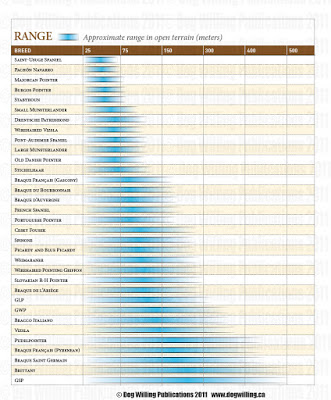
Be that as it may, I have come up with a chart that illustrates the typical range for each of the Continental pointing breeds, but we need to keep the following things in mind when consulting it.

THE BEST RANGE IS THE ONE THAT SUITS YOU: One of the most common sources of frustration among pointing dog owners is a mismatch between the range the hunter would like his dog to run at, and the range the dog’s genes tell it to run at. Most experts agree that a pointing dog’s range is largely an inherited trait. There are methods that can be employed to modify this range making a wide-ranging dog work closer or, more difficultly, making a close-working dog range further out—but in general the distance from the handler at which the dog is most comfortable hunting is mainly determined by its genes. So, finding a breed that has the kind of range you are comfortable with, and is suitable for the game and terrain you hunt, is very important.

THESE ARE BALLPARK FIGURES: The chart is not based on anything close to a scientific survey. Some of the distances given are based on the preferred ranges stated in the breed’s published work standard, but most are based on nothing more than the breed’s reputation or the generally accepted norm as expressed to me by the breeders and owners I have spoken to.

THERE ARE EXCEPTIONS: There are outliers in every breed. Some may run way bigger than the average, and others may work closer in. In many breeds, this applies to various strains and lines that may show significant differences in range. That is why the chart shows a wider spectrum of ranges for some breeds.


“HORSES FOR COURSES”: Generally speaking, within any given breed, breeders who select their stock for field trials tend to produce dogs that are toward the bigger running end of the spectrum. Other breeders may seek to produce closer-working dogs suitable for different types of terrain or game.


TO THE FRONT OR SIDE TO SIDE: In some countries, dogs are expected to run in a windshield wiper pattern in front of the hunter. In that case, the distances given would indicate how far the dog usually ranges out to one side or the other. In other countries, dogs are encouraged to “seek objectives”. They should run to areas of cover that are likely to hold birds no matter where they may be, to the left, to the right, or out in front.

DOGS ADJUST THEIR RANGE: The distances given reflect the usual range for the breed when hunting in open fields. Most dogs will adjust their range when working in tighter cover. The same dog that ranges out to over 300 meters across a stubble field for grey partridges might not go beyond 40 or 50 meters in the alder thickets in pursuit of woodcock. And yes, as mentioned above, a dog’s range can be adjusted. But it is easier to teach a wide-running dog to stay closer than it is to make a close working dog work further out


Enjoy my blog posts? Check out my book Pointing Dogs, Volume One: The Continentals

www.dogwilling.ca

Happy Father's Day!

Craig Koshyk


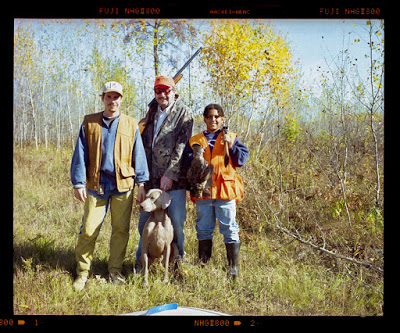
Me, my dad, Félix and CJ, circa 2000

In honour of Father's day, and because I just happen to have the best father in the world, I thought I would share a book of photos that I made for my dad on his 80th birthday three years ago. All the photos are either of him or taken by him. And in case you are wondering, yes, at almost 83 he is still going strong. In fact he now has more hair than me, and none of it is grey!!!

Happy Father's Day Dad!