Contact Us

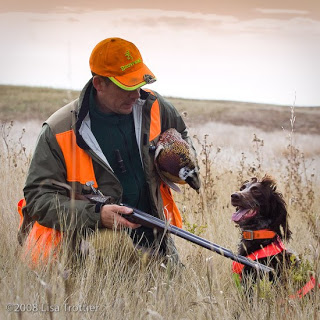
Use the form on the right to contact us. We should get back to you within 24 hours. If not, it means we are out chasing birds with dogs, shotguns and Canons. In that case we will get back to you as soon as we've finished the roasted Teal and Bordeaux . 


Form Block
This form needs a storage option. Double-click here to edit this form, and tell us where to save form submissions in the Storage tab. Learn more
         

123 Street Avenue, City Town, 99999

(123) 555-6789

email@address.com


You can set your address, phone number, email and site description in the settings tab.
Link to read me page with more information.

Pointing Dog Blog

The world of pointing dogs in words and images, moving and still.

Mad Dogs and Englishmen

Craig Koshyk
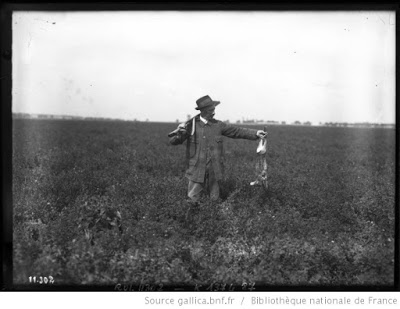

One of the more interesting things I discovered when I was researching the various French breeds of pointing dogs for my book was how much information there is to be found on them in the old English sporting press from the mid to late 1800s. In fact, for some breeds, there is more information in English than in French.

And now that I am writing my second book, this time on the British and Irish breeds, I am re-reading many of the same old books, but with an eye for references to Setters and Pointers. Unfortunately, even though the stories themselves are fascinating, a lot of them were written by unbelievably arrogant English snobs who regarded France as a third world country and its inhabitants as illiterate heathens. A few of them are so over the top, they sound like Donald Trump talking about Mexicans.

Anyway, here is a short passage from a book called "The sportsman in France : comprising a sporting ramble through Picardy and Normandy, and boar shooting in Lower Brittany" written in 1841. It is about how the author found and purchased a well bred-setter near Abbeville, France.
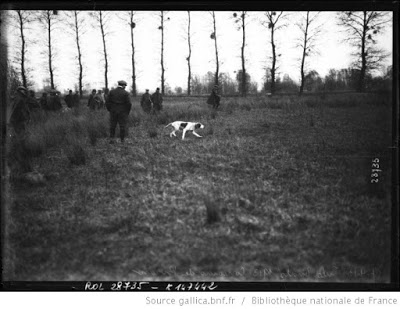


"It came to pass, that, being at Abbeville, in 1829, 1 was induced to shoot my way to Amiens, via the marshes on the banks of the Somme. On my return, and when about half way from home, my attention was attracted to a dog in the swamp, which was beating and quartering his ground in a very superior manner : the style of going, the pace, the action, and that indescribable dashing and swinging of the stern, which betrays high breeding, were so unusual in that part of the world, that I was induced to approach the chasseur, whom, to my astonishment, I found to be a Frenchman.

After the interchange of as many bows as would suffice for an Englishman during the term of his natural life, I ventured to observe, " that he had a nice dog with him." He answered me by stating that it was a '' sacre chienne Anglaise,'' and of the '' veritable race," but that she would not remain close to him, and always beat her ground at too great a distance to suit him.

I then inquired where he picked up the dog. He told me candidly, that he believed the mother to have been stolen, as she had strayed from the servant of an English gentleman, on the road from Boulogne ; that she was in pup at the time ; and that the animal before me was one of the litter. "


I've embedded the book below. But be forewarned; there are some passages that may make you want to say the following to the author:


Click on the right or left to leaf through the pages or on the link to read the book at archive.org
Modder Rhu

Craig Koshyk


My first book, Pointing Dogs ,Volume One: the Continentals took twelve years to write, mainly because I’m a slow and sometimes lazy writer. But I also had to travel a heck of a lot to photograph all the continental breeds in their native lands and find and interview experts in each breed. So that meant saving my pennies and holidays to spend on airline tickets, rental cars, hotels, meals and wine. And beer, which we discovered is a breakfast beverage in the Czech Republic. But I digress….


 I am now well into year three of writing Pointing Dogs, Volume Two: The British and Irish Breeds and I am really hoping to wrap it up in half the time it took me to complete Volume One, by the summer of 2017. So over the next couple of years, I will be booking flights, cars, hotels and tables for two at wine bars in North America, England, Ireland, Scotland and various countries in Europe as Lisa and I travel to photograph Pointers and Setters and interview breeders and breed experts from around the world.


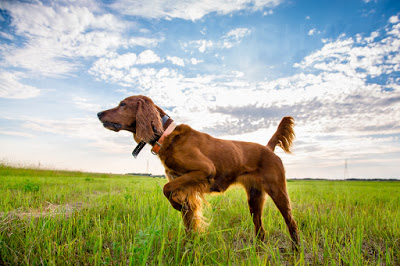
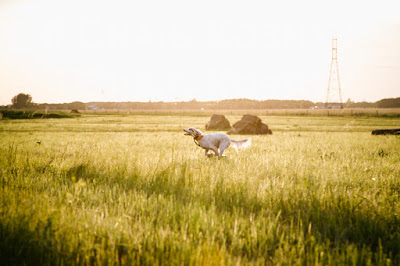
And, as luck would have it, we can also find awesome dogs close to home. Not only do some of the biggest names in horse-back field trialing come to Manitoba every year to train and run dogs on the prairies, there are also people living right near us with awesome dogs. Check out these Irish and English Setters owned by Graham Crawford a hunter, field trialer and talented trainer of gundogs. We photographed them the other night less than an hour from our front door!


Modder Rhu by Craig Koshyk on Exposure

Say Au Revoir to Language Barriers!

Craig Koshyk


Americans who travel abroad for the first time are often shocked to discover that, 
despite all the progress that has been made in the last 30 years, 
many foreign people still speak in foreign languages. 
‒Dave Barry


I recently set up a Facebook group to help hunters outside of France find out more about the French pointing breeds. And that means there may be a language barrier between members that don't speak each other's language. Fortunately, there are some great tools available to help us overcome language barriers online.


Un homme qui parle trois langues est trilingue.
Un homme qui parle deux langues est bilingue.
Un homme qui ne parle qu'une langue est anglais.
- Claude Gagnière
1. Use Facebook's 'translate' option. At the bottom of a post or comment, look for a blue 'see translation' link. When you click it, the post or comment is automatically translated. Keep in mind that the translation is computer generated so may only give you the overall gist, but it's better than nothing. If the 'see translation' link is missing, don't worry. For some reason, Facebook drops the service from time to time. One day it's there, the next it's not.

Quand on voyage sans connaître l'anglais, on a l'impression
d'être sourd-muet et idiot de naissance.
- Philippe Bouvard

2. Use Google translate. Here's how: 1. Copy the text of the post or comment. 2. Visit the Google Translate page 3. At the top of the page, choose the languages to translate between. If you aren't sure what language you want to use, click Detect language. 4. Paste the text and Google will automatically translate it for you.

Not only does the English Language borrow words 
from other languages,it sometimes chases them down dark alleys,
hits them over the head, and goes through their pockets.

- Eddy Peters

3. Install a translation plugin or app. Browsers like Chrome, Firefox and others offer plugins or apps that translate facebook posts and comments. I've never used one, but I've heard good things about this one and this one.

The limits of my language are the limits of my world.
‒Ludwig Wittgenstein

4.  Learn! It's never too late to learn another language. I was a unilingual anglophone until my mid 20s. Now I also speak French and Italian and can read Spanish, Portuguese and (if I've had enough schnapps) a bit of German. So don't look at posts or comments in other languages as obstacles, think of them as opportunities to learn a new word or two.

Language is the road map of a culture.
It tells you where its people come from and where they are going.
‒Rita Mae Brown
In upcoming posts, I will take a look at some French words that non-French speakers who are interested in pointing dogs should learn. In the meantime, here is a post I wrote a while back about the the word "Braque".


Enjoy my blog posts? Check out my book Pointing Dogs, Volume One: The Continentals

www.dogwilling.ca

French Pointing Breeds in North America and Beyond

Craig Koshyk


Did you know that France has produced the largest number and widest variety of pointing dog breeds? It's true. French hunters developed close to twenty different pointing breeds, and while some of them went extinct or never really got off the drawing board, 12 of them are still with us today.

Yet despite the large number of breeds created by French hunters, only two became well known outside of France. The Épagneul Breton (Brittany) is one of the most popular pointing breeds in the world, and the Korthals Griffon (wirehaired pointing griffon), is popular in some areas of North America and Europe.

Some of the other French pointing breeds have gained small but loyal followings outside of France. The Épagneul Français (French Spaniel) for example is relatively popular in Québec. There is an official breed club there and a small but dynamic group of enthusiasts have been producing solid hunting dogs, and achieving excellent results in hunt tests since the late 1970s. The Braque du Burbonnais has also been in North American for several decades and there is now a club for the breed.

But some breeds remain almost completely unknown outside of France. And that is a shame. I believe that the French produce some of the very best pointing dogs in the world and that dogs from their native breeds would be perfect matches for a lot of North American hunters. So in order to get the word out and help North Americans and others find out more about the French pointing breeds, I set up a Facebook group called French Pointing Breeds in North America and Beyond.

The group's goals are:
  • To engage in an open, honest, and respectful exchange of information, expertise and resources.
  • To promote the French pointing breeds as versatile, upland hunting dogs in North America and beyond. 
  • To assist hunters seeking a hunting companion from one of the French pointing breeds find well-bred pups from proven stock.
  • To provide information about the French pointing breeds, their history, clubs, current situations, availability etc.
  • To facilitate the exchange of information between breeders, club members and hunters with French pointing breeds in France and North America...and beyond!

The French pointing breeds are:
Épagneul Breton (French Brittany)
Épagneul Picard (Picardy Spaniel)
Épagneul bleu de Picardie (Blue Picardy Spaniel)
Épagneul de Pont-Audemer (Pont Audemer Spaniel)
Épagneul Français (French Spaniel)
Épagneul de Saint Usuge (Saint Usuge Spaniel)

Braque d'Auvergne
Braque Francais (Gascony type and Pyrenees type)
Braque du Burbonnais
Braque Saint Germain
Braque de l'Ariege

Griffon Korthals (Wirehaired Pointing Griffon)

Extinct French pointing breeds and/or breeds that never really got off the ground:
Griffon Boulet (Boulet Griffon)
Griffon Guerlain (Guerlain Griffon)
Braque Dupuy
Épagneul de Larzac
Braque de Mirepoix
Braque Charles X

Notes: Posts to the group may be made in English or in French. Translation services beyond those offered by Google and Facebook are available upon request.

Pure Copper Shot.

Craig Koshyk

UPDATED 

In my

previous post

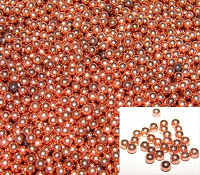
, I took a look at the various non-tox options available for hunters looking to go lead free. And one type of shot really stood out for me: pure copper. 

I discovered that French ammo maker FOB has been marketing an entire line of copper loaded shells called 

Sweet Copper

 since 2013 and another French company, 

Vouzelaud

 just announced similar shells loaded with copper shot and a bio-degradable wad. In Germany, 

Rottweil

 is now selling a shell called  

"Copper Unlimited"

In Italy, reloading website

Siarm

lists a product called "

Real Copper

". It is said to be made of 99.97840 % pure copper and is currently available in #3 and # 6 shot sizes for reloading. I also found a

recipe

 on the same site for a 12 gauge test load composed of 28 grams of pure copper shot and 2 grams of B&P's MBx36 powder. Test results indicated that it produced a peak pressure of 750 bar and a velocity of 450m/s (about 1475 f/s). 

So I wasn't suprised to see that Italian ammo giant 

Baschieri & Pellargi

are also getting into the pure copper shot game now.  

Here's a company rep at an outdoor/hunting fair in Germany announcing their new '

Dual Shock

' shells that contain a half-and-half mix of pure copper #6 shot and zinc-coated

copper 

#4 

shot. 

And here is a video of Dual Shock shells being tested in the fields of Argentina and the UK:

Naturally, with all the buzz around copper shot in Europe, I have to wonder if it will ever make its way over to this side of the ocean. But that brings up a whole slew of other questions. Here are a few I can think of, and my best guesses as to what the answers might be. 

Is copper shot approved for use in North America? 

I don't really know. But if I had to guess, I would say that copper shot should be perfectly fine to shoot wherever lead can be shot. But pellets made of pure copper are not on the 

list of approved non-tox

lead alternatives. However, as an

ingredient

 in shells combining different elements, copper gets the green light. Here are the percentages currently allowed in approved non-tox shot types.

  • Copper-clad iron: copper cladding can be up to 44.1% of the shot mass

  • Tungsten-bronze: can contain up to 44.4% copper

  • Tungsten-iron-copper-nickel: can be 9–16% copper

Is pure copper shot toxic?

There is no such thing as a completely non-toxic metal suitable for use in shotgun shells. So it comes down to figuring out which is the least toxic. And copper seems to have relatively low toxicity, especially when

compared to lead

. When copper is just one ingredient mixed with other things like tungsten, 

studies indicate

that "the rate of copper release from tungsten bronze shot was 30 to 50 times lower than that from the copper shot, depending on pH".  And other

studies

indicate that the "mortality among mallards fed iron, copper, zinc-coated iron or molybdenum-coated iron shot was significantly less than in birds fed lead shot, and was not significantly greater than the controls."

I am sure there are many more studies out there, all of which undoubtedly reveal at least some level of toxicity, but what is important to note is that regulators in Europe, where environmental regulations tend to be far stricter than in the US or Canada, have determined that pure copper shot can be used where lead is banned. And that means they've chosen it (and other metals like bismuth and tungsten) as the 'least bad' alternatives to lead. 

Can it be shot out of a gun that is not approved for steel?

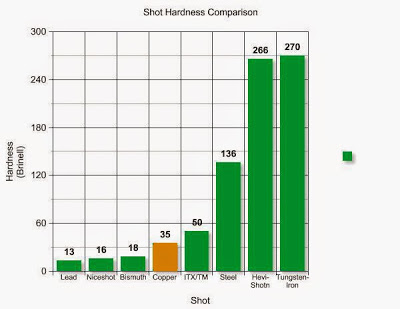
I think so. But don't quote me on that. In terms of hardness, copper actually looks like it might fit the bill. It is harder than lead and bismuth, but it is softer than most of the others, including ITX (original) and Tungsten polymer, both of which were specifically designed for use in guns not approved for steel.

Copper is harder than lead, but softer than ITX and Tungsten Matrix shot

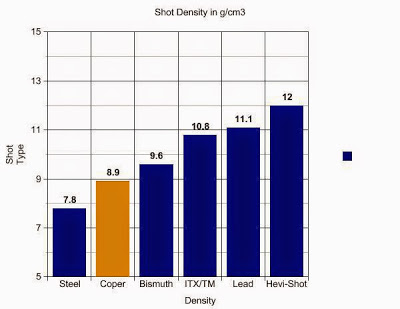
In terms of density, here is how it stacks up to some of the other options.

Copper shot is nearly15% denser than steel shot

And finally, what about price? 

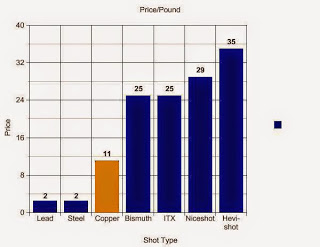
Pure copper shot is more expensive than lead or steel shot, but, surprisingly, it can be as much as 3 times cheaper than other options. Here's how it compares on a dollars-per-pound basis (#6 shot).

Copper is more expensive than lead and steel, but way cheaper than all the other lead alternatives

I will leave it up to the reloading experts to figure out what a decent 20 gauge upland load would cost on a per shot basis since I have no idea what hulls, wads, powder and primers cost or how much shot you'd need of each type for a decent upland load. But if all the other components remain more or less the same, it seems to me that copper shot would be a relatively inexpensive choice for reloading.

So, will we ever see pure copper shot loads over here? 

Only time will tell.

UPDATE, December 17, 2015

An article with test results

of 8 different pure copper loads appeared in a French magazine called "Armes de Chasse" (Hunting Guns) recently. I finally had a chance to read it today and here are some of the results.

NOTE: tests were done with a 12 gauge Beretta A400 with a 28 inch barrel and modified choke. The results in the magazine were given in metric, I've made approx. conversions to imperial.

Re Patterns: They ranged from 79% to 87% in a 30 inch (76cm) circle at 40-ish yards (35 meters)

These two loads are said to be safe to shoot in any gun. See my previous article "

After Lead

" to read about CIP's

specifications for loads specifically formulated to reduce (if not completely eliminate) the risks of shooting them in older guns not approved for steel shot.

Brand: FOB

Load: Sweet Copper

Pressure: 683 bars

Velocity: 1204 f/s

Brand: Vouzelaud

Load: 28

Pressure: 778 bars

Velocity: 1272 f/s

The loads below are designed to be shot only out of guns approved for steel shot and having a fleur de lys proof mark (ie: able to handle higher pressures).

Brand: Rottweil

Load: Ultimate 34 HP

Pressure: 767 bars,

Velocity: 1299

Brand FOB

Load Sweet Copper HP

Pressure: 914 bars 

Velocity: 1300

Brand B+P

Load: Dual Shock

Pressure 1043 bars

Velocity: 1400

Brand: FOB

Load: Sweet Copper Magnum

Pressure: 767 bars

Velocity: 1100

Brand: Rottweil

Load: Magnum

Pressure: 1050 bars

Velocity: 1265

Brand: B+P

Load: Magnum

PRessure: 957 bars

Velocity: 1368

And finally, I came across an interesing tidbit in the comment section of the B+P

youtube video posted above

. A viewer asked: "

...Will that ammo be available in the States??" and the video poster relpied: "B&P assured me that in 2016 the three cartridges of the Dual Shock line will be available for US market."

So, once again....will we ever see pure copper shot loads over here? 

Only time will tell.

Enjoy my blog posts? Check out my book 

Pointing Dogs, Volume One: The Continentals

2025 UPDATE: Well, it only took a decade, but pure copper shot cartridges are now available in North America. Boss and Epic Shotshell are both offering copper loads now. Check them out!!

www.dogwilling.ca