Pointing Dog Blog
The world of pointing dogs in words and images, moving and still.
Versatility Part 2: News from Germany
Craig Koshyk
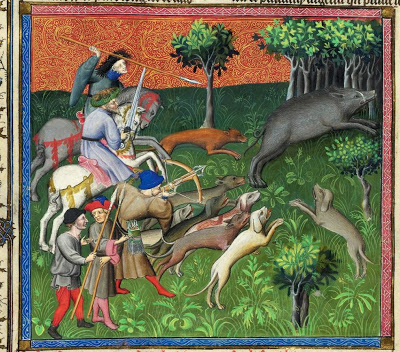
Think the German way of testing and breeding pointing dogs is an old fashioned, rigid system that never changes? Think again. The German system is, above all, practical. When hunting conditions change, the system adapts. And this adaptive strategy is now being implemented by most of the versatile dog clubs in Germany as they develop new training and testing methods to assist handlers and breeders deal with a mushrooming population of wild (and sometimes radio-active!) boars.
Recently I spoke to Tanja Breu-Knaup, a breeder of Longhaired Weimaraners in Germany about a new test that the Weimaraner club is setting up to verify a dog's willingness and ability to confront boars.
Tanja, why is a new test and award now being developed for Weimaraners?
As you know, the number of boars in Germany has increased greatly over the last 20 years. Last year, for example, German hunters killed over a half-million of them! So we realized that we needed to come up with a test to certify that a dog is able to hunt boars. Most of the other clubs are doing tests that are very similar. And it is something that has been done for other kinds of dog breeds like hounds and terriers for many years, especially in the old GDR (the former East Germany).
Can you describe the test for me?
The test is conducted in a large enclosure called a Schwarzwildgatter (schwarzwild = boar, gatter = gate, ie: a fenced enclosure) where a boar weighing at least 60 kilos is located. Two judges from the club observe as a dog is sent into the enclosure on its own -- the handler remains outside. The dog searches within the enclosure and must find the boar within 5 minutes. Once it has located the boar, it should bark at it, harry it and try to get it to move without endangering itself and without any help from the handler. It must continue to harry the boar for at least 5 minutes.
The judges look at a number or things and make notes during the test. For example, they note the approximate weight of the bar, if it stood its ground or charged at the dog. They note how intensely the dog goes about harassing the boar, how close it gets to it, how long it barks for and so on.
If all goes well, the dog receives a passing grade, a notation of Schwarzwildgatter [S] is made on its record and a certificate is issues. A dog that is too reckless however, will not pass. Nor will a dog that is too nervous or refuses to confront the boar.
Here is a report (in German) about training dogs in the Schwarzwildgatter to work boar.
And here is a Weimaraner confronting a boar in a Schwarzwildgatter during a test.
Can you describe the test for me?
The test is conducted in a large enclosure called a Schwarzwildgatter (schwarzwild = boar, gatter = gate, ie: a fenced enclosure) where a boar weighing at least 60 kilos is located. Two judges from the club observe as a dog is sent into the enclosure on its own -- the handler remains outside. The dog searches within the enclosure and must find the boar within 5 minutes. Once it has located the boar, it should bark at it, harry it and try to get it to move without endangering itself and without any help from the handler. It must continue to harry the boar for at least 5 minutes.
The judges look at a number or things and make notes during the test. For example, they note the approximate weight of the bar, if it stood its ground or charged at the dog. They note how intensely the dog goes about harassing the boar, how close it gets to it, how long it barks for and so on.
If all goes well, the dog receives a passing grade, a notation of Schwarzwildgatter [S] is made on its record and a certificate is issues. A dog that is too reckless however, will not pass. Nor will a dog that is too nervous or refuses to confront the boar.
Here is a report (in German) about training dogs in the Schwarzwildgatter to work boar.
And here is a Weimaraner confronting a boar in a Schwarzwildgatter during a test.
Does a dog have to pass this test to be allowed to breed?
No. The Schwarzwildgatter test is something that a lot of breeders want their dogs to do, and it helps us make breeding decisions, but it is not something that the club requires in order for a dog to be bred.
How is the test being received by members of the club and by hunters in general?
I think that they are generally happy with it and it is a good thing that this sort of test is now available. But that is not to say that the test is perfect. It is, after all, an artificial situation and that can lead to some problems. For example, some dogs realize that the whole thing is a 'set-up' and they don't react in the same way as they would if they were really hunting. Its like some dogs and planted birds, they don't react the same to them as they do to wild birds. So you can have a dog that hunts boars all the time and is really good at it go into the pen and not really do much since it knows that the whole thing is fake.
Or you could have a situation where the test is used to inflate the credentials of a dog that never actually hunts boars. The only boar it may ever see in its life may be the one in the enclosure. But if it passes the test, some may see it as all the proof they need to declare that they have a fantastic boar dog.
Personally, I think the certificate should be awarded to dogs who demonstrate their willingness and ability to hunt boar under actual hunting conditions in real-life hunting situations, perhaps something similar to a HN(Hartenachweis) award for predator sharpness. But the club has determined that the current way of testing is sufficient.
In North America, there are German 'Landesgruppe' (club chapters) for the Deutsch Drahthaar (GWP), Deutsch Kurzhaar (GSP), Deutsch Langhaar (GLP) and Pudelpointer. There is also the JGV-USA, a North American chapter of the German umbrella organization for all versatile dogs, the JGHV. However, I am not aware of any plans to develop similar tests on this side of the ocean. But that is not to say that it will never happen, the numbers of ferral pigs and wild boar are on the rise in many parts of the US and some speculate that a population explosion could also happen here.
And finally, if you are wondering why the Germans take boar hunting so seriously and why they train and select their dogs to be up to the challenge, have a look at this video showing just how big, fast and dangerous a boar can be (warning: graphic content).
In North America, there are German 'Landesgruppe' (club chapters) for the Deutsch Drahthaar (GWP), Deutsch Kurzhaar (GSP), Deutsch Langhaar (GLP) and Pudelpointer. There is also the JGV-USA, a North American chapter of the German umbrella organization for all versatile dogs, the JGHV. However, I am not aware of any plans to develop similar tests on this side of the ocean. But that is not to say that it will never happen, the numbers of ferral pigs and wild boar are on the rise in many parts of the US and some speculate that a population explosion could also happen here.
And finally, if you are wondering why the Germans take boar hunting so seriously and why they train and select their dogs to be up to the challenge, have a look at this video showing just how big, fast and dangerous a boar can be (warning: graphic content).
Versatility Part 1: Reporting From Finland
Craig Koshyk
In the gundog world, the term 'versatile' is pretty versatile. In the UK, France, Italy and other European countries, it means a dog that hunts, points and retrieves. In North America, according to NAVHDA, it means a dog that hunts, points, retrieves and tracks on land and water. In Germany and countries to the east, it means a dog that hunts, points, tracks, drives, bays, flushes, kills vermin and protects the house and home.
But even as broad as those definitions are, they still don't cover the full spectrum of how versatile dogs are actually used by hunters in each region. So in this next series of posts, I would like to explore some of the more interesting and unusual ways that versatile dogs are used in different parts of the world. Today's post will look at something called "reporting" done by Finnish hunters, field trialers and their dogs in the vast forests of Finland.
The dog has just done what the Finns call Tiedotus which means 'reporting' or 'announcing'. It is a technique used by Finnish hunters when they hunt grouse and is also a requirement of high-level 'winners class' field trials. Here is a more detailed description of how it works:
1. The dog, while hunting out of sight of the handler, sticks a point.
2. After a while, if the handler doesn't show up, the dog leaves the point to go get the handler OR, the handler, not seeing the dog and assuming it is on point somewhere over yonder whistles for it to come back in so that the dog can lead him back to the original scene of the point.
3. If it is done during a trial, the handler must tell the judge that his dog is reporting. He/she cannot say "I think the dog might be reporting" or "I think I should whistle him to see if he will report", it has to be a solid declaration. The handler must say something like "Judge, my dog is reporting" or "I am going to whistle to make my dog report".
4. Once the reporting is "declared", the judge starts evaluating how well the dog cooperates with the handler, specifically how well the dog keeps contact with the handler while returning to the point. Ideally, the dog should return quickly to the handler, but while going back to the scene of the point it should go more cautiously, keep close contact with the handler and work in silence.
5. Once the dog is back on point, with the handler close by, and if the situation allows, the handler or shooter may shoot the bird if given permission by the judge.
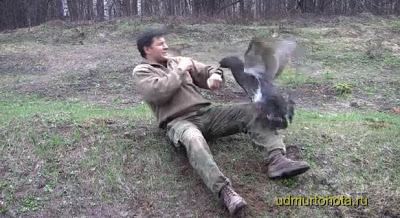
So there you have it, a pretty cool hunting technique if you ask me. But one has to wonder how and why the Finns came up with it. Personally, I have a hunch that it may have been developed because the Finns hunt a lot of Capercaillie, huge black grouse that often sit in trees and/or hold well for points in the forest since they are highly territorial and tend to 'stand their ground', even when facing a dog or a man.
| Click photo to see a crazy video of a brave Capercaillie in Russia. |
A traditional way of hunting Capercaillie in Finland is with Spitz type dogs that tree them and bark to alert the hunter who then approaches and shoots the grouse with a rifle. Could 'reporting' be a modern versatile dog adaptation of that technique?
If so, how do they train for it? And can breeders actually select for dogs that do it naturally? According to Finnish hunter and breeder of Picardy Spaniels, Jani Rajaniemi, the answer to both questions is 'yes'.
Here is a video showing how to develop Tiedotus in a young dog:
"Reporting is mainly something that some dogs do naturally. Of course you can encourage it through training, but it is almost impossible to teach it to a dog that does not want to do it naturally. There are some breeds and lines that have a lot of natural ability for it, German shorthairs from Finnish and German lines especially."
Here is a video showing how to develop Tiedotus in a young dog:
And here is an older dog:
And here is Tiedotus in a real hunting situation
How to Pass the Time Till Opening Day.
Craig Koshyk
The 2013 hunting season is over 6 weeks away and I'm already getting the itch! But I've found that one way to pass the time between now and opening day - besides enjoying some fine sipping whiskey and gorgeous summer weather - has been to revisit some of our photos from last year.
Here are a few from last November when Lisa and I met up with good friends Judy and Vince Balog for our annual South Dakota pheasant hunt. Judy, Vince and I were armed with shotguns. Lisa was armed with a Canon...camera.
Where did the Weim get its color?
Craig Koshyk
All theory, dear friend, is gray, but the golden tree of life springs ever green.
Johann Wolfgang von Goethe
The Weimaraner has a unique grey coat inherited from the Grey Dogs of King Louis. Right?
Wrong.
The Weim's coat is not grey, it is not unique, and it didn't come from any 'Grey Dogs of King Louis'.
Wrong.
The Weim's coat is not grey, it is not unique, and it didn't come from any 'Grey Dogs of King Louis'.
OK, I can practically hear the bloomers bunching up right now and you are probably doing this:
but please, hear me out.
The Weimaraner's coat is not grey. It is brown. However, a mutation in the MLPH (Melanophilin) gene causes an uneven distribution of the brown pigment that leads to the formation of large granules (macromelanosomes) in the hair follicles and shafts. So instead of looking similar to a solid brown GSP type coat, the Weim coat appears as a 'diluted' brown which Weim folks call "grey" or "silver-grey". If a dog with a black coat has the same mutation, the uneven distribution of pigment leads to a similarly diluted appearance. In Weim circles, dilute black is called 'blue'.
Ok, so if the Weim's coat is brown (or black) but is diluted by a mutation, where did that mutation come from?
Short answer: no one really knows.
Long answer: While it is possible that a spontaneous mutation occurred in hunting dogs in the area around Weimar sometime in the mid to late 1800s, it is far more likely that a mutation occurred centuries before the Weim was even on the drawing board and was then brought in by one or more of the types of dogs used to create the Weimarner in the mid 1800s. But what kinds of dogs could have brought it in ?
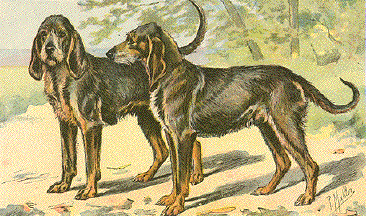
One of the most oft repeated theories is that it came from the Chiens Gris (grey dogs) of Saint Louis of France. But as I explained in a previous post, King Louis’ dogs weren't actually grey. They were tri-colour black, brown and red.
| Saint Louis' Chiens Gris (grey dogs) |
| Bavarian Mountain Hound |
![]() |
| Lemon Pointer |
If you read the old literature and look at old paintings and sculptures, one breed stands out. It had a grey coat, it was relatively common in Germany and elsewhere in Europe in the 1800s and it was popular among the nobility. The breed is the Italian Greyhound.
| A reenactor as Frederick the Great with two grey Italian Greyhounds |
Italian Greyhounds were also relatively popular in Germany just before the development of the Weim and among people who had the means to undertake a breeding program. The Italian Greyhound was in fact the favorite dog of Germany's Frederick the Great (1712 – 1786). However, Frederick the Great was not a hunter, but actually one of the earliest supporters of animal rights. So he was probably not involved in any efforts to create a new breed of gundog. But other nobles in Germany who had Italian Greyhounds and enjoyed hunting may have been. Could their dogs have been the source of the dilution gene that made its way into Weim lines?
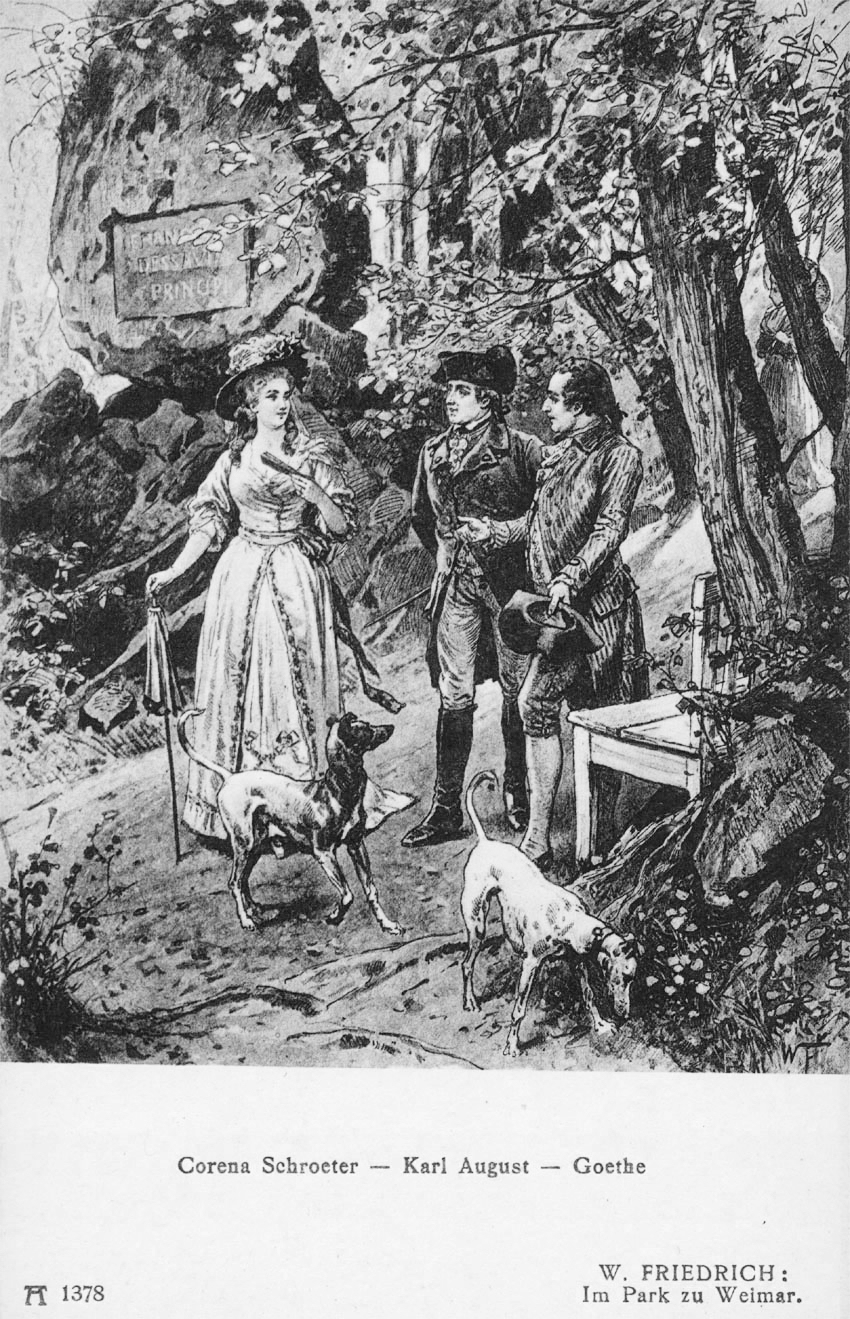
Could it have even been the dogs owned by good old Grand Duke Karl August? He was a great hunter, he had the ways and means of keeping many dogs of all types in his kennels and there are several works of art showing him with what are obviously greyhounds. And he is the guy that is usually credited with creating the Weim.
So maybe the real story is that the Grand Duke didn't actually create the Weim (as I speculate here) but somehow, his dogs managed to contribute a dilution gene to the ancestors of the Weim back when cross breeding and uncontrolled breeding was practiced just about everywhere.
'Whitemaraners' Cross-bred or Pure?
Craig Koshyk
I’ve previously written about Weimaraner pups being born with unusually large amounts of white in their coats, I called them ‘Whitemaraners’. I noted that when photos of such pups are posted, most people automatically assume that the pups are cross-bred, the results of breeding a Weim to a Pointer or to a GSP. And they could be right…sort of. Weim crosses can produce pups with grey and white coats or even solid grey coats but only if they are done for at least two generations.
I don't think that there is any question that such crosses sometimes occur, either by accident or deliberately. But I had never really heard of anyone declaring them publicly...until now. Recently, on the Facebook page of a talented German photographer named Anja Voss, an album of photos appeared showing "Weimaranermix" pups. They are said to be 75% Weim, 25% GSP, ie: the offspring of a Weim and a Weim x GSP cross. The mix of coat colors in the litter is quite interesting. There are solid liver pups, solid grey pups, a liver and white pup and a grey and white pup.
So the bottom line as far as Weim crosses are concerned is that the DNA in both parents must include a copy of the dilution factor responsible for the Weim grey coat color. In other words, if a pure GSP and pure Weim are crossed, the coats of all the pups simply cannot be grey. They will be brown or black depending on the color of the GSP parent. None will be grey. However, if the GSP parent was not quite as pure as the driven snow, if for example it's a GSP x Weim cross, then it could indeed produce pups with solid grey or grey and white coats if it is bred to a pure Weim, or even if it is bred to another GSP x Weim cross, since both parents can contribute a copy of the dilution factor.
But what about those grey and white pups from other litters that the breeders swore up and down were from purebred parents? Are those breeders lying? Are Weim pups with white coats always the result of cross-breeding no matter what the breeders say? Or is it in fact possible that pure Weim parents can produce such pups?
As mentioned in a previous post, it has long been suspected that, yes, under certain circumstances, solid grey parents can indeed produce white and grey coated pups. Some geneticists have speculated that if the migration of melanocytes, cells that regulate coat color, is delayed or interrupted during the pups development in the uterus, the pup can end up having a lot of white in its coat at birth. But no one had been able to conclusively prove that theory. There was no smoking gun as it were. That is, until now.
I can now report that conclusive proof has finally been established for pups with white and grey coats being produced by two solid grey parents. And it is now clear that the theory about disrupted melanocyte migration and proliferation is correct.
In a recently published paper entitled Spotted Weimaraner Dog Due to De Novo KIT Mutation W.M. Gerding, D.A. Akkad & J.T. Epplen, the same team that examined the molecular genetics of the so-called Blue Weimaraner, describe their investigation into the case of a Weim puppy with white spots born in Germany in a litter of otherwise normal-colored siblings. I recently interviewed Dr. Epplen about the investigation and the results.
Q: Dr. Epplen, tell me about how the project started.
A: About 2 years ago, a pup with a white spotted coat appeared in a litter of Weimaraners bred in Germany, not far from where I live. It was that breeder’s first litter and, as you can imagine, he was very surprised to see such a pup. His first thought was that it must be due to Pointer blood getting into the line somehow. But he had personally witnessed the mating of the two parents and was certain that his bitch had never been with a Pointer. So he contacted some more experienced members of the club and the breed warden, Mr. Giesemann and asked them for their opinion and advice. But when they saw the pup and the rest of the litter, they could not understand how it could have such a coat either so they contacted us to see if we could get to the bottom of it.
Q: So what sort of tests did you perform?
A: After collecting DNA samples from the pup, its parents and its siblings, the first thing we wanted to determine was the paternity and maternity of the litter. We wanted to know if the two dogs listed on the breeding documents were in fact the parents of all the pups. Within a week, we had the answer. The DNA clearly proved that the pups were indeed out of the two animals listed as parents.
Q: So you eliminated the possibility of the litter being a result of crossing to Pointers or GSPs?
A: Yes. The pup is a pure-bred Weimaraner, there is no question. Is is not the result of any cross breeding. Its parents are pure-bred Weimaraners from fully tested, recognized lines, approved for breeding by the club.
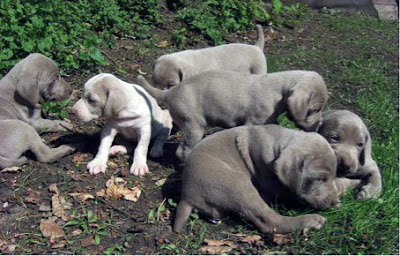
| Purebred Weim pups. The white coat is the result of a 'de novo' gene mutation. |
Q: So what tests did you run next?
A: The next step was to see if there were any mutations in the pup's genetic code that could be responsible for the white in its coat. So we ran DNA sequencing tests on a number of candidate genes that we know are associated with spotting in dogs. Eventually, we found a mutation. We identified it in a gene known as the KIT gene*. Specifically, we found what is known as a gene deletion, a missing portion of the DNA sequence in one very small area. And since the DNA of the parents and the solid-colored grey littermates did not have that deletion, we therefore concluded that the piebalding in the pup’s coat was due to a de novo (new) mutational event that occurred in that one pup’s DNA.
Q: So now that the pup has this new mutation, what would happen if it were bred? Would it produce pups with similar coats?
A: The trait would be transmitted in an autosomal dominant manner as we geneticists say. That means that if she were bred to another pure Weimaraner with a normal coat, any offspring would have a 50% chance of having a spotted coat and a 50% chance of having a normal Weimaraner coat as defined by the official standard.
Q: So now that the pup has this new mutation, what would happen if it were bred? Would it produce pups with similar coats?
A: The trait would be transmitted in an autosomal dominant manner as we geneticists say. That means that if she were bred to another pure Weimaraner with a normal coat, any offspring would have a 50% chance of having a spotted coat and a 50% chance of having a normal Weimaraner coat as defined by the official standard.
Q: What about the parents of the white spotted pup? If they had another litter, would they have more pups with similar coats? The risk for the same breeding pair to produce another white coated pup would be negligible. In fact, they would have the same odds of producing more white pups as any other Weim in the world, less than one in a million.
Q: Have Weim pups with white coats ever been seen before in Germany?
A: The only evidence we have is anecdotal, but I am sure it has happened in the past. However, since white coats were thought to be evidence of cross breeding, or, at the very least a throw-back to Pointers in the Weim’s ancestry, they were hushed up. But in reality, there is always a certain statistical probability that this sort of thing can happen. If you breed enough dogs, you will eventually get this type of mutation. After all, every pup is born with several new mutations in its DNA. But since those mutations rarely result in something that is so highly visible, we don’t really notice them.
Q: What was the reaction of the breeder and of the club?
A: Obviously the breeder was relieved. He was ‘off the hook’ as it were and no longer suspected of allowing his bitch to be bred by a Pointer. It was somewhat of a hot-button issue in the official club since there are some members who would like to see any and all white markings eliminated from the breed, even the small white patches on the chest or toes which have always been in the breed and still occur from time to time today. But in the end it was decided that the affected pup would be registered and accepted as a pure Weimaraner, but not be allowed to breed. Her siblings on the other hand, provided they pass all the breeding tests, will not be forbidden to breed since they are pure Weimaraners and absolutely not affected by the same mutation.
* A gene that plays a role in the development of certain cell types, including the melanocytes that produce the pigment melanin found in the hair, eye, and skin. Mutations to the KIT gene can disrupt melanocyte migration and proliferation during development, resulting in a patterned lack of pigment knowns as piebaldism.
Q: Have Weim pups with white coats ever been seen before in Germany?
A: The only evidence we have is anecdotal, but I am sure it has happened in the past. However, since white coats were thought to be evidence of cross breeding, or, at the very least a throw-back to Pointers in the Weim’s ancestry, they were hushed up. But in reality, there is always a certain statistical probability that this sort of thing can happen. If you breed enough dogs, you will eventually get this type of mutation. After all, every pup is born with several new mutations in its DNA. But since those mutations rarely result in something that is so highly visible, we don’t really notice them.
Q: What was the reaction of the breeder and of the club?
A: Obviously the breeder was relieved. He was ‘off the hook’ as it were and no longer suspected of allowing his bitch to be bred by a Pointer. It was somewhat of a hot-button issue in the official club since there are some members who would like to see any and all white markings eliminated from the breed, even the small white patches on the chest or toes which have always been in the breed and still occur from time to time today. But in the end it was decided that the affected pup would be registered and accepted as a pure Weimaraner, but not be allowed to breed. Her siblings on the other hand, provided they pass all the breeding tests, will not be forbidden to breed since they are pure Weimaraners and absolutely not affected by the same mutation.
* A gene that plays a role in the development of certain cell types, including the melanocytes that produce the pigment melanin found in the hair, eye, and skin. Mutations to the KIT gene can disrupt melanocyte migration and proliferation during development, resulting in a patterned lack of pigment knowns as piebaldism.