Contact Us

Use the form on the right to contact us. We should get back to you within 24 hours. If not, it means we are out chasing birds with dogs, shotguns and Canons. In that case we will get back to you as soon as we've finished the roasted Teal and Bordeaux . 


123 Street Avenue, City Town, 99999

(123) 555-6789

email@address.com


You can set your address, phone number, email and site description in the settings tab.
Link to read me page with more information.

Pointing Dog Blog

The world of pointing dogs in words and images, moving and still.

Versatility Part 1: Reporting From Finland

Craig Koshyk


In the gundog world, the term 'versatile' is pretty versatile. In the UK, France, Italy and other European countries, it means a dog that hunts, points and retrieves. In North America, according to NAVHDA, it means a dog that hunts, points, retrieves and tracks on land and water. In Germany and countries to the east, it means a dog that hunts, points, tracks, drives, bays, flushes, kills vermin and protects the house and home.  

But even as broad as those definitions are, they still don't cover the full spectrum of how versatile dogs are actually used by hunters in each region. So in this next series of posts, I would like to explore some of the more interesting and unusual ways that versatile dogs are used in different parts of the world. Today's post will look at something called "reporting" done by Finnish hunters, field trialers and their dogs in the vast forests of Finland.


Imagine a dog searching for game in a large field or forest, beyond the sight of the handler. Suddenly, it points. Then, after a while, it leaves the point, runs back to find its handler in order to lead him back to the place where the original point occurred. Once there, it points again. 

The dog has just done what the Finns call Tiedotus which means 'reporting' or 'announcing'. It is a technique used by Finnish hunters when they hunt grouse and is also a requirement of high-level 'winners class' field trials. Here is a more detailed description of how it works:

1. The dog, while hunting out of sight of the handler, sticks a point.

2. After a while, if the handler doesn't show up, the dog leaves the point to go get the handler OR, the handler, not seeing the dog and assuming it is on point somewhere over yonder whistles for it to come back in so that the dog can lead him back to the original scene of the point.

3. If it is done during a trial, the handler must tell the judge that his dog is reporting. He/she cannot say "I think the dog might be reporting" or "I think I should whistle him to see if he will report", it has to be a solid declaration. The handler must say something like "Judge, my dog is reporting" or "I am going to whistle to make my dog report". 

4. Once the reporting is "declared", the judge starts evaluating how well the dog cooperates with the handler, specifically how well the dog keeps contact with the handler while returning to the point. Ideally, the dog should return quickly to the handler, but while going back to the scene of the point it should go more cautiously, keep close contact with the handler and work in silence.

5. Once the dog is back on point, with the handler close by, and if the situation allows, the handler or shooter may shoot the bird if given permission by the judge.

So there you have it, a pretty cool hunting technique if you ask me. But one has to wonder how and why the Finns came up with it. Personally, I have a hunch that it may have been developed because the Finns hunt a lot of Capercaillie, huge black grouse that often sit in trees and/or hold well for points in the forest since they are highly territorial and tend to 'stand their ground', even when facing a dog or a man.
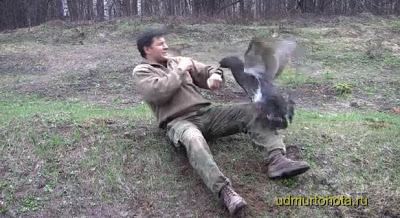
Click photo to see a crazy video of a brave Capercaillie in Russia.
A traditional way of hunting Capercaillie in Finland is with Spitz type dogs that tree them and bark to alert the hunter who then approaches and shoots the grouse with a rifle. Could 'reporting' be a modern versatile dog adaptation of that technique?


If so, how do they train for it? And can breeders actually select for dogs that do it naturally? According to Finnish hunter and breeder of Picardy Spaniels, Jani Rajaniemi, the answer to both questions is 'yes'.
"Reporting is mainly something that some dogs do naturally. Of course you can encourage it through training, but it is almost impossible to teach it to a dog that does not want to do it naturally. There are some breeds and lines that have a lot of natural ability for it, German shorthairs from Finnish and German lines especially."

Here is a video showing how to develop Tiedotus in a young dog:


And here is an older dog:


And here is Tiedotus in a real hunting situation


How to Pass the Time Till Opening Day.

Craig Koshyk

The 2013 hunting season is over 6 weeks away and I'm already getting the itch! But I've found that one way to pass the time between now and opening day - besides enjoying some fine sipping whiskey and gorgeous summer weather - has been to revisit some of our photos from last year. 

Here are a few from last November when Lisa and I met up with good friends Judy and Vince Balog for our annual South Dakota pheasant hunt. Judy, Vince and I were armed with shotguns. Lisa was armed with a Canon...camera. 


Where did the Weim get its color?

Craig Koshyk

All theory, dear friend, is gray, but the golden tree of life springs ever green.
Johann Wolfgang von Goethe


The Weimaraner has a unique grey coat inherited from the Grey Dogs of King Louis. Right?

Wrong.

The Weim's coat is not grey, it is not unique, and it didn't come from any 'Grey Dogs of King Louis'.

OK, I can practically hear the bloomers bunching up right now and you are probably doing this:
but please,  hear me out.


The Weimaraner's coat is not grey. It is brown. However, a mutation in the MLPH (Melanophilin) gene causes an uneven distribution of the brown pigment that leads to the formation of large granules (macromelanosomes) in the hair follicles and shafts. So instead of looking similar to a solid brown GSP type coat, the Weim coat appears as a 'diluted' brown which Weim folks call "grey" or "silver-grey". If a dog with a black coat has the same mutation, the uneven distribution of pigment leads to a similarly diluted appearance. In Weim circles, dilute black is called 'blue'.

Ok, so if the Weim's coat is brown (or black) but is diluted by a mutation, where did that mutation come from?

Short answer: no one really knows.

Long answer: While it is possible that a spontaneous mutation occurred in hunting dogs in the area around Weimar sometime in the mid to late 1800s, it is far more likely that a mutation occurred centuries before the Weim was even on the drawing board and was then brought in by one or more of the types of dogs used to create the Weimarner in the mid 1800s. But what kinds of dogs could have brought it in ?

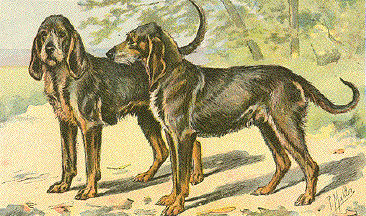
One of the most oft repeated theories is that it came from the Chiens Gris (grey dogs) of Saint Louis of France. But as I explained in a previous post, King Louis’ dogs weren't actually grey. They were tri-colour black, brown and red.

Saint Louis' Chiens Gris (grey dogs)
Another theory is that the grey came from crossing a "lemon" (orange and white) Pointer bitch to an old style German "Leithund" (tracking dog). However, the lighter pigment in lemon Pointers is caused by a mutation in the the MC1R gene, not the MLPH gene. Could the dilution mutation come from the Leithund? Maybe, but we don't really know what color the old Leithunds were and none of the old literature says anything about 'grey' ones. The closest thing we have to Liethunds today are breeds like the Bayerischer Gebirgsschweißhund (Bavarian Mountain Hound), and they are a reddish brown color.
Bavarian Mountain Hound
Lemon Pointer
So what we need to find is a breed or type of dog that a) had a grey coat, b) was relatively common in the area around Weimar before the 1800s and c) was owned by people ready and able to undertake a breeding program that could eventually lead to a new 'pure' breed of hunting dog.

If you read the old literature and look at old paintings and sculptures, one breed stands out. It had a grey coat, it was relatively common in Germany and elsewhere in Europe in the 1800s and it was popular among the nobility. The breed is the Italian Greyhound.

A reenactor as Frederick the Great with two grey Italian Greyhounds
Now that is not to say that the Italian Greyhound was specifically used in the creation of the Weimaraner as a hunting dog. But at a time when 'pure' breeds of dogs did not really exist and cross breeding was widely practiced, it is entirely possible that somehow, the dilution gene that was already in the Italian Greyhound somehow made its way into the dogs that were eventually used to create the Weim. After all, in an article entitled One coat color — one breed? Wanda M. Gerding & Jörg T. Epplen, Human Genetics, Ruhr-University Bochum, German state that "...the b-gene version  found in the Italian Greyhound is virtually identical to one of the three b-alleles found in the Weimaraner".

Italian Greyhounds were also relatively popular in Germany just before the development of the Weim and among people who had the means to undertake a breeding program. The Italian Greyhound was in fact the favorite dog of Germany's Frederick the Great (1712 – 1786). However, Frederick the Great was not a hunter, but actually one of the earliest supporters of animal rights. So he was probably not involved in any efforts to create a new breed of gundog. But other nobles in Germany who had Italian Greyhounds and enjoyed hunting may have been. Could their dogs have been the source of the dilution gene that made its way into Weim lines?

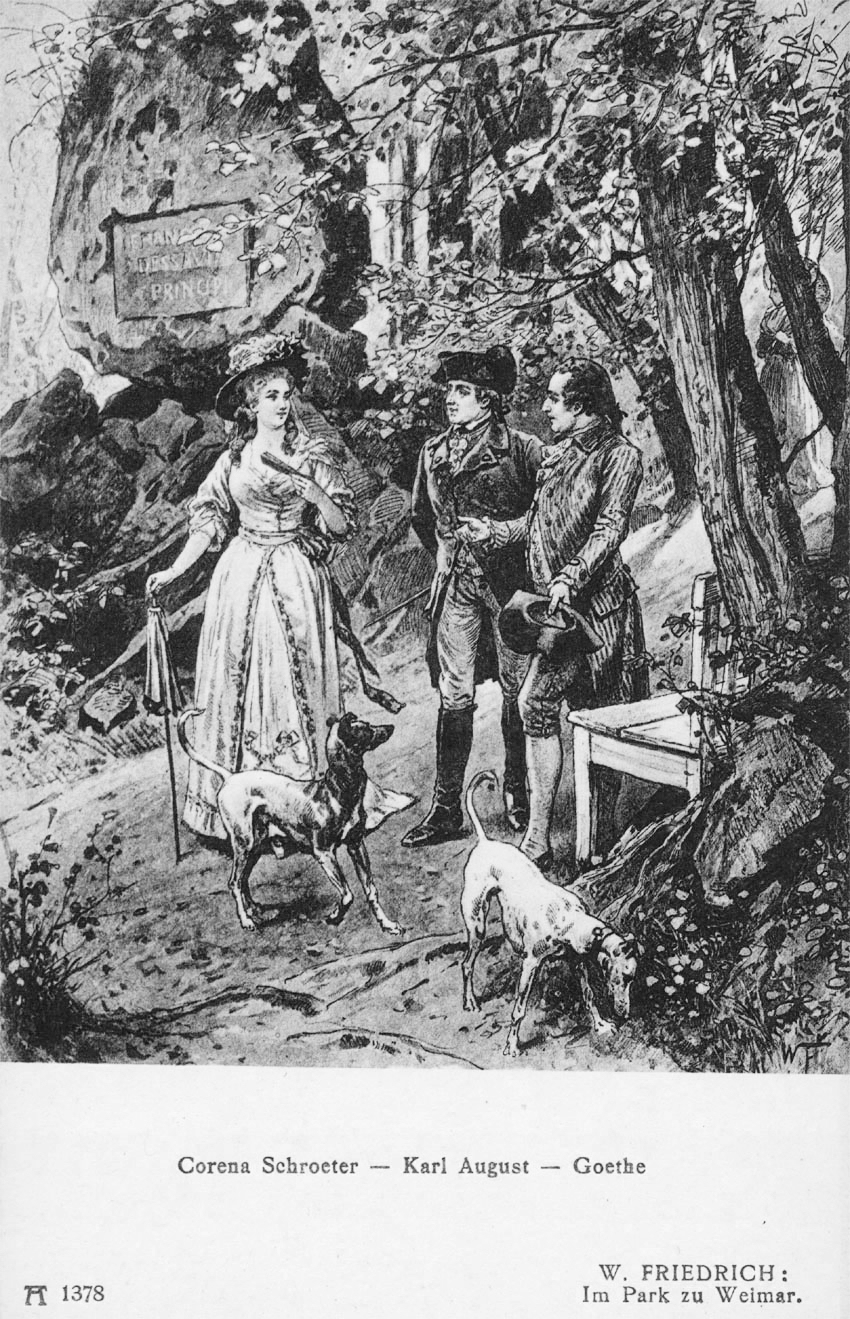
Could it have even been the dogs owned by good old Grand Duke Karl August? He was a great hunter, he had the ways and means of keeping many dogs of all types in his kennels and there are several works of art showing him with what are obviously greyhounds. And he is the guy that is usually credited with creating the Weim.

So maybe the real story is that the Grand Duke didn't actually create the Weim (as I speculate here) but somehow, his dogs managed to contribute a dilution gene to the ancestors of the Weim back when cross breeding and uncontrolled breeding was practiced just about everywhere.

Grand Duke Karl August with Corena Schroeter, Goethe and two Greyhounds


'Whitemaraners' Cross-bred or Pure?

Craig Koshyk

I’ve previously written about Weimaraner pups being born with unusually large amounts of white in their coats, I called them ‘Whitemaraners’.  I noted that when photos of such pups are posted, most people automatically assume that the pups are cross-bred, the results of breeding a Weim to a Pointer or to a GSP. And they could be right…sort of. Weim crosses can produce pups with grey and white coats or even solid grey coats but only if they are done for at least two generations.

I don't think that there is any question that such crosses sometimes occur, either by accident or deliberately. But I had never really heard of anyone declaring them publicly...until now. Recently, on the Facebook page of a talented German photographer named Anja Voss, an album of photos appeared showing "Weimaranermix" pups. They are said to be 75% Weim, 25% GSP, ie: the offspring of a Weim and a Weim x GSP cross. The mix of coat colors in the litter is quite interesting. There are solid liver pups, solid grey pups, a liver and white pup and a grey and white pup.

So the bottom line as far as Weim crosses are concerned is that the DNA in both parents must include a copy of the dilution factor responsible for the Weim grey coat color.  In other words, if a pure GSP and pure Weim are crossed, the coats of all the pups simply cannot be grey. They will be brown or black depending on the color of the GSP parent. None will be grey. However, if the GSP parent was not quite as pure as the driven snow, if for example it's a GSP x Weim cross, then it could indeed produce pups with solid grey or grey and white coats if it is bred to a pure Weim, or even if it is bred to another GSP x Weim cross, since both parents can contribute a copy of the dilution factor.

But what about those grey and white pups from other litters that the breeders swore up and down were from purebred parents? Are those breeders lying? Are Weim pups with white coats always the result of cross-breeding no matter what the breeders say?  Or is it in fact possible that pure Weim parents can produce such pups?

As mentioned in a previous post, it has long been suspected that, yes, under certain circumstances, solid grey parents can indeed produce white and grey coated pups. Some geneticists have speculated that if the migration of melanocytes, cells that regulate coat color, is delayed or interrupted during the pups development in the uterus, the pup can end up having a lot of white in its coat at birth. But no one had been able to conclusively prove that theory. There was no smoking gun as it were. That is, until now. 

I can now report that conclusive proof has finally been established for pups with white and grey coats being produced by two solid grey parents. And it is now clear that the theory about disrupted melanocyte migration and proliferation is correct. 

In a recently published paper entitled Spotted Weimaraner Dog Due to De Novo KIT Mutation W.M. Gerding, D.A. Akkad & J.T. Epplen, the same team that examined the molecular genetics of the so-called Blue Weimaraner, describe their investigation into the case of a Weim puppy with white spots born in Germany in a litter of otherwise normal-colored siblings.  I recently interviewed Dr. Epplen about the investigation and the results.

Q: Dr. Epplen, tell me about how the project started.
A: About 2 years ago, a pup with a white spotted coat appeared in a litter of Weimaraners bred in Germany, not far from where I live. It was that breeder’s first litter and, as you can imagine, he was very surprised to see such a pup. His first thought was that it must be due to Pointer blood getting into the line somehow. But he had personally witnessed the mating of the two parents and was certain that his bitch had never been with a Pointer.  So he contacted some more experienced members of the club and the breed warden, Mr. Giesemann and asked them for their opinion and advice. But when they saw the pup and the rest of the litter, they could not understand how it could have such a coat either so they contacted us to see if we could get to the bottom of it.

Q: So what sort of tests did you perform?

A: After collecting DNA samples from the pup, its parents and its siblings, the first thing we wanted to determine was the paternity and maternity of the litter. We wanted to know if the two dogs listed on the breeding documents were in fact the parents of all the pups. Within a week, we had the answer. The DNA clearly proved that the pups were indeed out of the two animals listed as parents.

Q: So you eliminated the possibility of the litter being a result of crossing to Pointers or GSPs?
A: Yes. The pup is a pure-bred Weimaraner, there is no question. Is is not the result of any cross breeding. Its parents are pure-bred Weimaraners from fully tested, recognized lines, approved for breeding by the club.

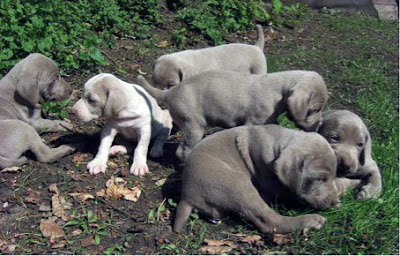
Purebred Weim pups. The white coat is the result of a 'de novo' gene mutation.

Q: So what tests did you run next? 
A: The next step was to see if there were any mutations in the pup's genetic code that could be responsible for the white in its coat. So we ran DNA sequencing tests on a number of candidate genes that we know are associated with spotting in dogs. Eventually, we found a mutation. We identified it in a gene known as the KIT gene*. Specifically, we found what is known as a gene deletion, a missing portion of the DNA sequence in one very small area. And since the DNA of the parents and the solid-colored grey littermates did not have that deletion, we therefore concluded that the piebalding in the pup’s coat was due to a de novo (new) mutational event that occurred in that one pup’s DNA.

Q: So now that the pup has this new mutation, what would happen if it were bred? Would it produce pups with similar coats?
A: The trait would be transmitted in an autosomal dominant manner as we geneticists say. That means that if she were bred to another pure Weimaraner with a normal coat, any offspring would have a 50% chance of having a spotted coat and a 50% chance of having a normal Weimaraner coat as defined by the official standard.  

Q: What about the parents of the white spotted pup? If they had another litter, would they have more pups with similar coats? The risk for the same breeding pair to produce another white coated pup would be negligible. In fact, they would have the same odds of producing more white pups as any other Weim in the world, less than one in a million.

Q: Have Weim pups with white coats ever been seen before in Germany?
A: The only evidence we have is anecdotal, but I am sure it has happened in the past. However, since white coats were thought to be evidence of cross breeding, or, at the very least a throw-back to Pointers in the Weim’s ancestry, they were hushed up. But in reality, there is always a certain statistical probability that this sort of thing can happen. If you breed enough dogs, you will eventually get this type of mutation. After all, every pup is born with several new mutations in its DNA. But since those mutations rarely result in something that is so highly visible, we don’t really notice them.

Q: What was the reaction of the breeder and of the club?
A: Obviously the breeder was relieved. He was ‘off the hook’ as it were and no longer suspected of allowing his bitch to be bred by a Pointer. It was somewhat of a hot-button issue in the official club since there are some members who would like to see any and all white markings eliminated from the breed, even the small white patches on the chest or toes which have always been in the breed and still occur from time to time today. But in the end it was decided that the affected pup would be registered and accepted as a pure Weimaraner, but not be allowed to breed. Her siblings on the other hand, provided they pass all the breeding tests, will not be forbidden to breed since they are pure Weimaraners and absolutely not affected by the same mutation.


* A gene that plays a role in the development of certain cell types, including the melanocytes that produce the pigment melanin found in the hair, eye, and skin. Mutations to the KIT gene can disrupt melanocyte migration and proliferation during development, resulting in a patterned lack of pigment knowns as piebaldism.

The Turkish Pointer's Spanish Connection: Updated

Craig Koshyk

Since my previous post about the Turkish Pointer, I've received a few questions and comments regarding the origins of the breed, its 'double nose' and it's hunting style. Answers/replies below.

Origins: Personally, I believe that the Turkish Pointer is a transplanted Pachon Navarro. The most plausible explanation for it's origin is that somehow, probably in the 1920s or 1930s a small number of Pachones made their way to Turkey from Spain. Over time, a small local population formed in the Tarsus region and became known as the Tarsus Catalburun (Turkish Pointer).

Double Nose: All dogs have a slight crease between their nostrils but it is usually no more than a very shallow line. But many Pachones and Turkish Pointers have nostrils that are clearly divided by a much deeper furrow making it look like the business end of a side-by-side shotgun. This is the famous “double nose” referred to in the old literature.

Anatomically, it is actually a cleavage in the structure of the nose itself. It is not unique to the Pachon Navarro. In fact a good number of breed standards mention a split or double nose but when they do, it is always listed as a serious or disqualifying fault.

A 'double' nose.

It is interesting to speculate just how the double nose came to be viewed as a positive characteristic. It is certainly possible that an individual with a split nose just happened to be an excellent hunter with a very fine sense of smell. Was this then seen as “proof” that at double nose was better than a regular nose?

Nowadays of course, breeders understand that the double nose offers no advantage over a normal nose and that it is simply a cosmetic feature of the breed. Furthermore, not all Pachones and Turkish Pointers have a double nose. Nor do all breeders select for it. Pachon breeders understand that by using double-nosed dogs in their lines, they run the risk of producing pups with completely cleft palates. I was told that up to 10% of pups are either stillborn or are put down immediately after birth since the cleft is so profound that the they are incapable of breathing or nursing properly. But most Pachones have a moderate cleft and are fine. They can breathe and suckle, run and hunt just like any other dog. 

Hunting Style: I found a pretty neat video the other day showing a Pachon Navarro hunting. It is pretty much exactly what we saw in Spain when we were there to photograph them and if you read the old literature from Spain and from England about how the classic old spanish pointers hunted, my guess is that if you could go back 300 years or so and watch the first "Spanish Pointers" brought to England hunting, you would see more or less exactly what is in the video.
"There were Ponto and Tanto, the two great, solemn-eyed, double-nosed Spanish Pointers who lurked in a dignified way about the house, a gentle gloom upon their countenances. They were the grandchildren of the Spanish Pointers owned by my great grandfather, Robert Asplan, the little, old, dapper gentleman who wore black knee-breeches with stockings and silver-buckled shoes. I think those Spanish Pointers knew that their day was done, that they were the last of their race -- gone with the hand-sickle and the centuries of the long September stubbles, where partridges had sit like quails. --  J. Wentworth Day, The Dog in Sport, 1938
Spanish Pointer by George Stubbs (1724-1806)


UPDATE: A recent article by well known Spanish dog expert Dr. Jose Manuel Sanz Timón explores the connection between the Pachon Navarro and the Turkish Pointer. Sanz Timón feels that we may need to re-examine our theories of the Pachon's origin, suggesting that the Turkish Pointer may in fact be its predecessor.

Coincidentally, Sanz Timóns blog post appeared just a few days before this one. However, I was unaware of his post at the time and only read it today, after the good Dr. brought it to my attention. My post on the Pachon-Turkish Pointer connection was inspired by a discussion on the versatiledogs forum that followed my article on the Turkish Pointer published on June 17 and based on breed description found in my book published in 2011.

In any case, I am happy to see that the Turkish Pointer is getting some much needed attention. When I first started researching it in 2008, I could find almost no information on it. But I eventually contacted and interviewed Umit Dincer, who wrote a book about the breed. Now, there are several websites and blogs about the Turkish Pointer and even a few videos on YouTube and elsewhere.

Personally, I am not convinced that the Turkish Pointer predates the pointing breeds developed on either side of Pyrenées mountains in the 13th century. Of course, hunting dogs certainly existed in Turkey, and everywhere else, since the dawn of civilization. But training, selecting and breeding dogs specifically to seek and point game seems to have been a European thing, not an eastern or mid-eastern thing.

The fact that many Turkish Pointers and Pachon Navarros have split noses and other similarities in physical attributes suggests that they may be related, but offers no evidence one way or another for which one came first. In addition, a split nose is actually listed as a fault in many breed standards indicating that it can occur from time to time in just about any breed (in the same way as a cleft palate can occur in humans). In 1913, a small population of dogs with split noses was also found in Bolivia and recently 'rediscovered'. Does that mean they are related to Turkish Pointers and Pachon Navarros? And if so, which one came first?


Read more about the breed, and all the other pointing breeds from Continental Europe, in my book Pointing Dogs, Volume One: The Continentals
http://www.dogwilling.ca/index.cfm

Breed of the Week: The Turkish Pointer

Craig Koshyk

Until very recently the Turkish Pointer, a.k.a. the Tarsus Catalburun, was a completely unknown to hunters outside of Turkey. Today, most people still know nothing about it, even in its homeland.


Tarsus is a 2,000-year-old city in south central Turkey. In ancient times it was the capital of the province of Cilicia and was the scene of Mark Antony and Cleopatra’s romance as well as the birthplace of Saint Paul. Today the city is a popular tourist destination and an important industrial center. 

It is known that pointing dogs have been in the region since at least the 1930s, but no one knows exactly how or when they arrived. Some believe that the Turkish Pointer may be an indigenous breed of pointing dog that has been around for centuries. It may have developed in the region long ago and then made its way to western Europe, either while much of Spain was under Arab control in the 8th to 11th century, or when European Crusaders returned from the Middle East in the 12th century. If so, then the Turkish Pointer would be the great-grandfather of all the pointing breeds in the world today.


A Turkish origin for all pointing dogs is an intriguing idea, but it is not supported by the available evidence. No one disputes the fact that certain types of dogs were introduced to western Europe from the Middle East and North Africa. But there is no reason to believe that any of them were pointing dogs, and many reasons to believe that they were not. As we’ve seen in the historical overview in the Introduction, pointing dogs have never been a part of Middle Eastern or Asian hunting traditions. Even today hunters still practising traditional Oriental hunting methods do not employ pointing dogs of any kind. It is also quite telling that there are no illustrations, photos or written references to pointing dogs in the Tarsus area before the 1930s.

So it is far more probable that the Turkish Pointer is in fact a sort of landrace that developed in the Tarsus region out of a nucleus of European dogs imported in the 19th century. The Turkish Pointer has a classic shape and hunting style that harkens back to a bygone age and, like the Pachón Navarro, it has a “double nose”. In fact, its name in Turkish, Catalburun, is derived from this trait; catal (pronounced chatal) means “fork” and burun means “nose”. 


In terms of hunting style and ability, the Turkish Pointer works in much the same way as the Pachón Navarro. It is mainly used to hunt partridges and rabbits and, despite a rather thick build, it is said to be quite agile. Umit Dinçer, who wrote an excellent book on the breed, told me that: 
They generally hunt at a trot but will occasionally gallop, depending on the cover they are working. Since the breed is most often used in very bushy terrain or areas of thick grass, it is a very close worker, typically staying within 25 to 30 meters from the hunter. They tend to be good pointers and they are natural retrievers with a soft mouth, as well. There is no specific effort to select for tracking but the more the dogs practise, the better they get. These dogs track, stalk, find and retrieve game. Giving voice is common and desired. The Turkish Pointer is mostly an upland dog but if they are trained, they may be successful at swimming, too. The breed was originally found in the Tarsus area, but nowadays you can see a few in other regions of the country. People who have them are basically hunters. The Turkish police force is interested in using the breed as narcotic detectives as well. But numbers are decreasing because it is not under the protection of any official club. It must be protected and officially known. 
Recently, the municipality of Tarsus has applied to the Turkish Patent Institution to register it as a breed. Due to the limited gene pool, all current Turkish Pointers are heavily inbred, but so far no known hereditary health issues have been reported. Recently a few websites and blogs about the breed have popped up  online and there is an interesting video (in Turkish) about the Tarsus Catalburun on Vimeo:


Digitürk İZTV Çatalburun AV Köpekleri Belgeseli from Adana_DT on Vimeo.


Read more about the breed, and all the other pointing breeds from Continental Europe, in my book Pointing Dogs, Volume One: The Continentals
http://www.dogwilling.ca/index.cfm