Contact Us

Use the form on the right to contact us. We should get back to you within 24 hours. If not, it means we are out chasing birds with dogs, shotguns and Canons. In that case we will get back to you as soon as we've finished the roasted Teal and Bordeaux . 


123 Street Avenue, City Town, 99999

(123) 555-6789

email@address.com


You can set your address, phone number, email and site description in the settings tab.
Link to read me page with more information.

Pointing Dog Blog

The world of pointing dogs in words and images, moving and still.

Breed of the Week: The Russian Setter

Craig Koshyk

In October 1823, an illustration of a rough-haired dog retrieving a pheasant appeared on the cover of the The Sporting Magazine. The caption beneath the image read “Basto, A Russian Setter”. A description of Basto appears inside.
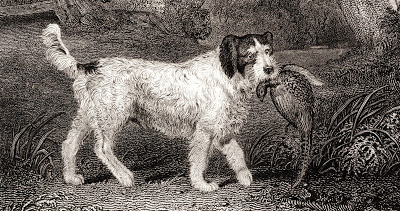
Basto is of Russian parents, which were highly valued in this country, and their offspring has in no way disgraced the character of these setters! He is distinguished in the lower parts of Surrey and in Sussex as an excellent finder, and of very delicate mouth. Basto brings his game, and has scarcely ever been known to lose a wounded bird, in either corn, furze, or water, which he takes and hunts with the same ease as a smooth-haired pointer hunts a stubble! Basto, like all sporting dogs of Russian blood, is slow, but he often picks up birds, hares, and pheasants, that a fast-hunting pointer has passed in the field. He is about eight years old, and the property of T. Gilliland, Esq.

References to the Russian Setters are relatively common in 19th century English sporting literature, but they are often so highly polarized and contradictory that it is hard to form an accurate picture of what they were really like. In terms of appearance, John Henry Walsh, also known as Stonehenge wrote that:
The actual form of the Russian Setter is almost entirely concealed by a long woolly coat, which is matted together in the most extraordinary manner. He has the bearded muzzle of the Deerhound and Scotch Terrier but the hair is of a more woolly nature, and appears to be between that of a Poodle and the water spaniel
Robert Leighton, who also mentions a “Russian Retriever” in the New Book of the Dog , says of the Russian Setter that:  
There are two varieties of the breed and, curiously enough, they are distinguished from each other by the difference in their color. The dark-colored ones are deep liver and are curly-coated. The light colored ones are fawn, with sometimes white toes and white on the chest; sometimes the white extends to a collar on the neck. These latter are straight-coated, not curly like the dark ones.
Some descriptions read as if they were written by men who had never laid eyes on a Russian Setter. In Biographical Sketches and Authentic Anecdotes of Dogs, Thomas Brown provides a summary of the breed that is clearly no more than bits and pieces taken from descriptions of other pointing breeds. He even seems to confuse Russia with Spain, claiming that the Russian Setter had a cleft nose and was called the 'Doublenosed Pointer'.
There is one peculiarity about him, which is, that his nose is so deeply cleft that it appears to be split in two, on which account he is termed in Russia the Doublenosed Pointer. His scent is said to be superior to that of the smooth dogs. This cleft nose is found to be inconvenient when he is beating in cover, as the face is apt to be torn where the brushwood is thick.
Other descriptions were from more reliable sources such as Edward Laverack, the man who litterally wrote the book on setters.
Russian (behind) English and Irish Setters
These dogs are but little known in this country. The late Joseph Lang's I have repeatedly seen. Two of them were brought down by Mr. Arnold, of London, to my shooting quarters, Dunmaglass. He had given thirty guineas a-piece for them as puppies, and had them very carefully broken by an English keeper. They were not at all good specimens of the class, and, as working dogs, comparatively useless. So disgusted was he with them before he left, that he shot one, and gave the other away. I have never seen but one pure specimen, which was in the possession of the late Lord Grantley, at Rannoch Barracks, head of Loch Rannoch, Perthshire. This dog was a magnificent type of the Russian setter, buried in coat of a very long floss silky texture; indeed he had by far the greatest profusion of coat of any dog I ever saw.
They were good but most determined, wilful, and obstinate dogs, requiring an immense deal of breaking, and only kept in order and subjection by a large quantity of work and whip; not particularly amiable in temper, but very high-couraged and handsome, an enormous quantity of long silky white hair, and a little weak lemon colour about the head, ears, and body ; and their eyes completely concealed by hair.
'Old Calabar' got a brace of these puppies, had them well broken, and took them to France ; but, after shooting to them two seasons, and being disgusted with their wilfulness and savage dispositions (they would take no whip), sold them to a French nobleman for a thousand francs (40/.), and considered he had got well out of them.

Reading through the old literature, it is clear that the terms “Russian Setter” and “Russian Pointer” were used to describe any rough-coated pointing dog in Britain at that time. Similar, if not identical dogs were called Smousbaarden in the Netherlands, Griffons in France and Polish or Hungarian Water Dogs in Germany. Before the late 1800s, none of them were 'pure' or independent breeds. They just represented a type of dog that was found just about everywhere sportsmen took to the field. A rough coat was their most distinctive feature and it was probably the reason men in Britain called the dogs “Russian”. It was commonly believed that people from the frozen eastern regions, and their dogs, were rather hairy and unkempt. In an article from The Farmer's Magazine in 1836, we can see just how politically incorrect many of the writers were at the time.
We may perhaps have seen a dozen of these brutes, which, like the people whence they derived their grossly misapplied appellation, are very uncouth very rough, imperturbably stupid, and, by way of continuing the similarity to the greatest possible extent, will generally be found infected with loathsome vermin.
Thomas Burgeland Johnson's description of what he called the "Russian Pointer" in the 1819 issue of The Shooter’s Companion equally negative. 
Whether he be originally Russian is very doubtful; but he is evidently the ugliest strain of the water-spaniel species; and, like all dogs of this kind, is remarkable for penetrating thickets and bramble bushes, runs very awkwardly, his nose close to the ground (if not muzzle-pegged), and frequently springs his game. He may be taught to set, and so may a terrier, or any dog that will run and hunt, and even pigs, if we are to believe the story of Sir Henry Mildmay’s black sow; but to compare him with the animals which have formed the subjects of the two preceding chapters (setters and pointers), would be outrageous: nevertheless, I am not prepared to say, that out of a hundred of these animals, one tolerable could not be found; but I should think it madness to recommend the Russian Pointer to sportsmen, unless for the purpose of pursuing the coot or the water-hen.
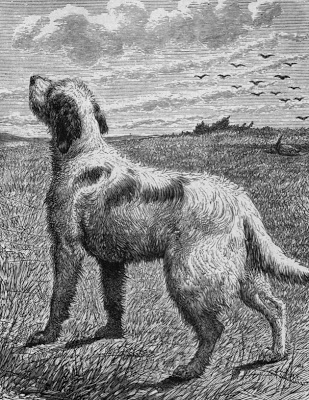
Mixing Russian Setters with other breeds is sometimes mentioned.  The results of a crosses "...between the Russian setter and the smooth pointer" are given in Dogs of the British Islands.
... I must admit that the Russian and pointer cross has produced dogs that for work could not well be surpassed. I may, perhaps, have been fortunate in the specimens seen, but do not speak from one or two, but many. In appearance, however, they are not to be compared to the thorough-bred pointer or setter, though more elegantly shaped than the Russian. There is another peculiarity in this breed worthy of notice. You may go back to the Russian with favourable results. I shot over a brace so bred on the moors last season, that would be hard to beat for range, keenness of scent, and sagacity.
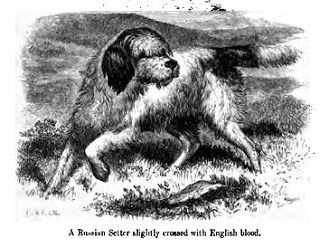
References to Russian Setters in America are scarce, but there are a few and one in particular is quite well known: the first Korthals Griffon to be registered with the AKC, a bitch imported from France, was listed as a "Russian Setter (Griffon)". In The Complete Manual For Young Sportsmen, Henry William Herber (aka Frank Forester) wrote that Russian Setters were:
... rarely or never met with in this country. Could they be procured, I think of all sporting dogs they are the most adapted for ordinary American shooting, and the best of all for beginners. They have less style, and do not range so high as the English or Irish dogs, but that is no disadvantage for America, where there is so much covert shooting.
The Russian Setter never really achieved the status of an independent breed of pointing dog. I must have been just as difficult to stabilize as any other strain of griffon. And without a British Eduard Korthals or Emmanuel Boulet to champion its cause and perfect its breeding, the Russian Setter soon faded from the scene.
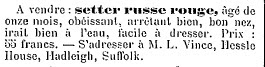

Classified ad the French sporting newspaper Le Chenil, 1884. "For sale, Red Russian Setter, 11 months old, obedient, points well, good nose, works well in water, easy to train. Price: 55 Francs. Contact M. L. Vince, Hessle House Hadleigh, Suffolk


Read more about the breed, and all the other pointing breeds from Continental Europe, in my book Pointing Dogs, Volume One: The Continentals

http://www.dogwilling.ca/index.cfm

Breed of the Week: The Württemberger

Craig Koshyk

The Württemberger, known in Germany as the Dreifarbige Württemberger or Dreifarbige Württembergische Vorstehhund, was a short-haired, tricolored pointing dog that disappeared just after World War I. Exactly where, when and how it came to be is the subject of speculation.


The most common assumption is that the breed was developed in the Württemberg region of southwest Germany in the 1870s. Some sources claim that Gypsies traveling from Russia brought it to the  Kingdom of Württemberg in the early 1800s, but others insist that it was an ancient breed, known in southern Germany for centuries. Whatever their origin, heavy, tricolored pointing dogs were present in large enough numbers in the 1880s and ’90s to catch the attention of Germany’s Delegate Commission which, for a time, recognized them as a breed. But no separate stud book was ever created for Württembergers and they, along with Weimaraners, were registered in the German Shorthaired Pointer stud book. 


Apparently a Tricolored Shorthair Club (Dreifarbige Kurzhaar Klub) was formed in Germany, but its efforts to gain official recognition for the breed failed. It is not clear exactly why, but it may have been due to the fact that many of the leading dog experts of the time believed that any tricolored coat had to be the result of crossbreeding to either Gordon Setters or some kind of hound, such as the Large Blue Gascony and therefore the breed could not be considered 'pure'.

Physically, Württemburgers were fairly large dogs, up to 70 centimeters at the shoulder with a large head, heavy flews and loose skin. They probably looked like a tricolored Bracco Italiano or Burgos Pointer. A fairly detailed description of the breed was written by J.B. Samat and appears in the book Les Chiens de Chasse, published by the Manufrance company in the 1930s. 
The Württemberger has not yet undergone the same transformation as the real German Shorthaired Pointer which, nowadays, looks nothing like its ancestors. The Württemberger is a fairly tall dog with a heavy appearance, but it is rare to see a well-built and absolutely correct example, for the hunters in Württemberg are not very fussy and have no particular interested in a carefully thoughtout breeding system. However, there are two or three large kennels where the breed is carefully raised and where they have probably been improved in the same way as the other German breeds. The coat is tricolor marked with brown and tan spots and streaks on a blueish background, white with brown ticking with yellow markings above the eyes, on the cheeks, the edges of the ears, the lips, the chest, the inside of the legs and the underside of the tail. 
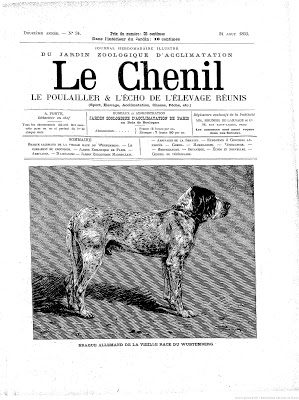
Other descriptions and images appeared in the late 1800s and early 1900s in sporting journals such as Le Chenil in France. In the book Die deutschen Vorstehhunde, author Manfred Hözel states that the last litter of Württemberger pups was whelped near the city of Nanz, Germany in 1910 and that two pups were “exported to America”. Other authors, however, have written that the breed managed to survive until just before the Second World War.


Read more about the breed, and all the other pointing breeds from Continental Europe, in my book Pointing Dogs, Volume One: The Continentals
http://www.dogwilling.ca/index.cfm

Breed of the Week: The Majorcan Pointer

Craig Koshyk


Of all the breeds I’ve seen and studied, the Majorcan Pointer came as the biggest surprise. Despite finding a good number of historical references to it in the old literature, I was unable to determine if the Balearic Islands’ native pointing breed was still being bred today. And since Googling its name in English, French and Spanish only turned up the same old quotes from the same old books, for a long time I assumed that the breed was extinct. 


But only a few weeks before flying to Spain to photograph Burgos Pointers and Pachónes Navarro, I decided to give it one more shot. This time the words I entered into the Google search field were in Catalan, the other official language of the island of Majorca. I typed ca de mostra and ca de caça, then hit return. Less than an hour later I was on the phone to Sheryl Marchand, my very understanding travel agent, telling her that Lisa and I would need to extend the Spanish leg of our trip. Majorca’s native pointing dog was still alive!


HISTORY
The Balearic Islands are an archipelago off the east coast of Spain.They have been inhabited from at least the time of the ancient Phoenicians and Greeks who probably introduced hunting dogs to the four major islands of Majorca, Minorca, Ibiza and Formentera. Even today, Podengos —a type of hunting dog used throughout the Mediterranean in ancient times—are still found on the islands, used by their owners to hunt rabbits by sight and scent.

We know that pointing dogs have been present on Majorca since at least the 14th century. A number of documents surviving from that era clearly indicate that hunters armed with crossbows used pointing dogs to help them take small game. In fact, the practice seems to have been so widespread and effective that game populations may have been adversely effected. Royal ordinances banning it were issued in 1383 and again in 1392. How pointing dogs got to the island is unknown, but it is reasonable to assume that they were brought over from the mainland and that they share a common origin with the earliest types of pointing dogs that were then being developed on both sides of the Pyrenees Mountains. They were probably bred in fairly small numbers on Majorca and the other Balearic islands, and developed in similar ways to pointing dogs elsewhere. 

By the late 1800s they had gained a reputation as excellent hunting dogs. At least one hunter thought they were the best dogs to be found anywhere. Jules Tallien de Cabarrus was a French doctor and diplomat who had hunted in many parts of the world. In the 1860s he fell ill and was sent to Majorca to recuperate. There, he hunted over Majorcan Pointers and wrote about them in his book, Chasses et Voyages, published in 1863: I repeat and will continue to say that the Majorcan pointing dog is the best and most accomplished that one could possibly find.1

In 1882 he published another book, El Mejor Perro de Muestra, in which he wrote: The Majorcan Pointer...is worth more than all the beautiful spaniels, setters or pointers. I speak from experience since I have used them for over 25 years, nine of which I spent on Majorca, three in Trieste [a city in Italy, but under Austrian rule at the time], and the others in America. And of the 49 dogs that I have had, 29 of the Majorcan breed have passed through my hands, and I have also seen many more besides mine at work.2

Another high profile person who described pointing dogs on Majorca was Archduke Ludwig Salvator of Austria (1847- 1915). He wrote a nine-volume book on the Balearic Islands in which he mentions local hunters using pointing dogs to hunt quail.

In 1911, the Real Sociedad Central de Formento de las Razas Caninas in España (later renamed Real Sociedad Canina de España) was formed. In some of its earliest stud books there are listings for Perdigueros Mallorquínes (Majorcan Pointers). But then the breed seems to fall into near complete obscurity. While a few references are found in the Spanish sporting literature of the 1940s and ’50s, it was not until the mid-1990s that any efforts to establish Majorca’s native pointer as a recognized breed got under way. In 1996 the Club del Ca Mè Mallorquí was formed and a standard drawn up. In 2002 a stud book was established, and in 2004, after six centuries on the island, Majorca’s native pointing breed was officially recognized—sort of. Recognition was granted by the Minister of Agriculture of the Balearic Islands but not (yet) by the Real Sociedad Canina de España or the FCI.

MY VIEW
Before travelling to Majorca, we spent several days on the Spanish mainland with the people involved in the revival and growth of the Pachón Navarro and Burgos Pointer. We discovered that both breeds had faced difficult times in the recent past but were now in the hands of well-organized clubs and were becoming more popular throughout the country. The Majorcan Pointer seems to be following in their footsteps, but efforts to revive it did not really get going until the late 1990s. And the relative isolation and small population of the island mean that it will probably never reach the level of popularity that the Pachón Narvarro and Burgos Pointer now enjoy. Nevertheless, supporters of the Majorcan Pointer are every bit as dedicated to their cause as supporters of Spain’s other indigenous pointing breeds. They also have had the opportunity to observe the progress of the other breeds and to learn from them. 
After we had photographed a number of dogs in the field, Lisa and I went to diner with members of the breed club. While discussing the future of the Majorcan Pointer, club president Francesc Mir Tomàs had this to say: We are very happy with the progress we have made so far. We know this is a long-term project and we want to do it right. We also understand that the most important thing is to breed dogs that are born to hunt, that are authentic Majorcan Pointers. They are an important part of the heritage of this island and the local people support our efforts. Pedro Salva Vidal added, “We are a patient bunch. We will make progress poco a poco.”


1. Jules Tallien de Cabarrus, Chasses et Voyages, quoted in Referencias Históricas, http://www.camemallorqui.org/referencias_historicas.htm (April 13, 2009)

2. Jules Tallien de Cabarrus, El Mejor Perro de Muestra, quoted in José Manuel Sanz Timón, Origenes e Historia Antigua, http://perdiguerodeburgos.info/historia/historia.htm (August 19, 2010)


Read more about the breed, and all the other pointing breeds from Continental Europe, in my book Pointing Dogs, Volume One: The Continentals
http://www.dogwilling.ca/index.cfm

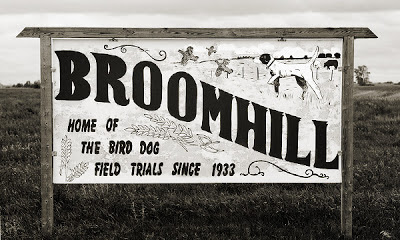
Everybody Knows Where Broomhill's At!

Craig Koshyk

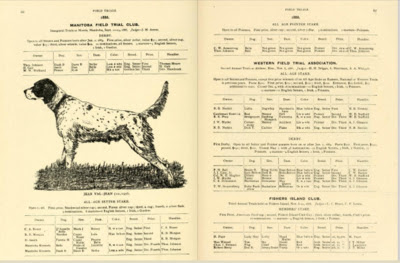
Field trials for Setters and Pointers have been run in Manitoba since 1886 when the Manitoba Field Trial Club held its inaugural Derby and All-Age Stakes near Morris, about 50 miles south of Winnipeg.  


Field trials are still held in Manitoba today, but further west, just outside of Broomhill, a small hamlet that most people in Manitoba have never heard of. But among field trialers, Broomhill is almost as well-known as Grand Junction Tennessee. When I interviewed Hall of Fame trainer and handler Colvin Davis last fall during the Manitoba Championship Trial, I asked him about Broomhill. Here is what he had to say.


Stay tuned for more video of Colvin and more on the history of field trials in Manitoba including first hand accounts from over 120 years ago!


My Next Dog?

Craig Koshyk


Currently I have plenty of dog-power available to me to hunt just about anything. So I am not in the market for another dog right now. But in a year or three, Lisa and I will probably welcome a new addition to the herd. And even though we don't know what breed of dog it will be, we know this: it will have a mainly white coat. Mainly white?  Why?

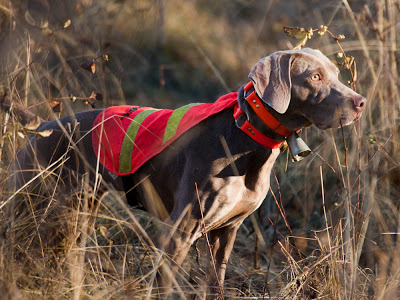
Well it turns out that 50-year-old eyes are not great at seeing dogs with coats that act as camouflage in the field. I now have to put orange vests on my Weims every time we hunt just so I can keep track of them as they hunt or find them on point.

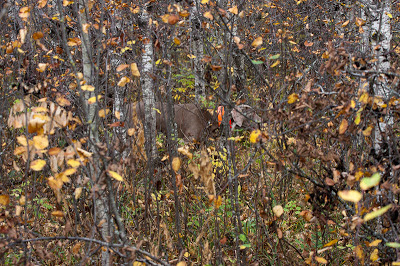
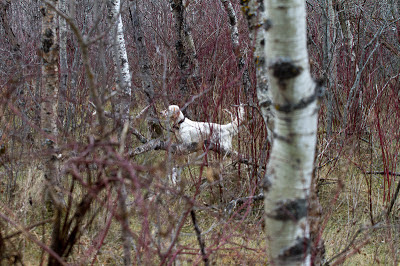
Without a vest, Souris is almost impossible to find in heavy cover,
even though she is wearing a blaze orange collar in this photo.
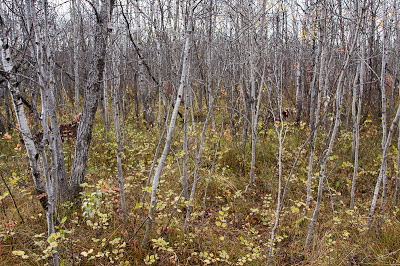
There are actually TWO weims in this shot; one pointing and one backing.
Both are wearing orange collars. Can you find them?
Last season I hunted with a couple of absolutely awesome English Setters brought over from Holland by my good friends Marjolein and Roel Kamman. The Setters are from Italian lines, were bred in France, and have mainly white coats. And even though they run fairly big, fly across fields and sprint through the heavy cover, they are a thousand percent easier to see than my Weims, especially when they are on point.
THIS is why I want a white dog.
They are so much easier to see in heavy cover.
So what are my choices? Well, in Volume One of my book on Pointing Dogs, I include a chart that indicates the various coat types and color combinations available in the Continental breeds.


Looking it over, it seems like the list is actually quite extensive. And when the British breeds (Pointers and setters) are included,  it turns out that there are over 20 pointing breeds in which you can find dogs with a lot of white in the coat. So the long list looks like this: 
  • English Setter, Pointer
  • Irish Red and White Setter
  • Épagneul Français (French Spaniel)
  • Épagneul Breton (Brittanny)
  • Braque du Bourbonnais
  • Braque de l'Ariège
  • Braque Saint Germain
  • Braque Francais (both types)
  • Old Danish Pointer
  • Burgos Pointer
  • GSP 
  • GWP
  • GLP
  • Drentsche Patrijshond
  • Small Munsterlander
  • Large Munsterlander
  • Weim (sort of...see my blog post on the "Whitemaraner")
  • Bracco Italiano
  • Spinone
  • Pachon Navarro
  • Ca Mé Mallorqui
  • Cesky Fousek
By narrowing the list to only those breeds in which the majority of dogs have mainly white coats, it looks like this:
  • English Setter
  • Pointer
  • Irish Red and White Setter
  • Épagneul Français (French Spaniel)
  • Épagneul Breton (Brittanny)
  • Braque de l'Ariège
  • Braque Saint Germain
  • Old Danish Pointer
  • Drentsche Patrijshond
  • Small Munsterlander
  • Bracco Italiano
  • Spinone
And if I limit my search further, say by selecting only breeds that are relatively easy to find, offer a good selection of field-bred lines and are mainly selected for the type of hunting I do (80% upland birds, 20% waterfowl), the list gets even shorter:
  • English Setter
  • Pointer
  • Épagneul Français (French Spaniel)
  • Épagneul Breton (Brittanny)
And, finally, if I narrow it down to breeds with long tails (because I like long tails) only three breeds remain.
  • English Setter
  • Pointer
  • Épagneul Français (French Spaniel)
    So over the next couple of years I will be keeping my eye on those breeds, looking for just the right breeder and just the right litter. In the meantime, I will just enjoy watching videos of them in action. 

    Here's an awesome video of some really nice Épagneuls Français. 


    And here is an incredibly beautiful video of and English Setter in hunting Ptarmigan in Iceland


    And here is a video of famous American Pointer breeder Bob Whele and his Elhew Pointers


    Choices...choices!!