
Everyone Loves a Clean Bitch
Dog Willing
Never trust the translation or interpretation of something without first trusting its interpreter. ― Suzy Kassem

Today’s translation programs are light-years ahead of where they were just a few years ago. And they will only get better with time. I use Google Translate and DeepL for various tasks, from communicating with gundog enthusiasts in other countries to translating documents, old and new, written in languages I do not understand. However, every day, I am reminded of their limitations when it comes to translating gundog-related terms and concepts.
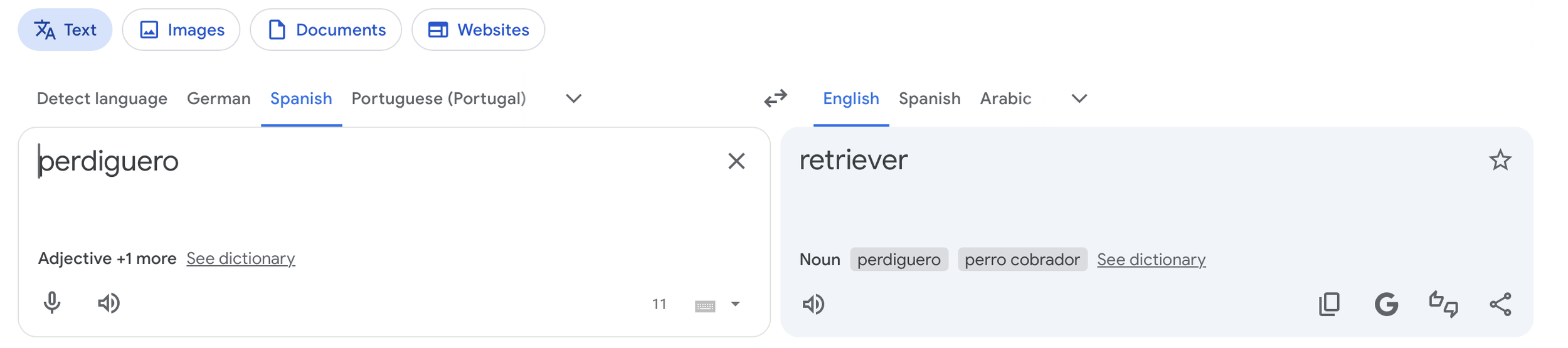
Here is an example. If you enter the Spanish word “perdiguero” into Google Translate or DeepL you get “Retriever” as the result. If you enter the name of the Spanish pointing breed “Perdiguero de Burgos”, you get Burgos Retriever. But the translation is wrong.
Let me explain.
The word “perdiguero” is made up of two parts. “Perdi” is from the Latin word perdix which means ‘partridge’ and ‘ero, from the Latin suffix “-arius’ which means “pertaining to” or ‘connected with’. So a literal translation of perdiguero would be ‘partridge dog’. In the old sporting literature, we see the words perdiguero and its Portuguese equivalent, ‘perdigueiro,’ used to describe a certain type of hunting dog found across much of Europe. Other Spanish terms like Braco, Perro de Punta, and Perro de Muestra were also used for the same type of dog. All of those terms refer to dogs that hunted partridges by pointing them.
Did some of those dogs retrieve? Absolutely! All the perdigueros I photographed in Spain showed a strong natural retrieving desire. And all the breeders I spoke to expected their dogs to retrieve. But the word perdiguero in the context of hunting dogs does NOT mean retriever. It means pointing dog. And all the dogs I saw were used as pointing dogs and all their breeders considered finding and pointing birds their dogs' number one job.
So why does Google Translate say it means ‘retriever’? Well, because it does mean ’retriever’ (sort of), but in a completely different context.

Perdiguero de Burgos
If you look up the word 'perdiguero' in major Spanish dictionaries, you will find the ‘partridge dog’ definition is listed first. However, in some older, more in-depth dictionaries, you can find a secondary definition of the word, one that pertains to a person who purchases game (like partridges) from hunters to sell to the public.
Take a look at this entry in the Spanish dictionary Diccionario general etimológico de la lengua española published in 1889. The first definition is the one we would expect: Adjetivo que se aplica al perro u otro animal que caza perdices (Adjective applied to a dog or other animal that hunts partridges). But take a look at the second definition. El recovero que compra de los cazadores la caza para revenderla. (The dealer who buys game from hunters to resell it). See the word “recovero” in there? In this context, it refers to the person, dealer, or middleman who purchases game (such as partridges) from the hunter and then resells them. But in other contexts, it can mean someone or something that ‘recovers’ or ‘retrieves’ something. And that, I believe, is the source of the faulty translation of the word ‘perdiguero’. Both Google Translate and DeepL, for some strange reason, skip the first and most obvious definition and opt for the second, far more obscure definition.
And as if that is not confusing enough, Google Translate has no problem with the Portuguese word “Perdiguiero” or the breed name “Perdigueiro português”. It says that Perdigueiro means ‘pointer’ and Perdigueiro português means ‘Portuguese Pointer’. But DeepL, usually more accurate than Google, falls once again into the ‘retriever’ trap, translating the words as ‘retriever’ and ‘Portuguese retriever’.
So why does it matter? Well, to most people it doesn’t. But to anyone who wants to know more about the breed, it can lead them to believe that the Perdiguero de Burgos is a retrieving breed, and not a pointing breed. I have even seen breed enthusiasts insist that the “retriever” translation is correct since they consider the breed to be one of the retriever/pointer/versatile breeds. But that is simply not true. Yes, a well-bred Perdiguero de Burgos should have a solid retrieving instinct. And yes, they can do well in NAVHDA tests and be used as a versatile dog. But the breed was developed as a pointing dog, first and foremost, and the breed name makes it clear that its number one job has always been to find and point partridges and other feathered game.
The first rule of translation: make sure you know at least one of the bloody languages! ― Faiz Ahmed Faiz
Now imagine how many other things we could get wrong if we rely on machine translations for dog-related content from non-English countries, or if non-English speakers use them to translate what we write about our dogs.

A friend of mine was trying to communicate with a breeder in France about a potential breeding. They’d been exchanging emails, translated via Google Translate, but were unable to figure out what they were saying. They asked me to review the messages to see if I could figure it out. And as soon as I did, I knew exactly what the problem was.
There were sentences about dogs ‘throwing’ litters or having pups ‘on the ground’ out of a ‘blue hen’. There was talk of dogs ‘hitting objectives’ in field trials and using whoa posts, carded pigeons, and check cords for training. There were entire paragraphs about ‘breaking’ dogs to be ‘steady to wing and shot’ and even mentions of ‘snake breaking’ and ‘trash breaking’! When those terms were fed into Google Translate, the results were insane. The French breeder had no idea why the English speaker was talking about chickens (blue hens) and was shocked by the idea of ‘throwing’ puppies around! He even asked why we ‘break’ dogs, snakes and trash? What the hell was wrong with us!?
In the end, I helped both sides figure it out, and the breeding was a success. But both parties realized that when using machine translation apps, you really have to avoid using the sort of dog slang we tend to take for granted when talking to other gundog enthusiasts. Even between different English-speaking countries, there can be vast differences in expressions and concepts. ‘12 O’clock tails’ are just as confusing to an Englishman as ‘sticky’ setters are to an American.
So, how do you say “retriever” in Spanish? Strictly speaking, it would be perro de cobro, i.e., a dog that retrieves, but in Spain, hunters just use the English word. They say retriever. It is even in the official name of the "Club Espanol de Retrievers". Here is a quote from the club’s website: Los Retrievers son perros de cobro de pluma, tanto de tierra como en agua, y están representados por 6 razas en el grupo 8 de la FCI. (Retrievers are dogs that retrieve feathered game, both on land and in water, and are represented by six breeds in the FCI’s Group 8.)
Bottom Line: Machine translation apps can be great for getting the gist of something, but they often fail when they encounter terms or concepts used in highly specialized contexts. Use them with caution.